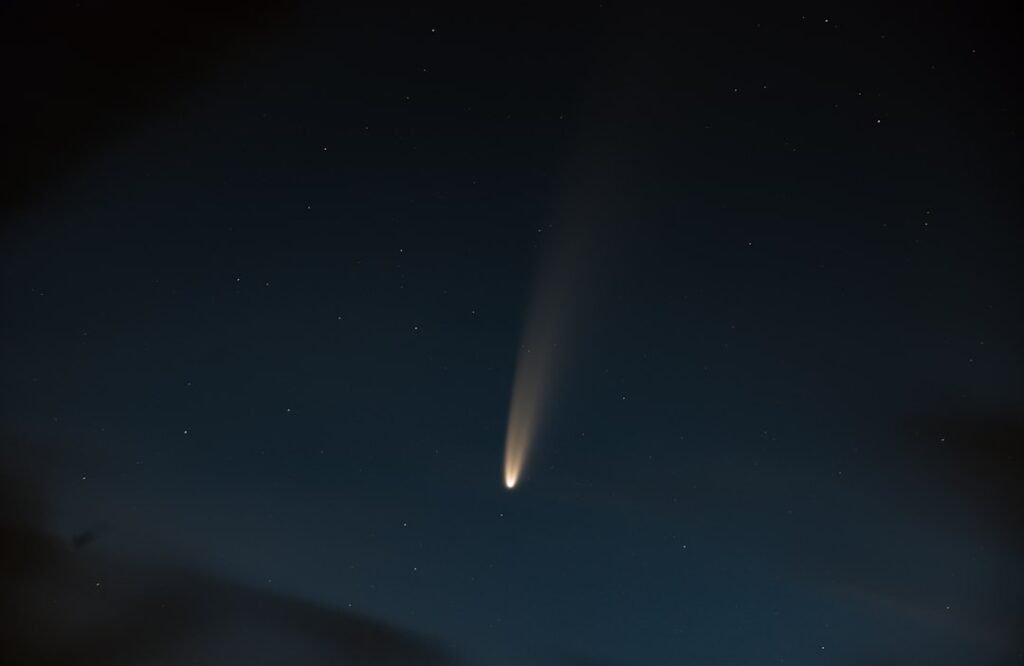


Amateur Spotters Uncover a Cosmic Gem (Image Credits: Unsplash)
A newly discovered sungrazing comet barrels toward an intense solar encounter that could either destroy it or transform it into a daytime beacon for observers around the world.[1][2]
Amateur Spotters Uncover a Cosmic Gem
On January 13, 2026, a team of French amateur astronomers made a remarkable find. Alain Maury, Georges Attard, Daniel Parrott, and Florian Signoret detected the faint object using a remotely operated telescope in Chile’s Atacama Desert as part of the MAPS survey for near-Earth asteroids.[2][3]
The comet, officially designated C/2026 A1 (MAPS), appeared at magnitude 18 near the constellation Columba. Recent observations placed it around 17th magnitude in the Eridanus-Fornax border, still too dim for most backyard scopes but steadily brightening.[3]
Discovered farther from the sun than any prior sungrazer – over 2 astronomical units away – this early detection hints at a potentially larger nucleus, estimated up to 2.4 kilometers across.[4]
Kreutz Family’s Latest Daredevil
C/2026 A1 belongs to the Kreutz sungrazer family, remnants of an ancient mega-comet that fragmented centuries ago, possibly as far back as 371 B.C.[2]
Its orbit carries a steep inclination of 144.5 degrees to the ecliptic and a period of about 1,175 years. The comet reaches perihelion – its closest solar approach – on April 4, 2026, at approximately 10 a.m. EDT, skimming within roughly 748,000 kilometers of the sun’s surface.[3][1]
Extreme heat, radiation, and tidal forces pose grave threats. Most Kreutz comets vaporize during such passes, as seen in thousands captured by NASA’s SOHO spacecraft.[5]
Brightness Boom or Bust?
Survival odds remain uncertain, but success could yield explosive results. The comet might surge to negative magnitudes – brighter than Venus – for hours around perihelion, rivaling historic standouts.[3]
Past Kreutz survivors like the Great Comet of 1843 achieved magnitudes of -6 to -8 with daylight tails. Ikeya-Seki in 1965 outshone the full moon, while Lovejoy in 2011 reached Venus-like brilliance.[2]
| Comet | Year | Peak Brightness |
|---|---|---|
| Great Comet of 1843 | 1843 | -6 to -8 (daylight visible) |
| Ikeya-Seki (C/1965 S1) | 1965 | Brighter than full moon |
| Lovejoy (C/2011 W3) | 2011 | Venus brightness |
Even fragmentation might spike brightness temporarily through dust release.[5]
Tracking the Twilight Visitor
Southern Hemisphere viewers hold the advantage, with the comet rising higher in darker western skies from mid-March.[3]
Northern observers face low southwestern horizons amid twilight. Expect naked-eye potential post-perihelion in early April, possibly with a sweeping tail.[4]
- Start with 8- to 10-inch telescopes now for magnitudes 13-17.
- Scan low west after sunset April 4-10; use solar filters near sun.
- Check SOHO coronagraph feeds for real-time solar views.
- April 6-15 offers rapid post-perihelion brightening window.
- Avoid direct sun gazing; binoculars aid faint tail spotting.
Daytime naked-eye sightings could occur if it flares exceptionally bright, low near the sun.[2]
Key Takeaways
- C/2026 A1 faces perihelion April 4; survival unlocks potential negative-magnitude glow.
- Southern skies prime for evening views; Northern twilight challenges persist.
- SOHO images will capture the action regardless of fate.
This high-stakes solar slingshot reminds us of comets’ unpredictable allure – one wrong turn, and poof. Yet triumph promises a rare treat. What do you think: dazzler or disintegrator? Tell us in the comments.