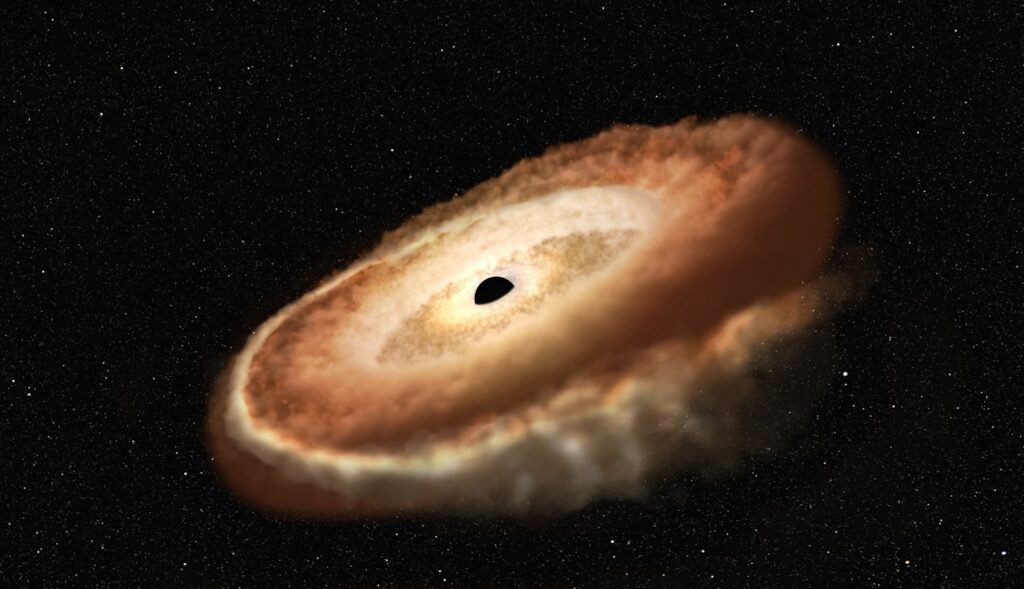

They’re the shimmering shortcuts of science fiction: doors in spacetime that swallow ships and spit them out among new stars. In real physics, the idea refuses to fade because it presses on a thrilling question – could such tunnels ever stay open long enough for a traveler to pass through? The stakes are huge, from how we understand gravity to whether our universe polices its own causality. New theoretical work keeps nudging the conversation forward, even as hard limits set by energy, stability, and quantum rules push back. Between hope and harsh math, the story of wormholes is a tug-of-war that reveals as much about us as it does about the cosmos.
The Hidden Clues

What if the universe already allows wormholes – but only the kind that slam shut faster than any signal could cross? That’s the maddening possibility behind many solutions to Einstein’s equations: the geometry can exist on paper, yet nature refuses passage. The trouble is stability; without the right kind of support, spacetime throats tend to pinch off like a stressed balloon. Even tiny disturbances – light, dust, heat – can seed a collapse that outpaces any traveler. The hint here is sobering: existence in math is cheap, endurance in reality is expensive.
Physicists hunt for exceptions by asking how energy flows through spacetime and whether known quantum effects can hold a tunnel open. Negative energy, a weird but real feature of quantum fields, occasionally sets the table. But those negative dips are usually fleeting and faint, like momentary cold spots on a hot griddle. To get a traversable passage, you’d need those dips arranged just right and long enough to counter gravity’s urge to snap the throat shut. That’s a tall order, but it’s not obviously impossible.
From Einstein–Rosen to Modern Science

The story starts with bridges: the early solutions connecting two regions of spacetime that looked like a tunnel but weren’t passable. Decades later, more flexible constructions showed how a traversable version might work if supported by matter with unusual properties. I remember staring at those diagrams as a student, the way you stare at a map that shows a road where the mountain clearly stands; the map isn’t wrong, it’s just incomplete. The missing piece is the stuff that props the tunnel open without ripping the fabric around it. That’s where exotic matter – or, more precisely, negative energy density – enters the plot.
Gravity normally attracts, but negative energy can repel, providing tensile strength against collapse. The tantalizing part is that quantum physics does produce negative energy in controlled setups, like between closely spaced plates where vacuum fluctuations are trimmed. The disappointing part is scale: those effects are tiny and notoriously hard to scale up. The transition from tabletop oddities to starship corridors isn’t a step; it’s a canyon. Bridging it means contending with strict quantum bounds on how much negative energy you can gather and for how long.
The Physics That Keeps Them Open

To keep a wormhole traversable, you need to violate the usual energy conditions that say matter should behave “nicely.” Quantum fields bend those rules a bit, but they impose their own budgets through so-called quantum inequalities. Think of them like a cosmic credit score: you can dip below zero for a moment, but you must pay it back quickly and with interest. That makes long-lived, wide-throated wormholes fantastically expensive in energy bookkeeping. It’s not just collecting negative energy; it’s sustaining it without triggering a catastrophic rebound.
There’s also the danger of feedback. If a wormhole lets signals loop back in time, quantum fluctuations can amplify wildly, flooding the throat with radiation that seals it. Some theorems – topological censorship among them – say you don’t get smooth, traversable shortcuts in ordinary, well-behaved universes. You can evade the rules on paper with special boundary conditions or unusual spacetime environments, but every workaround tightens practical constraints elsewhere. The universe seems to tolerate cleverness, not abuse.
Why It Matters

Even if we never fly a mission through a cosmic tunnel, the question forces precision about gravity, quantum fields, and the limits of engineering. Comparing wormholes to conventional travel is like comparing a fire escape to teleportation: one depends on materials and patience, the other on rewriting the blueprints. Traditional propulsion fights distance; wormholes try to erase it. Asking whether they can stay open tests how far our theories stretch before they snap. That pressure, in turn, sharpens ideas that spill into other realms of physics and technology.
There’s also a cultural stake. Wormholes are the public’s favorite “what if,” and that curiosity is rocket fuel for science literacy. When we explain why most wormholes would collapse, we’re not crushing dreams; we’re showing how science distinguishes dazzling mirages from viable paths. And sometimes the detours pay off: techniques born from chasing wormhole stability now influence quantum information theory, black hole thermodynamics, and new ways to model spacetime. The shortcut may be unreachable, but the journey is surprisingly productive.
What Telescopes and Detectors Can Actually See

Could a real wormhole masquerade as something more familiar, like a black hole? In principle, yes: the gravity outside could look nearly identical, fooling our telescopes. But subtle differences might betray the trick – specific lensing patterns, time delays from light looping through a throat, or echoes in gravitational waves after a massive collision. So far, the black holes we’ve imaged and the ripples we’ve recorded fit the standard playbook remarkably well. If wormholes are out there, they’re either rare, small, or very shy.
Future surveys will keep pressing. Sharper black hole images, denser gravitational-wave catalogs, and precise timing of pulsars could flag anomalies that match wormhole models. Non-detections matter too; they tighten the leash on how large or common traversable tunnels could be. In astronomy, ruling things out is as powerful as finding them, because constraints sculpt the viable theories. Each year, the room for secret shortcuts gets a little smaller – or more interesting.
The Debate Over Quantum Shortcuts

One surprising twist is the link between wormholes and quantum entanglement. In certain theoretical setups, you can make a tunnel effectively traversable by arranging a delicate negative-energy pulse, turning “don’t enter” into “go, but quickly.” These are not cosmic highways; they’re more like service hatches opened by finely tuned quantum tricks. The timescales are short, the distances modest, and the requirements exacting. Still, they prove a powerful point: under strict conditions, spacetime can be coaxed into allowing brief passage.
Quantum simulation experiments have even emulated the mathematics of such passages in toy models, offering a taste of the dynamics without claiming a literal tunnel in the lab. That’s a healthy boundary to keep clear. Simulations validate how information would move if a wormhole were possible, but they don’t create one. The payoff is conceptual clarity and better tools for exploring quantum gravity. For travel dreams, it’s a polite maybe later.
Global Perspectives

Keeping this question alive isn’t the effort of one lab or one country; it’s a web of collaborations spanning theory and observation. Large interferometers listen for spacetime ripples while radio arrays stitch black hole silhouettes out of whisper-thin signals. Space agencies hedge bets on precision timing missions that might catch tiny anomalies in gravity’s behavior. Meanwhile, math-heavy teams push the limits of theorems that govern exotic geometries, looking for holes in the no-go fences. Progress is rarely linear, but it’s shared.
That global spread matters because wormholes sit at the intersection of many hard problems. What looks like an astrophysics question is also a quantum field theory question and a computation question. When different communities agree on a constraint or a possibility, confidence rises. When they disagree, the friction surfaces fresh ideas. Either way, the result is a sturdier picture of what our universe permits.
The Future Landscape

The near-term roadmap is less starship and more microscope. Upgrades to gravitational-wave detectors may expose post-merger ringdowns with exquisite detail, letting us test spacetime near its breaking point. Next-generation radio arrays could sharpen black hole images enough to spot subtle departures from the expected shadow. On the theory side, better models will fold in quantum effects without hand-waving, tightening predictions for what a transiently open throat would actually do. Even negative-energy engineering – though still wildly speculative – will see clearer boundaries.
The big challenges won’t be poetic; they’ll be budgets, noise, and patience. Building instruments that can catch faint, brief, or rare signatures is painstaking work that spans decades. Meanwhile, quantum information research will keep exploring how entanglement and geometry talk to each other. If there’s a window for short-lived traversable wormholes anywhere, that dialogue is where we’ll hear the first knock. And if not, we’ll at least have mapped the silence.
Conclusion

If this puzzle grabs you, there are simple, meaningful ways to help move it forward. Support the observatories and open-data projects that let anyone sift the sky for anomalies; some of the best constraints come from volunteers and students following careful guides. Champion science education that links big ideas – like wormholes – to the gritty methods that test them, because wonder paired with rigor is how myths become knowledge. Stay curious but ask hard questions when headlines oversell breakthroughs; healthy skepticism is a gift to real discovery. And if you’re able, back the nonprofits that advocate for long-horizon research, the kind that doesn’t fit neatly into a quarterly report.
I don’t expect a tourist’s tunnel across the galaxy in my lifetime, and I’m oddly comforted by that. The universe is letting us earn every inch of understanding, and that makes each inch feel profound. Whether wormholes ever stay open long enough for a traveler or only long enough for a thought experiment, chasing them is already reshaping physics in quiet, powerful ways. If you could step through, just once, would you dare?
Suhail Ahmed is a passionate digital professional and nature enthusiast with over 8 years of experience in content strategy, SEO, web development, and digital operations. Alongside his freelance journey, Suhail actively contributes to nature and wildlife platforms like Discover Wildlife, where he channels his curiosity for the planet into engaging, educational storytelling.
With a strong background in managing digital ecosystems — from ecommerce stores and WordPress websites to social media and automation — Suhail merges technical precision with creative insight. His content reflects a rare balance: SEO-friendly yet deeply human, data-informed yet emotionally resonant.
Driven by a love for discovery and storytelling, Suhail believes in using digital platforms to amplify causes that matter — especially those protecting Earth’s biodiversity and inspiring sustainable living. Whether he’s managing online projects or crafting wildlife content, his goal remains the same: to inform, inspire, and leave a positive digital footprint.