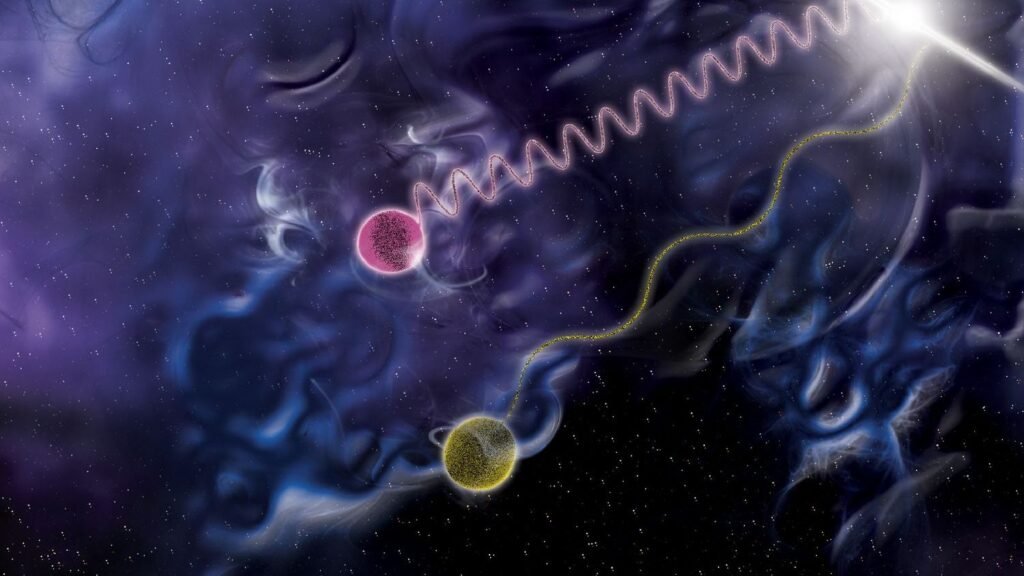

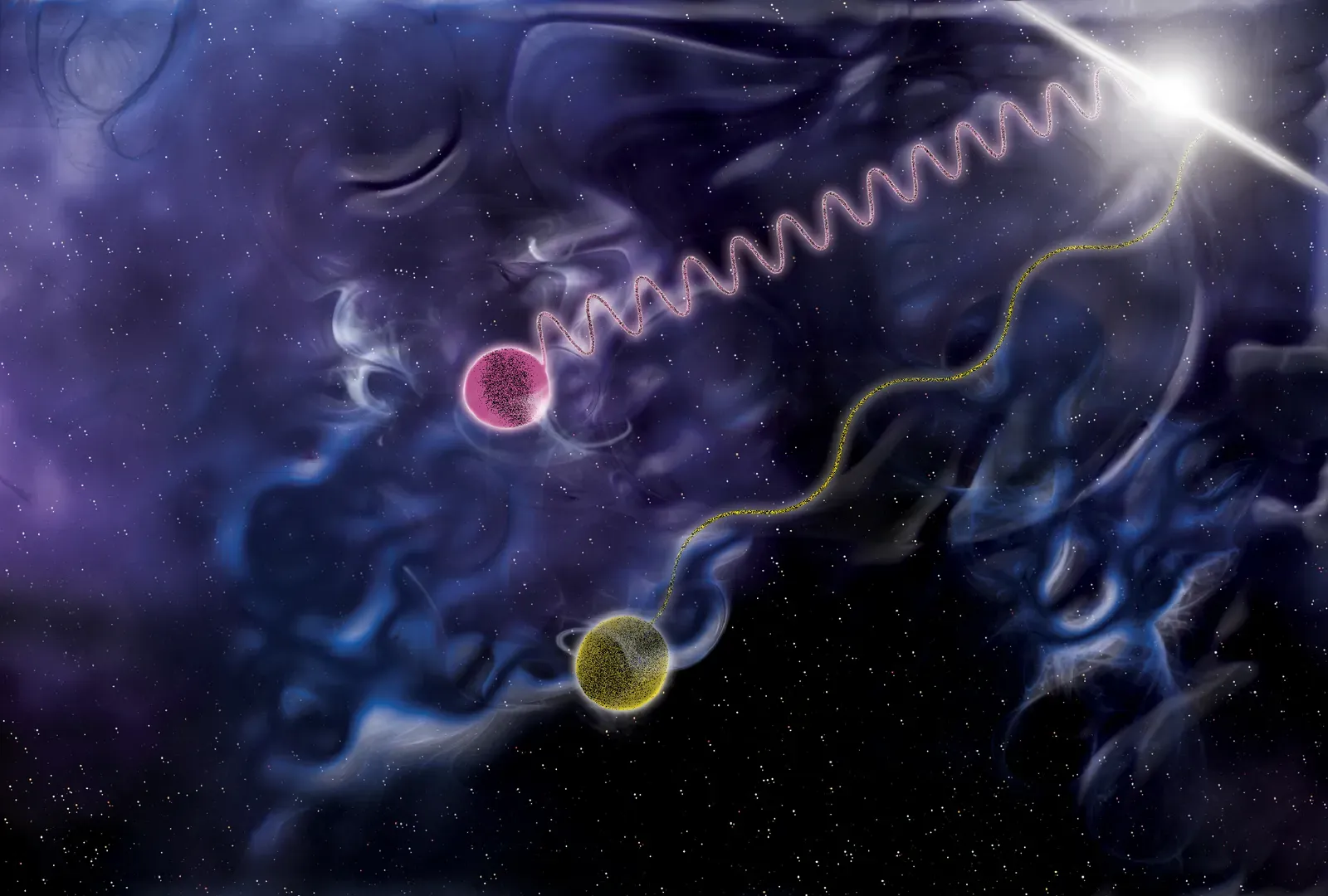
Imagine sending a message that cannot be intercepted, copied, or hacked, no matter how powerful a computer becomes. That sounds like science fiction, but it is exactly the kind of promise people see in quantum entanglement. The idea that two particles can be mysteriously linked across vast distances has fascinated scientists for decades, and now it is quietly working its way out of the lab and into early-stage communication networks.
At the same time, a lot of wild claims float around: instant messaging across galaxies, faster‑than‑light internet, telepathic-style connections. Those parts are, at least with what we know today, wrong. The real story is more subtle, but in many ways more exciting: quantum entanglement could completely transform how we secure information, build networks, and even think about the internet itself.
The Strange Reality of Quantum Entanglement
Picture two coins that always land on opposite sides: if one lands as heads, the other must be tails, every single time. Now imagine those coins are on opposite sides of the planet, and they still stay perfectly coordinated the instant you flip one. That’s roughly what entanglement feels like, except instead of coins, we’re talking about quantum particles like photons, electrons, or atoms, and instead of simple heads or tails, they can exist in superpositions of states until measured. When two particles are entangled, their properties are deeply correlated in a way that classical physics simply can’t explain.
What makes this so shocking is that these correlations stay intact even when the particles are separated by large distances. Experiments have repeatedly shown that no signal seems to travel between them in any normal way, and yet their measurements line up with uncanny precision. This behavior does not allow information to travel faster than light, but it violates what many people’s intuition says about how the world should work. That same weirdness, though, is exactly what makes entanglement such a powerful resource for future communication technology.
Why Entanglement Still Can’t Send Faster‑Than‑Light Messages

It’s tempting to assume that if particle A and particle B are entangled, then you could tap on A in a certain way and have B respond instantly with a message. But nature refuses to cooperate with that fantasy. When you measure one particle in an entangled pair, you get a random result, even though the partner’s result is perfectly correlated when it’s measured later. You can’t control what outcome you get, which means you can’t encode a chosen message into that randomness and send it to someone else.
Physicists describe this limitation using what’s called the “no‑signalling principle,” which says entanglement can’t move usable information faster than light. You can think of it like two people opening identical sealed envelopes that were prepared in advance: whatever is inside matches in a special way, but neither person can decide what gets written inside at the moment of opening. That’s why, despite all the mystery, entanglement doesn’t break Einstein’s speed limit. And yet, within this restriction, it still offers incredibly powerful tools for making communication more secure and more efficient.
Quantum Key Distribution: Near‑Unbreakable Security

Where entanglement really shines today is not in sending messages directly, but in creating encryption keys that are almost impossible to steal undetected. In quantum key distribution, often shortened to QKD, two parties use single photons or entangled photons to generate a shared secret key. If an eavesdropper tries to intercept or copy these quantum states, they inevitably disturb them, leaving a clear fingerprint of tampering in the error rates that the users can check. The moment the disturbance goes beyond a safe threshold, they can simply discard the key.
This is a huge deal in a world where traditional cryptography depends on hard math problems that future quantum computers could eventually crack. Several countries and companies have already demonstrated real‑world quantum key distribution links over hundreds of kilometers of fiber, and even between ground stations and satellites. That means entanglement‑based or quantum‑based security is not just a thought experiment anymore; it’s already being woven into early versions of what people sometimes call a quantum‑safe internet.
Quantum Teleportation: Not Sci‑Fi Beaming, But State Transfer
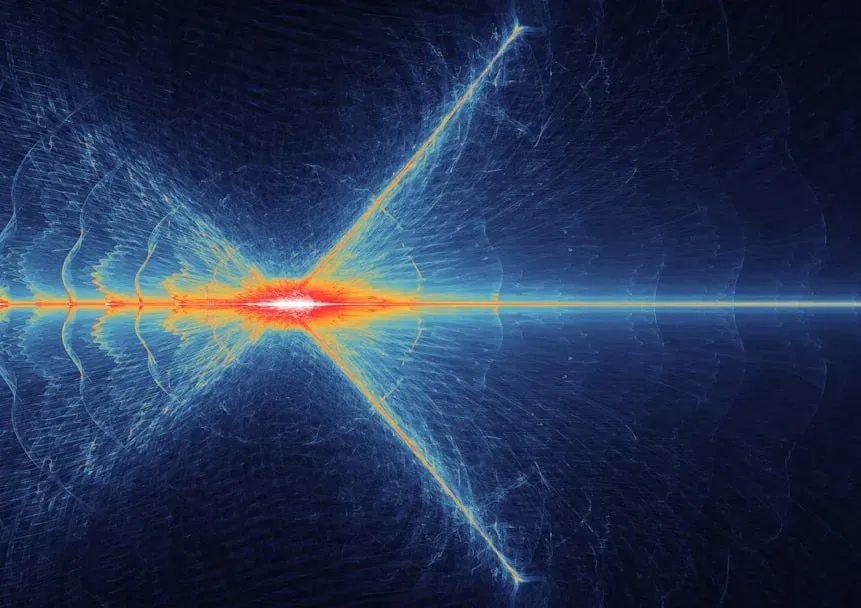
The phrase “quantum teleportation” sounds like someone is about to beam a person across a room, but the reality is much more modest and far more useful for communication. In quantum teleportation, the goal is to transfer the precise quantum state of a particle from one location to another, using a combination of entanglement and a classical message. The original particle’s state is destroyed in the process, and a distant particle takes on that exact state, as if the information that defined it has been relocated. Nothing physical is moving faster than light; what moves is the abstract pattern.
This kind of teleportation has already been demonstrated in laboratories and in free‑space experiments spanning tens of kilometers and even between ground and satellites. In principle, teleportation is a building block for future quantum networks, where quantum information might hop across chains of entangled nodes. While this does not replace ordinary internet traffic, it enables functions that classical networks simply can’t mimic, such as distributing delicate quantum states for sensing, computing, and ultra‑secure communication tasks.
Quantum Repeaters: Building a Global Quantum Network
One of the major headaches in using entanglement over long distances is that photons get lost or absorbed as they travel through fiber or the atmosphere. In classical networks, you can just amplify the signal, but quantum states can’t be copied or amplified without destroying the very information that makes them useful. That means you need a new kind of infrastructure to extend entanglement across continents: quantum repeaters. These are devices that store, swap, and purify entanglement across intermediate nodes, effectively stitching together short links into long ones.
Researchers are experimenting with quantum memories based on cold atoms, solid‑state defects, and trapped ions to hold entangled states long enough to connect distant users. It’s a bit like building a chain of carefully synchronized lighthouses instead of one giant floodlight. Early demonstrations of small quantum networks and “entanglement swapping” between distant points are already here, but scaling them up is a huge engineering challenge. Still, if quantum repeaters can be made reliable and affordable, they open the door to a genuine quantum internet layered on top of – or intertwined with – the classical one we use every day.
What a Quantum Internet Might Actually Look Like

When people hear “quantum internet,” they often imagine a replacement for everything we do online today, just unbelievably faster. In reality, the most likely scenario is more subtle: a hybrid network where classical data carries most of the familiar content – videos, emails, chats – while quantum channels provide specialized services. Those services could include distributing cryptographic keys, running secure identification protocols, or linking distant quantum computers. Instead of speeding up your video streaming, quantum links would quietly protect the keys that keep that stream private.
There are already regional testbeds connecting universities, research labs, and companies with experimental quantum links. In the future, your devices might not talk directly in qubits, but they could rely on backbone networks that use entanglement behind the scenes for authentication or secure access. Much like most people have no idea which routing protocols carry their data now, users might never see the “quantum” label, even as it becomes central to how critical infrastructure stays secure. The change would be deep and structural, not flashy at the surface.
Hard Limits, Real Hype, and the Road Ahead
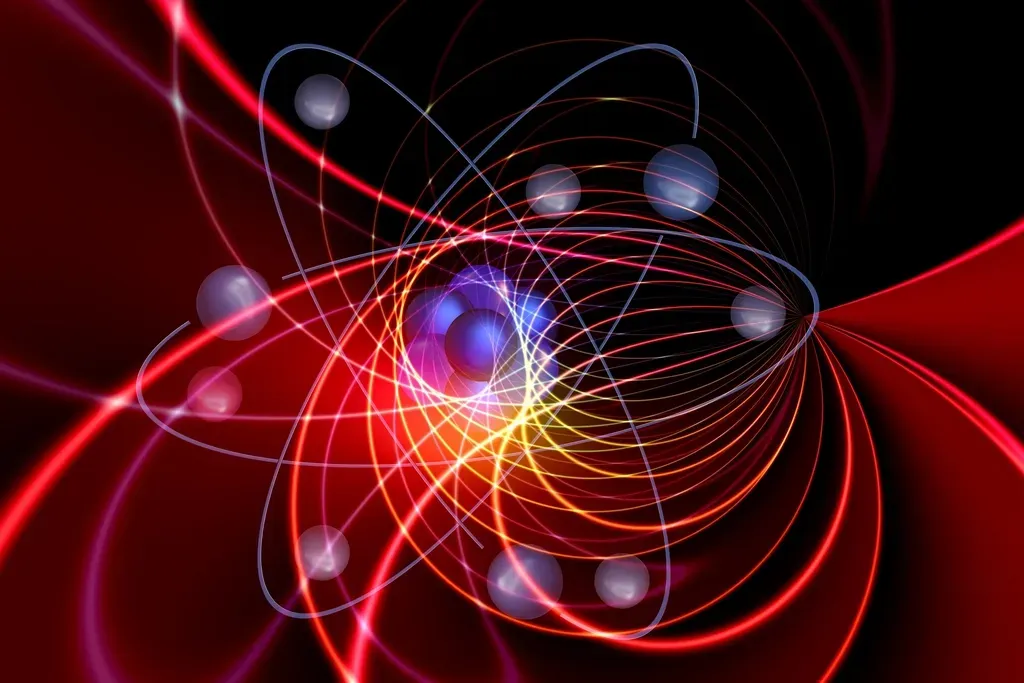
There’s a bit of a tug‑of‑war around quantum technologies right now: one side is overhype promising instant, limitless communication, and the other side is healthy skepticism pointing out the serious technical hurdles. The truth sits somewhere in between. Quantum entanglement will not allow faster‑than‑light messaging or magical long‑distance mind‑links, and anyone claiming that is either misunderstanding the physics or overselling it. At the same time, dismissing entanglement as a mere curiosity misses how quickly it’s moving from textbooks into fibers, chips, and satellites.
Practical issues like loss, noise, device imperfections, and cost still stand in the way of global quantum communication networks. But the trajectory is clear: step by step, researchers are turning fragile lab demonstrations into robust tools. I find it strangely comforting that nature gives us a resource as bizarre as entanglement and then sets strict rules on what we’re allowed to do with it. Within those rules, though, we get something extraordinary: communication technologies that may not break the speed of light, but can fundamentally reshape what it means for information to be private, trusted, and shared.