

The Colossal Spin in the Void (Image Credits: Upload.wikimedia.org)
Astronomers recently uncovered a colossal rotating structure in the cosmic web, stretching across 50 million light-years and linking the fates of dozens of galaxies in unexpected harmony.
The Colossal Spin in the Void
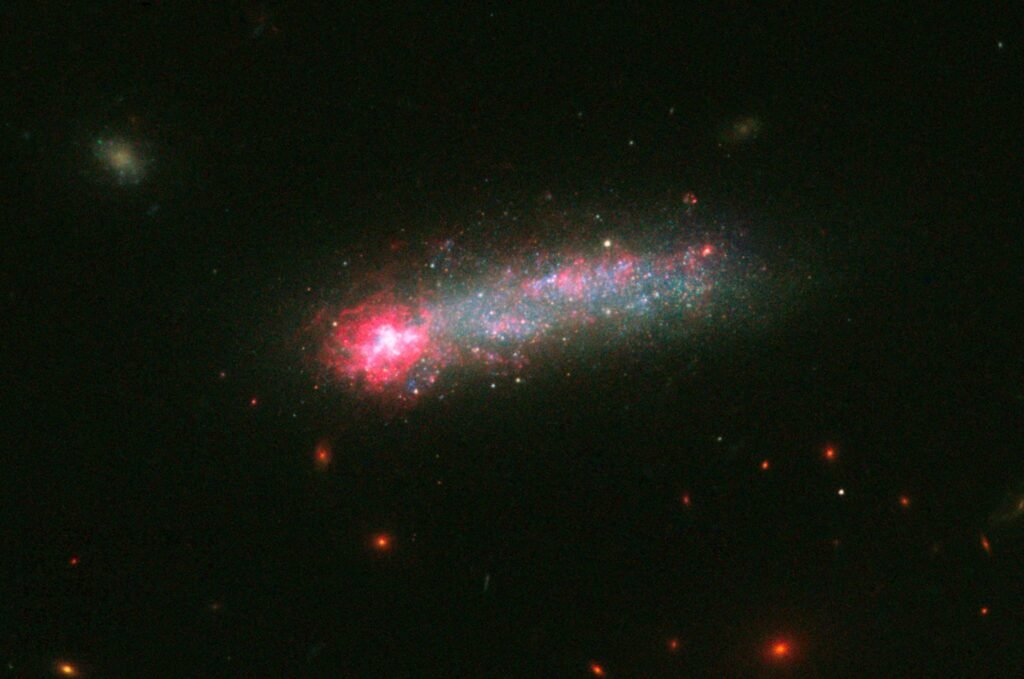
Imagine a thread woven from the fabric of the universe itself, twisting slowly through the darkness of space. Researchers led by the University of Oxford identified this enormous filament, one of the largest rotating features ever observed. The structure, located about 140 million light-years from Earth, consists of a razor-thin chain of 14 hydrogen-rich galaxies embedded within a broader cosmic scaffold.
This discovery, detailed in the Monthly Notices of the Royal Astronomical Society, revealed that the galaxies rotate in unison with the filament, a synchronization that defies random cosmic chance. Such alignment suggests deeper connections between large-scale structures and the individual behaviors of galaxies. The filament’s slow rotation, spanning millions of light-years, marks it as a potential record-holder for the biggest spinning object known.
Unraveling the Filament’s Secrets
At the heart of this find lies a narrow inner chain, just 5.5 million light-years long but remarkably slender, holding galaxies that whirl together like dancers in a grand cosmic ballet. Observations showed their spins aligned far more strongly than models predicted, pointing to inherited motion from the surrounding web. Dark matter and cold gas likely form the backbone of this thread, funneling material toward galaxy clusters.
The broader filament, part of the universe’s vast cosmic web, appears to rotate as a cohesive unit. This coordinated motion could explain why some galaxies exhibit preferred spin directions, challenging earlier assumptions of isolated evolution. Scientists used advanced telescopes to map hydrogen emissions, revealing the structure’s dynamic nature over vast distances.
Implications for Galaxy Formation
This spinning filament offers fresh clues to how galaxies took shape in the early universe. Traditional theories held that galaxy rotations arose from local interactions, but the evidence here implies that larger cosmic flows imprint their twist on forming stars and disks. Matter streaming along these filaments may carry angular momentum, seeding the spins observed today.
Understanding such structures could refine models of the universe’s expansion and the role of dark energy. The discovery highlights how the cosmic web, often seen as static scaffolding, pulses with motion that influences everything from star birth to black hole growth. Future surveys might uncover more of these rotating behemoths, painting a more dynamic picture of cosmic history.
Key Features of the Discovery
To grasp the scale and significance, consider the filament’s standout attributes:
- Length: Approximately 50 million light-years, dwarfing most known structures.
- Galaxy Count: A core chain of 14 galaxies, all rich in hydrogen and spinning in sync.
- Rotation Strength: Alignment exceeds random expectations by a wide margin, suggesting inherited dynamics.
- Location: 140 million light-years distant, embedded in the cosmic web’s filaments.
- Composition: Primarily dark matter, cold gas, and galaxy clusters in formation.
These elements combine to form a structure that not only amazes but also instructs, bridging scales from individual galaxies to the universe’s architecture.
Key Takeaways
- The filament’s rotation hints at momentum transfer from the cosmic web to galaxies.
- It represents one of the largest coherent spinning features detected to date.
- This finding could reshape simulations of matter flow and structure formation.
As astronomers peer deeper into the cosmos, structures like this spinning filament remind us of the universe’s intricate choreography. What secrets might the next observation reveal about our place in this vast, turning tapestry? Share your thoughts in the comments below.