

Unexpected Twists in Our Cosmic Neighborhood (Image Credits: Upload.wikimedia.org)
Throughout 2025, astronomers and space observers worldwide witnessed a cascade of revelations that reshaped understandings of the universe, from distant explosions to nearby orbital tensions.
Unexpected Twists in Our Cosmic Neighborhood
A repeating gamma-ray burst captured attention early in the year when astronomers detected GRB 250702BDE, which flared for nearly a full day – far longer than typical short bursts. NASA’s Fermi Gamma-ray Space Telescope and China’s Einstein Probe identified the event, and follow-up observations with the European Southern Observatory’s Very Large Telescope and Hubble Space Telescope confirmed its extragalactic origin. This anomaly ruled out a supernova connection and pointed toward novel mechanisms in high-energy astrophysics.
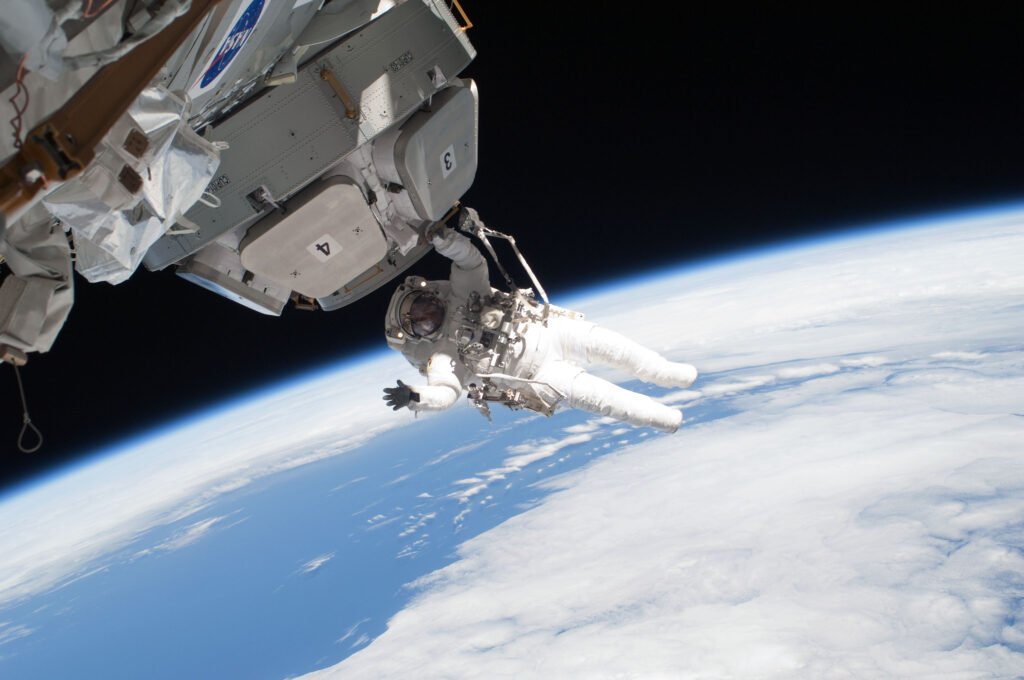
Closer to home, Russian space operations faced scrutiny amid reports of procedural lapses during a crewed mission, highlighting ongoing challenges in international collaboration at the International Space Station. These incidents, coupled with unusual atmospheric phenomena over Earth, sparked debates among enthusiasts about the reliability of current space infrastructure.
Black Holes and Stellar Enigmas Unveiled
One of the year’s most intriguing finds involved a red giant star orbiting a dormant black hole, spinning unusually fast as revealed by vibrations in its light. Researchers analyzed these “starquakes” to uncover the star’s turbulent history, challenging models of binary systems and black hole interactions. The discovery, detailed in recent studies, emphasized how subtle signals can rewrite cosmic narratives.
Black hole research dominated headlines with multiple breakthroughs, including evidence of massive early-universe black holes observed by the James Webb Space Telescope. These findings, weighing millions of solar masses, questioned traditional theories on galaxy and black hole co-evolution. Additionally, hints of primordial black holes emerged from gravitational-wave data collected by LIGO and Virgo in November, suggesting relics from the Big Bang might influence modern detections.
Exoplanets and Distant Galaxies in Focus
Exoplanet hunting yielded bizarre results, such as worlds resembling Tatooine with dual suns and others trailing comet-like tails due to stellar winds. These observations underscored the Milky Way’s diversity, with telescopes capturing evidence of atmospheric stripping and orbital oddities. The discoveries fueled speculation about habitable zones beyond our solar system.
A nine-ringed galaxy, the most complex of its kind, emerged as a record-breaker in structure, offering insights into galaxy formation processes. Meanwhile, the James Webb Space Telescope imaged a supernova from the universe’s dawn, providing a rare glimpse into early stellar deaths at high redshifts. The debut of a new prolific survey telescope further accelerated data collection on distant galaxies, including the enigmatic “Little Red Dots” that hinted at compact early black holes.
Explosive Events and New Phenomena
Astronomers identified SN 2025wny, the most strongly lensed superluminous supernova to date, magnifying its light through gravitational effects and revealing details of a distant galaxy cluster. This event marked a milestone in observational techniques, transforming how transient cosmic events are studied.
Extreme nuclear transients, dubbed ENTs, debuted as a new category of explosions from massive stars torn apart by unknown forces, surpassing known supernovae in power. Observations tied these to stars at least three times the Sun’s mass, expanding the catalog of violent cosmic endings. An interstellar comet also made a stealthy appearance, weaving through the solar system and prompting fresh analyses of extrasolar visitors.
Key Takeaways from 2025’s Space Saga
- Black hole mysteries deepened with evidence of ancient giants and primordial echoes, challenging formation theories.
- Exotic exoplanets and lensed supernovae highlighted the universe’s structural wonders and observational advances.
- From gamma-ray bursts to new explosion classes, high-energy events revealed untapped cosmic dynamics.
2025 proved that the cosmos continues to surprise, blending drama in near-Earth orbits with profound insights into the universe’s origins. These stories not only advanced astrophysics but also reignited public fascination with the stars. What was your favorite space moment this year? Share your thoughts in the comments below.