

A Trigger for Galactic Powerhouses (Image Credits: Unsplash)
Recent observations from the Euclid space telescope have unveiled a direct connection between violent galactic collisions and the sudden activation of supermassive black holes.
A Trigger for Galactic Powerhouses
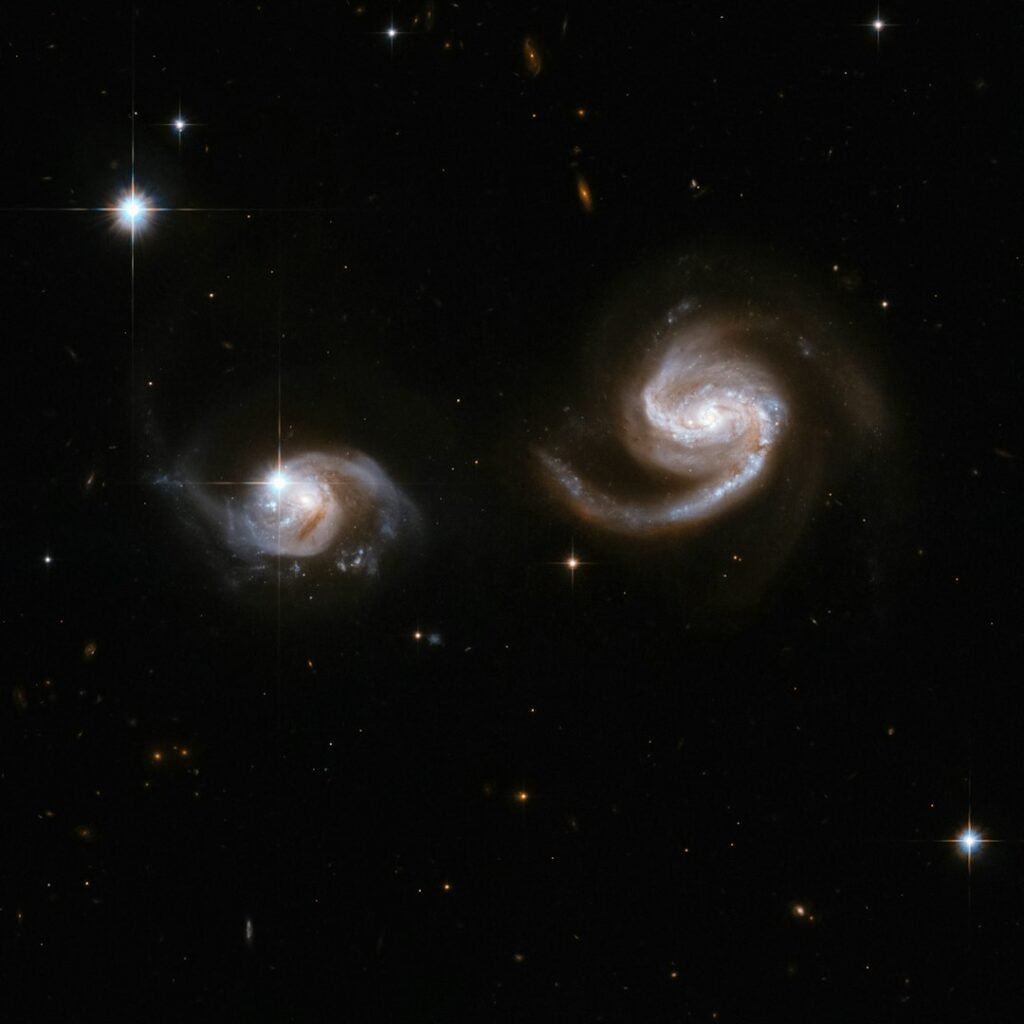
Astronomers have long suspected that mergers between galaxies play a crucial role in awakening dormant black holes at their cores. Now, data from Euclid confirms this theory with striking clarity. The satellite’s analysis of over a million galaxies revealed that those undergoing mergers host active galactic nuclei – regions where supermassive black holes devour matter and emit intense radiation – up to six times more frequently than isolated ones.
This discovery, published in early December 2025, builds on years of speculation. During a merger, gravitational chaos funnels vast amounts of gas and stars toward the central black hole, igniting rapid growth phases. Such events transform quiet galactic centers into blazing beacons visible across billions of light-years. Researchers emphasized that these collisions not only fuel black holes but also reshape entire galaxies, blending their structures into new forms.
The findings highlight how mergers dominate the early universe’s evolution, where such interactions were far more common. Euclid’s wide-field imaging captured these processes in unprecedented detail, offering a snapshot of cosmic history.
The Mechanics of Merger-Driven Growth
When two galaxies collide, the process unfolds over hundreds of millions of years, but the effects on their black holes can be swift and dramatic. Tidal forces strip away outer layers, driving material inward and sparking accretion. This leads to quasars, the most luminous AGN, which outshine their host galaxies by factors of thousands.
Studies from the Euclid mission, combined with simulations, show that mergers increase the likelihood of AGN activity by two to six times, depending on the galaxies’ masses. Smaller mergers might gently nudge growth, while massive ones trigger explosive bursts. For instance, in dense clusters, repeated interactions amplify this effect, building the universe’s most massive black holes.
These insights challenge earlier models that downplayed mergers in favor of steady accretion. Instead, the data points to episodic, merger-fueled spurts as key to explaining the rapid appearance of billion-solar-mass black holes in the young universe.
Implications for Black Hole Origins
Beyond activation, mergers may explain the formation of supermassive black holes themselves. Early in cosmic history, dense star clusters could have spawned seed black holes that grew through successive collisions, as suggested by recent gravitational wave detections. Euclid’s observations align with this, showing how galactic smash-ups provide the raw fuel for such runaway growth.
One intriguing case involves runaway black holes ejected from mergers, hurtling through space at millions of miles per hour. The James Webb Space Telescope recently confirmed such an outlier, pushing a trail of star-forming gas ahead of it. These events underscore the dynamic nature of black hole evolution, where mergers not only grow cores but also scatter remnants across the cosmos.
Astronomers now predict that future surveys will detect even more merger-AGN pairs, refining our understanding of how these monsters seeded galaxy formation.
Key Observations from Euclid’s Dataset
The Euclid telescope, launched in 2023, has revolutionized our view of the distant universe by mapping dark matter and galaxy distributions. Its December 2025 release focused on a million galaxies up to redshift 1.5, capturing merger signatures like distorted arms and tidal tails.
- Merging galaxies exhibit AGN two to six times more often than non-merging ones.
- Post-merger systems show elevated star formation rates, linked to black hole feedback.
- The brightest quasars correlate strongly with recent major mergers.
- Minor mergers sustain lower-level activity over longer periods.
- Overall, mergers account for up to 30 percent of observed AGN in the sample.
This catalog provides a benchmark for testing theories on black hole-galaxy co-evolution.
Key Takeaways
- Galaxy mergers are primary drivers of supermassive black hole activation and growth.
- Euclid’s data confirms a 2-6x higher AGN probability in merging systems.
- These collisions shaped the early universe’s most massive structures.
As telescopes like Euclid and James Webb peer deeper into the cosmos, they reveal a universe sculpted by relentless collisions. This merger-black hole link not only demystifies galactic powerhouses but also hints at the violent births of the structures we see today. What role do you think these cosmic events play in the universe’s grand design? Share your thoughts in the comments.
Jan loves Wildlife and Animals and is one of the founders of Animals Around The Globe. He holds an MSc in Finance & Economics and is a passionate PADI Open Water Diver. His favorite animals are Mountain Gorillas, Tigers, and Great White Sharks. He lived in South Africa, Germany, the USA, Ireland, Italy, China, and Australia. Before AATG, Jan worked for Google, Axel Springer, BMW and others.