

Jupiter Takes Center Stage This January (Image Credits: Unsplash)
As winter evenings lengthen across the Northern Hemisphere, the night sky unfolds a tapestry of bright planets and lunar spectacles ready for eager observers.
Jupiter Takes Center Stage This January
Jupiter reaches opposition on January 10, 2026, positioning itself opposite the sun and rising at sunset for optimal viewing throughout the night. This event places the gas giant at its brightest and largest in telescopes, showcasing its banded clouds and perhaps even a glimpse of its four largest moons. Observers in the Northern Hemisphere will find it high in the southern sky around midnight, while those farther south enjoy it climbing higher. The planet’s prominence draws stargazers worldwide, marking a highlight of the season.
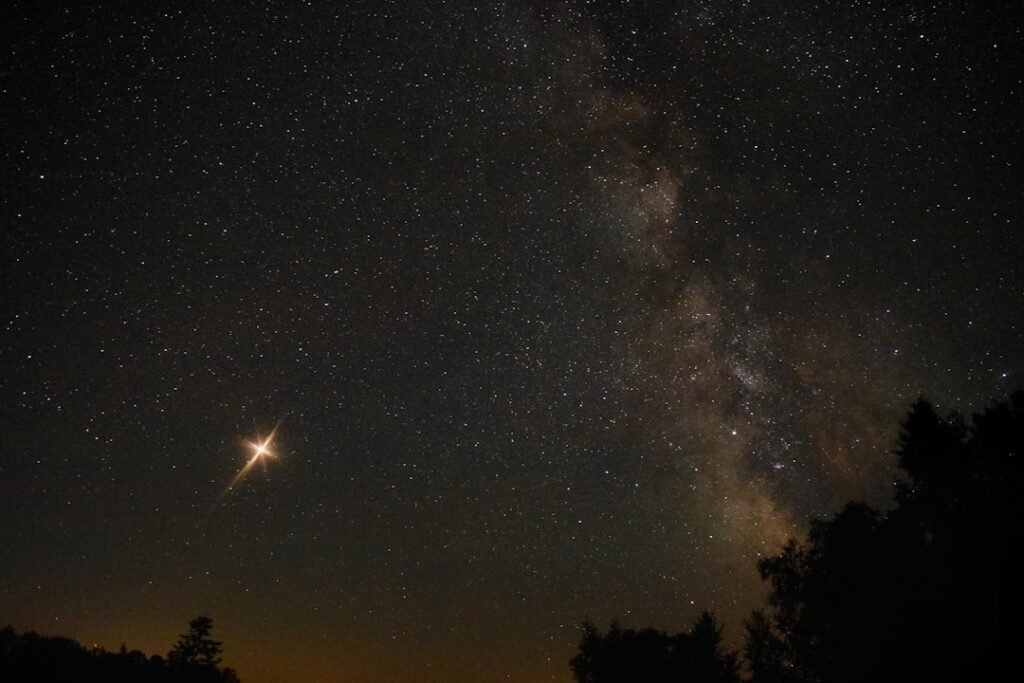
Preceding this, Jupiter shines steadily in Taurus during December, often appearing near the Pleiades star cluster. On December 31, a waxing gibbous moon passes close by, creating a striking duo against the starry backdrop. This alignment offers a perfect opportunity to practice binocular viewing, revealing the cluster’s hazy glow alongside Jupiter’s steady light.
Moonlit Encounters and Holiday Skies
The moon’s phases provide rhythmic guides through the heavens, starting with a waxing crescent in late December that joins Saturn on December 26. This conjunction forms a serene pairing low in the southwestern sky after sunset, ideal for holiday stargazing on Christmas evening. By December 27, the first quarter moon arrives, illuminating the evening hours and setting the stage for fuller views later in the month. A full moon on January 3 bathes the landscape in silver light, potentially washing out fainter stars but enhancing planetary contrasts.
Third quarter moon follows on January 10, rising after midnight and offering predawn vistas high overhead. During these nights, the moon’s proximity to bright points like Aldebaran in Taurus adds context to the celestial map. Such events remind viewers of the moon’s ongoing dance with our solar system’s landmarks, blending ancient rhythms with modern observation.
Tracking the Parade of Visible Planets
December and January feature several planets gracing the evening and morning skies, with Venus leading as the brilliant “evening star” in the southwest after sunset. Saturn lingers nearby, visible to the naked eye as a steady yellowish point until it dips below the horizon by late evening. Mars rises in the east during the night, its reddish hue becoming prominent by January as it climbs higher. Mercury, however, bids farewell in early January, sinking into the sun’s glare after a brief morning appearance in December.
For deeper exploration, Uranus and Neptune require binoculars or telescopes but add to the count during January’s planetary alignment. Starting around January 21, up to six planets – Venus, Saturn, Mars, Jupiter, Uranus, and Neptune – line up from southwest to southeast after sunset, with Mercury occasionally joining. This configuration, visible for about four weeks, rewards patient skywatchers with a sweeping vista of our solar neighborhood.
- Venus: Brightest planet, low west after sunset all month.
- Saturn: Faint but steady, near the moon on December 26.
- Jupiter: Opposite the sun on January 10, midnight highlight.
- Mars: Red beacon rising east, best in January evenings.
- Mercury: Morning view until early January, then fades.
- Uranus and Neptune: Telescope targets in the alignment.
Practical Tips for Clear Nights Under the Stars
Clear, dark skies enhance these observations, so check local weather and find locations away from city lights. Use apps or star charts to pinpoint positions, as planets move noticeably over weeks. Binoculars suffice for most naked-eye targets, revealing Jupiter’s moons or the moon’s craters during close passes. In the Southern Hemisphere, these sights shift higher, with Jupiter dominating summer evenings.
Patience pays off; allow eyes 20 minutes to adjust to darkness for better faint-object detection. Document sightings with sketches or photos to track changes, turning casual looks into engaging pursuits. These strategies ensure memorable experiences amid the winter chill.
Key Takeaways
- Jupiter’s opposition on January 10 offers prime viewing all night.
- December’s moon-Saturn conjunction highlights holiday skies.
- January’s six-planet alignment begins late in the month, spanning southwest to southeast.
These celestial displays connect us to the vast cosmos, inviting reflection on our place within it. What catches your eye first in the coming nights? Share your observations in the comments below.
Hi, I’m Andrew, and I come from India. Experienced content specialist with a passion for writing. My forte includes health and wellness, Travel, Animals, and Nature. A nature nomad, I am obsessed with mountains and love high-altitude trekking. I have been on several Himalayan treks in India including the Everest Base Camp in Nepal, a profound experience.