On a quiet night more than 2,000 years ago, a mysterious light in the sky is said to have guided the Magi across deserts and borders to the birthplace of Jesus. Known to history as the Star of Bethlehem, this celestial sign has fascinated theologians, astronomers, and historians for centuries. Was it a miraculous, one-of-a-kind event—or could it have been something far more familiar to ancient sky-watchers?
Among the many scientific explanations proposed over the years, one idea stands out for its drama and plausibility: what if the Star of Bethlehem was a comet? Bright, slow-moving, and impossible to ignore, comets were seen in the ancient world as powerful omens, often associated with the birth or death of great leaders. In this article, we explore whether a real comet could align with historical records, ancient astronomy, and the biblical account—and what modern science can tell us about one of the most enduring mysteries in human history.
The Christmas story has long captivated imaginations with its account of a brilliant star guiding wise men to the birthplace of Jesus, a celestial sign that astronomers and historians continue to investigate through ancient texts and modern science.
The Biblical Enigma That Has Puzzled Generations

Scholars have debated the nature of the Star of Bethlehem for centuries, drawing from the Gospel of Matthew’s description of a light that appeared in the east and moved to hover over a specific location. This event, dated roughly between 6 and 4 B.C., sparked journeys across vast distances and symbolized divine intervention in early Christian narratives. While some viewed it as a miraculous phenomenon beyond natural explanation, others sought astronomical events that could align with the timeline. The quest gained momentum in the 20th century as tools like orbital modeling allowed researchers to reconstruct ancient skies. Today, this mystery bridges faith, history, and the stars, inviting fresh interpretations.
Early theories ranged from supernatural signs to observable phenomena, but none fully satisfied all observers until recent analyses of distant records. Chinese astronomers, known for their meticulous sky-watching, documented unusual sights during the era, providing clues that Western scholars later overlooked. These accounts described a “broom star,” a term often linked to comets due to their sweeping tails. As technology advanced, experts began cross-referencing these with biblical details, revealing patterns that challenged traditional views. The debate persists, fueling books, documentaries, and academic papers that explore how the heavens might have influenced human events.
Ancient Chinese Observations Meet Cutting-Edge Science
In 5 B.C., Chinese chroniclers noted a striking comet that lingered in the sky for more than 70 days, an unusually long duration for such an object. This record, preserved in historical annals, described the apparition in the constellation of Capricorn, visible even during daylight hours. Planetary scientist Mark Matney, from NASA’s Johnson Space Center, recently examined these texts and proposed that the comet’s path brought it perilously close to Earth – potentially as near as the Moon’s orbit. Using computer simulations, he traced possible trajectories that matched the ancient descriptions, suggesting the object would have appeared exceptionally bright and dynamic. Matney’s work, published in the Journal of the British Astronomical Association, marks a significant step in connecting Eastern records to Western lore.
This hypothesis gained traction because the comet’s slow, erratic motion could explain why it seemed to “lead” travelers before pausing, unlike the steady paths of stars or planets. Traditional comet sightings often carried omens in ancient cultures, from portents of change to warnings of upheaval, which resonated with the Star’s role as a herald. Matney emphasized that while not all details align perfectly, the timing and visibility fit historical estimates of Jesus’s birth. Skeptics, however, caution that interpretations of old texts can vary, and the 70-day span might reflect multiple sightings rather than a single event. Still, this blend of archaeology and astrophysics offers a compelling bridge between eras.
Why a Comet Could Explain the Magi’s Journey
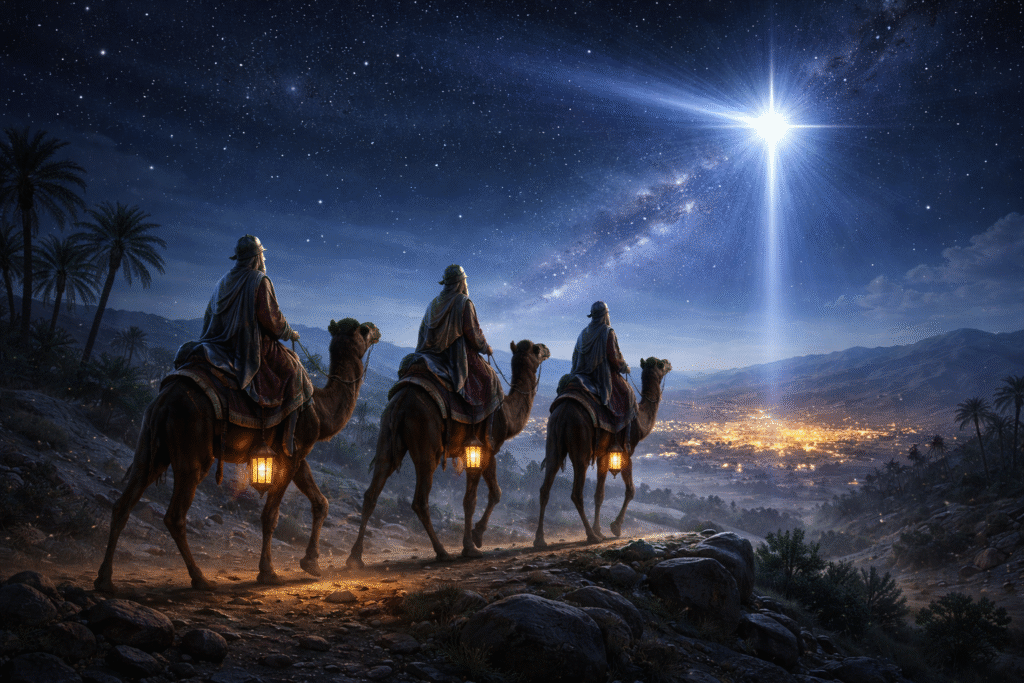
The Bible portrays the Star as a guide that compelled the Magi – likely astrologers from Persia or Babylon – to follow it westward to Jerusalem and then Bethlehem. A comet’s tail and nucleus would have created a vivid, directional glow, especially if positioned low on the horizon at dusk. Unlike fixed stars, comets wander across constellations, mimicking the narrative of movement toward a destination. If the 5 B.C. comet passed close to Earth, its brightness could have rivaled the full Moon, drawing eyes skyward and inspiring awe. This visibility, combined with cultural beliefs in comets as messengers, would have prompted the scholars’ trek.
Simulations show the comet might have looped in a way that made it reappear after brief disappearances, aligning with the idea of it “stopping” over the town. Historians note that Babylonian astronomers, experts in celestial omens, influenced the Magi’s traditions, making them attuned to such signs. The theory also accounts for why the Star eluded Roman records, as comets were sometimes dismissed as ill omens rather than precisely logged. Yet, not everyone agrees; some argue the description better suits a planetary conjunction, like Jupiter and Saturn aligning in 7 B.C. Despite these alternatives, the comet model revives interest in how ancient skies shaped religious stories.
Alternative Explanations and Ongoing Debates
Beyond comets, several astronomical events have been proposed for the Star, each with strengths and limitations. A series of planetary conjunctions in 7 B.C., involving Jupiter and Saturn in Pisces, caught attention for their symbolic ties to kingship and the Jewish people. Supernovae or novae, explosive stellar events, offered another possibility, though no definitive remnants match the date. Some researchers even suggested a rare alignment of multiple planets creating a pseudo-star effect. These ideas, explored in works like those from the U.S. Naval Observatory, highlight the era’s active skies but often fail to capture the Star’s reported motion.
Astronomers like Ralph Neuhäuser from Friedrich Schiller University have scrutinized Chinese records, questioning if the “broom star” truly indicated a single comet or perhaps a nova with rays. Debates in journals underscore the challenges of retrofitting modern astronomy to hazy ancient accounts. While Matney’s comet theory addresses visibility and path, it leaves room for interpretation on cultural impacts. Organizations such as National Geographic continue to cover these discussions, emphasizing how they enrich our understanding of history without resolving every question. The variety of theories ensures the Star remains a vibrant topic in both scientific and theological circles.
Key Takeaways
- The 5 B.C. comet recorded in China aligns closely with biblical timelines and descriptions of a guiding light.
- Modern simulations suggest the object could have approached Earth closely, enhancing its dramatic appearance.
- While promising, the theory competes with planetary alignments and other celestial events, keeping the mystery alive.
As new tools illuminate the past, the Star of Bethlehem emerges not just as a tale of faith but as a window into humanity’s gaze at the cosmos, reminding us how the universe’s wonders continue to inspire. What celestial event do you think best fits the ancient story? Share your thoughts in the comments below.
Hi, I’m Andrew, and I come from India. Experienced content specialist with a passion for writing. My forte includes health and wellness, Travel, Animals, and Nature. A nature nomad, I am obsessed with mountains and love high-altitude trekking. I have been on several Himalayan treks in India including the Everest Base Camp in Nepal, a profound experience.