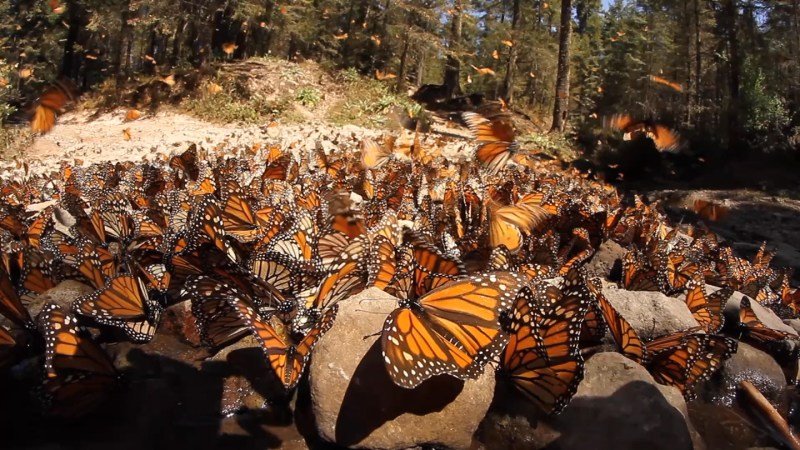
Millions Embark on an Epic Trek Each Year (Image Credits: Sciencenews.org)
Mexico – Researchers warn that shifting milkweed habitats could disrupt the synchronized annual journey of millions of monarch butterflies from North America to central mountain forests.
Millions Embark on an Epic Trek Each Year
Every fall, vast numbers of monarch butterflies leave breeding grounds in Canada and the United States for overwintering sites in Mexico’s central mountains. These insects cover thousands of kilometers in a feat of navigation that spans generations.[1]
The return trip northward occurs over multiple generations as spring warms the continent. Monarch caterpillars rely exclusively on milkweed plants for food and egg-laying sites. This dependence ties their survival to the plant’s availability along the route. Populations have plummeted more than 80 percent since the 1990s. Numbers once approached 700 million individuals at Mexican sites. Factors like habitat loss and weather extremes compound the challenges.
New Models Reveal Southern Habitat Shifts
Biologists at the National Autonomous University of Mexico analyzed climate data through computer simulations. They factored in temperature, precipitation, and biological needs to map future milkweed suitability.[1] Current suitable habitat spans about 19,500 square kilometers. Projections show a drop to roughly 8,000 square kilometers by 2070. Much of the viable area would move south of established overwintering zones.
These changes stem from warming trends altering conditions in mountainous central regions. Milkweed growth patterns would follow, pulling potential sites into lower elevations.
Routes at Risk of Breaking Apart
A southward push in habitats could lengthen migration distances for northern-bound butterflies. Greater energy demands might exhaust some before they complete the journey. Fractured routes could emerge as pockets of suitable areas appear disconnected from traditional paths. Citizen scientists already note monarchs lingering in northeastern and central Mexico.
Smaller wing sizes in these stay-behinds signal non-migratory traits, similar to populations in Chile, New Zealand, and Europe. Carolina Ureta, one of the study’s authors, stated, “In this case, the species is not in danger because of climate change, but the migration might be.”[1]
Broader Threats Compound the Pressure
Monarchs face multiple hurdles beyond climate shifts. Droughts stunt milkweed growth across breeding areas. Deforestation erodes overwintering forests.
- Loss of milkweed in the U.S. and Canada limits reproduction.
- Storms have wiped out large portions of clustered butterflies in past winters.
- Land use changes fragment nectar sources needed for adult fueling.
- Non-native tropical milkweed may disrupt reproductive cues.
- Predators and pesticides add to mortality risks.
Climate models also predict stress on oyamel fir groves from heat and drought. Víctor Sánchez-Cordero, a co-author, observed that not all monarch populations migrate globally, hinting at adaptive potential.
| Aspect | Current | By 2070 Projection |
|---|---|---|
| Suitable Habitat (sq km) | 19,500 | 8,000 |
| Shift Direction | Central mountains | Southward |
| Population Trend | >80% decline since 1990s | Risk to migration continuity |
Key Takeaways
- Milkweed habitat contraction threatens route synchronization.
- Some monarchs may evolve resident behaviors.
- Monitoring wing morphology could track changes.
The iconic mass arrival in Mexico’s forests might evolve into scattered groups or shorter travels. Conservation demands habitat restoration and climate mitigation. What do you think about these shifts? Tell us in the comments.