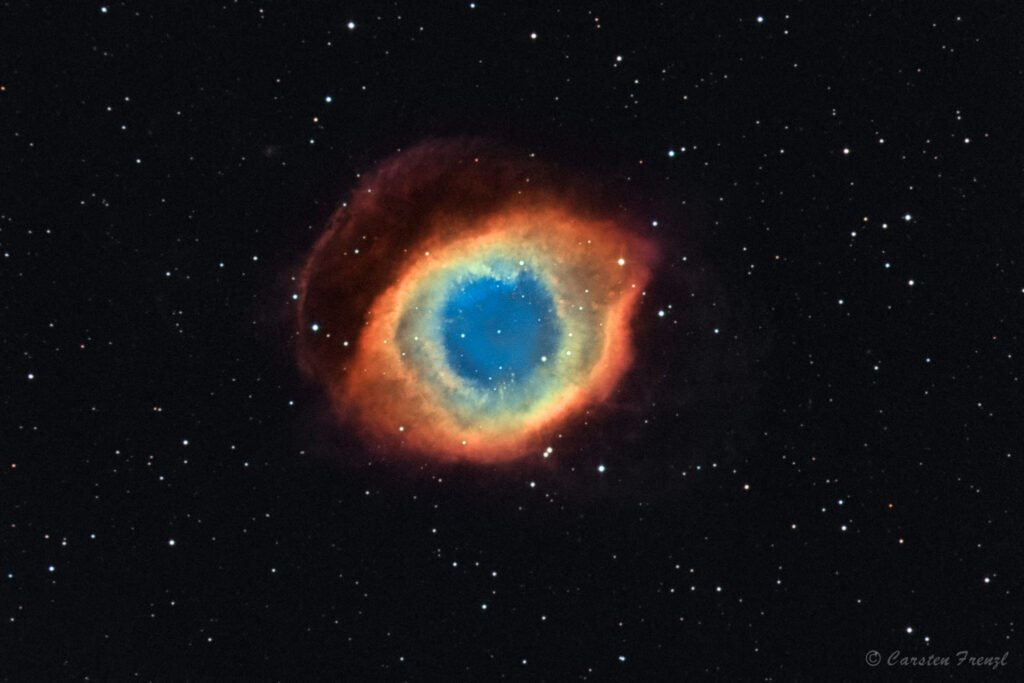
In an astonishing astronomical breakthrough, scientists have observed two massive collisions between rocky bodies orbiting a nearby star dubbed the “Eye of Sauron”, located about 25 light-years from Earth in the constellation Piscis Austrinus. These events—far larger than typical asteroid impacts—sent shimmering clouds of debris into space and were captured through years of telescopic observations, offering an unprecedented real-time view of dramatic processes that shaped planetary systems.
The discovery challenges conventional assumptions about how often such catastrophic collisions occur and reshapes astronomers’ understanding of how planetary building blocks interact in debris-rich stellar environments. Because these rare phenomena happened within only a couple of decades, researchers are rethinking debris disk dynamics and what signals should truly be interpreted as exoplanets as opposed to ephemeral dust clouds.
A Star with a Fiery Moniker
The star at the center of this celestial drama is Fomalhaut, a bright, nearby star known for its striking ring of dust and gas that gives it an eerie resemblance to the Eye of Sauron from The Lord of the Rings. Its distinctive appearance has long fascinated both astronomers and space enthusiasts alike.
Fomalhaut’s debris disk acts like a cosmic racetrack where numerous small rocky bodies—planetesimals—zip around the star. Under normal circumstances, collisions among these objects are exceedingly rare, occurring perhaps once every 100,000 years. Yet the recent observations recorded two such colossal collisions within just 20 years, prompting scientists to probe deeper into this system’s unusual dynamics.
Witnessing Real-Time Collisions
The first collision, labeled Fomalhaut cs1, was spotted when a bright object was initially mistaken for an exoplanet. Over time, researchers noticed that this object behaved unlike a true planet—its light faded and its motion didn’t follow typical orbital paths. Eventually, it disappeared entirely, revealing itself not as a planet but as a cloud of debris from a massive smash-up of two planetesimals roughly 60 kilometers across.
Years later, a second collision, cs2, appeared in the same system, exhibiting similar explosive characteristics and conforming to predictions made by theoretical models that suggested such impacts, while rare, could temporarily light up a star’s debris disk. Detecting both events in close succession has offered scientists an extraordinary and rare opportunity to study these violent processes as they unfold.
Debris Disks and Mistaken Planets
The Fomalhaut system has historically been a source of debate among astronomers. In the early 2000s, a supposed exoplanet known as Fomalhaut b was thought to be orbiting the star, but its odd behavior defied expectations. Later analysis revealed that this object, like cs1, was more likely a debris cloud from a cataclysmic collision than a bona fide planet.
This history underscores an emerging caution in exoplanet studies: not all bright, moving objects in debris disks are necessarily planets. Instead, transient dust clouds from collisions can mimic planetary signatures, potentially misleading even experienced observers.
Implications for Planetary Formation Theories
Traditional models of planetary formation and system evolution assume that debris collisions of this magnitude are exceptionally rare once a system matures. Fomalhaut’s double-collision record suggests that large impacts can continue well into a system’s life, reshaping debris and possibly influencing late stages of planet formation or disruption.
The sheer frequency of these events in such a short timespan hints at a population of hundreds of millions of big rocky bodies within the system’s dust belt, offering astronomers a vivid laboratory for testing and refining theories about how planets assemble and evolve.
What This Means for Future Observations
These unprecedented celestial collisions emphasize the importance of long-term monitoring and nuanced interpretation of space observations. As telescopes like NASA’s Hubble and the James Webb Space Telescope continue gathering data, researchers will be better equipped to distinguish between genuine exoplanets and the ephemeral afterglow of cosmic collisions.
Furthermore, the Fomalhaut system’s activity may inspire scientists to re-examine other nearby stars with debris disks, searching for similar collision signatures that could have been overlooked or misidentified in past surveys.
The dramatic events unfolding around the Eye of Sauron star remind us that the universe is far more dynamic—and sometimes chaotic—than our textbooks suggest. Observing two massive collisions in a single system in just two decades is a humbling revelation that challenges assumptions about how planetary systems age and evolve. Rather than rare anomalies, such events may be integral to the life cycle of debris disks and planetary formation itself. As our observational capabilities sharpen, we should expect more surprises that force us to revise longstanding theories and embrace the unpredictable nature of the cosmos. The Fomalhaut collisions don’t just illuminate a distant star system—they illuminate the evolving frontier of astronomical discovery.