A Historic Detection in X-rays (Image Credits: Cdn.mos.cms.futurecdn.net)
Astronomers captured the inaugural clear X-ray image of a vast bubble surrounding a youthful star resembling the Sun, offering fresh insights into stellar winds and early cosmic environments.
A Historic Detection in X-rays
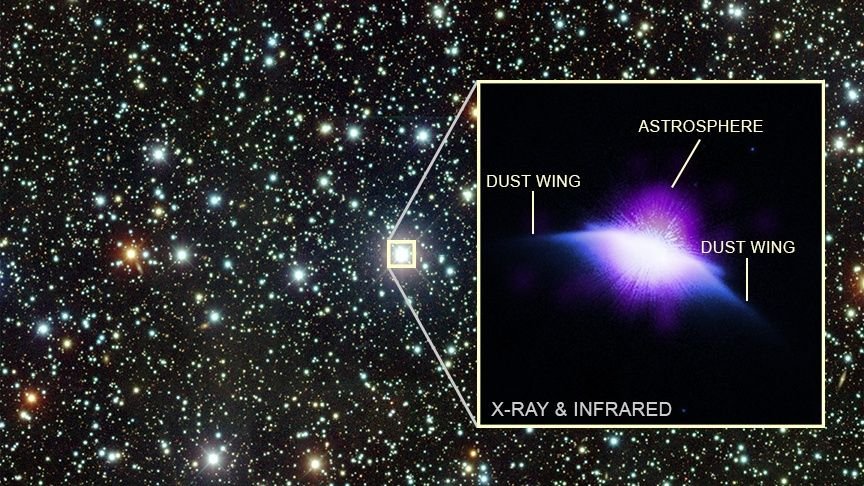
NASA’s Chandra X-ray Observatory revealed an astrosphere around the star HD 61005, marking the first such structure imaged around a Sun-like star.[1][2]
This wind-blown bubble, filled with hot gas, forms as powerful stellar winds from the star’s surface collide with surrounding cooler interstellar material. The discovery stemmed from extended observations that detected extended X-ray emissions rather than a mere point source from the star itself. Previous brief scans in 2014 hinted at X-ray activity, but deeper data from nearly 19 hours in 2021 confirmed the bubble’s presence. Chandra’s high-resolution imaging proved essential in this breakthrough, which astronomers had pursued since the 1990s.
Profile of the ‘Moth’ Star HD 61005
HD 61005 lies approximately 120 light-years from Earth and shares the Sun’s mass and surface temperature, yet it remains a cosmic adolescent at about 100 million years old – compared to the Sun’s 5 billion years.[1]
The star earned the nickname “Moth” from infrared observations showing wing-like dust patterns trailing behind it, remnants of its formation disk similar to the Kuiper Belt in our system. Its stellar winds blow three times faster and prove 25 times denser than the Sun’s current output, inflating the astrosphere to a diameter roughly 200 times the Earth-Sun distance. The surrounding interstellar medium stands a thousand times denser than near our Sun, intensifying interactions that generate detectable X-rays.
Parallels to Our Sun’s Heliosphere
The astrosphere mirrors the Sun’s heliosphere, which envelops our solar system and shields planets from galactic cosmic rays. Carey Lisse of Johns Hopkins University, lead author of the study published in the Astrophysical Journal, stated: “We have been studying our Sun’s astrosphere for decades, but we can’t see it from the outside. This new Chandra result about a similar star’s astrosphere teaches us about the shape of the Sun’s, and how it has changed over billions of years as the Sun evolves and moves through the galaxy.”[1]
Scott Wolk of the Center for Astrophysics added: “This image of the astrosphere around HD 61005 gives us important information about what the Sun’s wind may have been like early in its evolution.”[1] Such observations illuminate conditions during the Sun’s formative phase, when denser winds likely sculpted the early solar neighborhood and influenced planet formation.
Technical Feats and Future Horizons
Chandra led the effort, supplemented by Hubble Space Telescope infrared data and optical images from Chile’s Cerro Tololo Inter-American Observatory. These combined views highlighted the star’s central X-ray glow amid dusty wings.
- Observation dates: February 23 and 25, 2021.
- Total exposure: 18 hours and 42 minutes using Chandra’s ACIS instrument.
- Interstellar density: 1,000 times greater than local space.
- Wind strength: 3x speed, 25x density versus modern Sun.
The findings underscore Chandra’s role in probing faint emissions from distant stellar phenomena. They also prompt questions about how varying galactic densities affect stellar bubbles over time.
Key Takeaways
- First X-ray astrosphere around a Sun-like star provides a proxy for the young Sun.
- HD 61005’s bubble spans 200 AU, driven by intense early-stage winds.
- Insights into heliosphere evolution and cosmic ray protection.
This pioneering image not only rewrites our view of stellar youth but also deepens appreciation for the dynamic forces that shaped our own solar system. What aspects of this discovery intrigue you most? Share in the comments below.