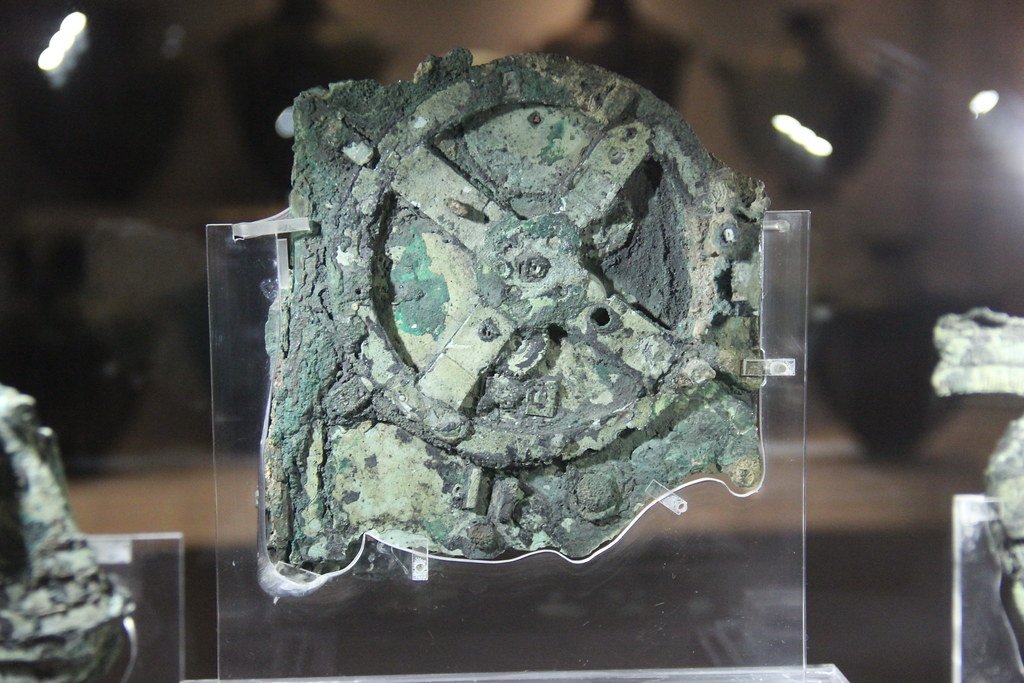
A Relic of Remarkable Engineering (Image Credits: Flickr)
Antikythera, Greece – Divers exploring a shipwreck in 1901 recovered a corroded bronze device that has puzzled scholars for generations. The Antikythera Mechanism, dating to the 1st century BCE, stands as the world’s oldest known analog computer, with intricate gears that modeled celestial movements. Researchers at the University of Glasgow recently applied techniques from gravitational wave detection to resolve a key uncertainty about its calendar ring.[1]
A Relic of Remarkable Engineering
The mechanism emerged from the Aegean Sea depths off the Greek island of Antikythera during a sponge-diving expedition. Experts quickly recognized its sophistication, as it featured more than 30 gears interlocked to perform complex calculations. Built during the Roman Republic era, when Greek ingenuity persisted under Roman oversight, the device showcased mechanical prowess unmatched until the 14th century.
Today, fragments of the Antikythera Mechanism reside in the National Archaeological Museum in Athens. Theories link its design to luminaries like Hipparchus or Archimedes, though its exact origins remain elusive. The artifact’s gears allowed predictions of astronomical events, including lunar phases and possibly eclipses, highlighting ancient mastery over mathematics and craftsmanship.[1]
The Enduring Puzzle of the Calendar Ring
One persistent question centered on the mechanism’s calendar ring, a circular dial marked by precisely spaced holes. Earlier analyses suggested it tracked days in a year, but the exact count eluded confirmation due to corrosion and fragmentation. Researchers debated whether it aligned with solar, lunar, or hybrid systems used in ancient cultures.
The ring’s design demanded exceptional precision, with potential hole spacings as fine as 0.028 millimeters. Such accuracy implied advanced tools and steady hands among its creators. Without definitive evidence, the ring’s purpose fueled decades of speculation in archaeological circles.[1]
Gravitational Wave Tools Enter the Fray
In 2024, University of Glasgow physicists Graham Woan and Joseph Bayley tackled the problem with unconventional methods. A colleague introduced them to data from YouTuber Chris Budiselic, whose Clickspring channel recreated the ring for a replica project. Woan and Bayley employed Bayesian statistical analysis alongside techniques honed for the Laser Interferometer Gravitational-Wave Observatory (LIGO), which detects spacetime ripples from cosmic events like black hole mergers.
These tools proved ideal for handling noisy, incomplete datasets from the ring’s 77.1-millimeter radius (with a tolerance of just one-third of a millimeter). The approach modeled possible hole configurations probabilistically, sifting through vast combinations to identify the most likely arrangement. Their findings appeared in The Horological Journal.[1]
Proof of a Lunar Calendar
The analysis pinpointed 354 to 355 holes on the ring, matching the Greek lunar calendar’s length. This system accounted for the moon’s synodic month of about 29.5 days over 12 cycles. The tight spacing and positioning ruled out longer solar calendars of 365 days, such as the Egyptian civil version.
| Calendar Type | Days per Year | Key Feature |
|---|---|---|
| Greek Lunar | 354-355 | Follows moon phases |
| Solar (Gregorian-like) | 365/366 | Earth’s orbit |
| Egyptian Civil | 365 | Fixed, no leap years |
Joseph Bayley noted, “Previous studies had suggested that the calendar ring was likely to have tracked the lunar calendar, but the dual techniques we’ve applied in this piece of work greatly increase the likelihood that this was the case.” The precision required for such minute holes underscored the skill of ancient Greek artisans.[1]
Echoes of Ancient Brilliance
Graham Woan reflected on the project’s origins: “A colleague pointed me to data acquired by YouTuber Chris Budiselic, who was looking to make a replica of the calendar ring and was investigating ways to determine just how many holes it contained. It struck me as an interesting problem, and one that I thought I might be able to solve in a different way during the Christmas holidays.” This blend of modern computation and historical data bridges millennia.
The breakthrough not only clarifies the mechanism’s function but also reveals the era’s technological depth. It invites fresh scrutiny of other artifacts through interdisciplinary lenses. Bayley added, “It’s given me a new appreciation for the Antikythera mechanism and the work and care that Greek craftspeople put into making it – the precision of the holes’ positioning would have required highly accurate measurement techniques and an incredibly steady hand to punch them.”[1]
- The calendar ring holds 354-355 holes, confirming lunar tracking.
- LIGO-inspired stats overcame data gaps from corrosion.
- Ancient Greeks achieved sub-millimeter precision in bronze work.
This resolution of the Antikythera Mechanism’s calendar mystery reaffirms humanity’s enduring quest to measure the heavens, from ancient gears to today’s observatories. As techniques evolve, more secrets from the past may surface. What do you think about this fusion of ancient and modern science? Tell us in the comments.