No Other Pulsar Matches This Stark Pattern (Image Credits: Upload.wikimedia.org)
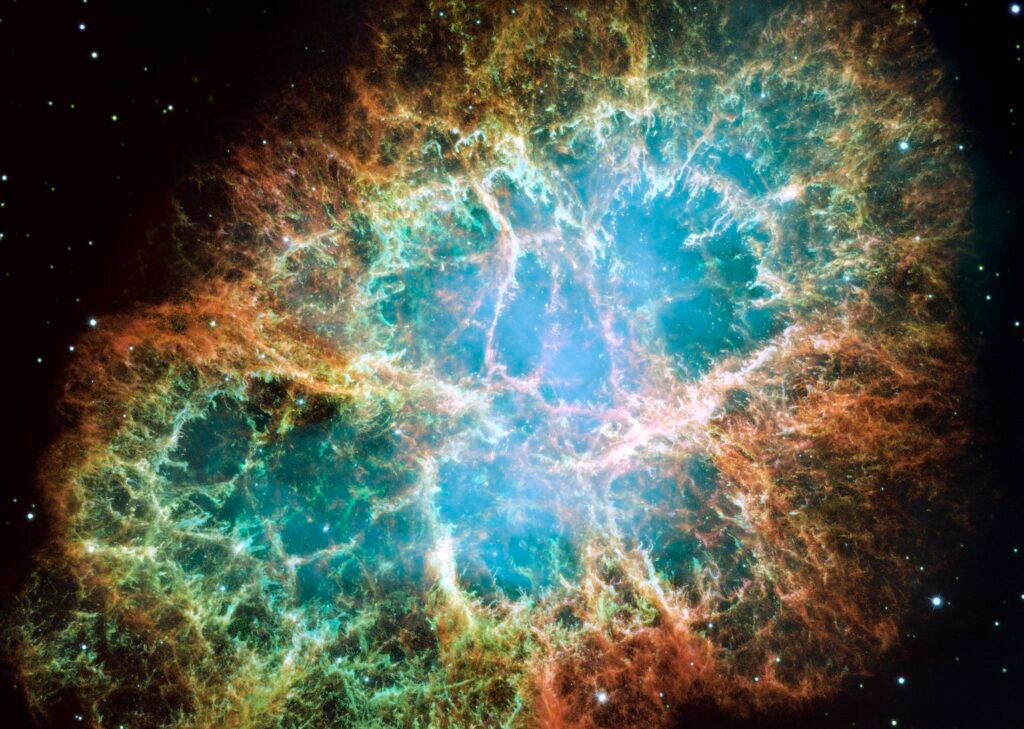
The Crab Pulsar, the rapidly spinning core of a supernova remnant first witnessed by astronomers in 1054, has long captivated observers with its unusual radio emissions. For over two decades, scientists scrutinized bright bands interspersed with total darkness in its high-frequency signals, a pattern resembling zebra stripes unlike anything seen in other pulsars. Recent theoretical work from the University of Kansas has pinpointed the cause: an intricate interplay between the pulsar’s magnetospheric plasma and the relentless pull of gravity.[1][2]
No Other Pulsar Matches This Stark Pattern
Researchers first noted the Crab Pulsar’s distinctive stripes around 20 years ago during radio observations of its high-frequency inter-pulse. These emissions featured discrete spectral bands where bright stripes stood out sharply against complete darkness, defying the broader, noisier profiles typical of most pulsars.[3]
The pulsar, located 6,500 light-years away in the Crab Nebula within the Milky Way’s Perseus Arm, spins 30 times per second. Its radio waves, captured by ground-based telescopes, revealed this unique striation that puzzled experts. No comparable pattern appeared in surveys of thousands of other pulsars, marking the Crab as an outlier in extreme astrophysics.[1]
Plasma Acts as a Defocusing Lens
The dense plasma filling the pulsar’s magnetosphere plays a starring role in dispersing incoming radio waves. This charged particle environment functions like a defocusing lens, diffracting electromagnetic pulses and spreading light rays apart in a process akin to wave optics.[2]
Early models captured some striping through plasma diffraction alone, but they fell short on replicating the observed high contrast between bright and dark regions. “The plasma in the pulsar’s magnetosphere can be thought of as a lens – but a defocusing lens,” explained physicist Mikhail Medvedev of the University of Kansas.[1] This spreading effect set the stage, yet required a counterforce to forge the full pattern.
Gravity Steps In as the Focusing Counterpart
Gravity provides that essential balance, curving spacetime around the dense neutron star and acting as a focusing lens. Light rays bend inward along these warped paths, countering the plasma’s dispersive influence. Where the two effects precisely offset each other, radio waves travel along symmetric trajectories to Earth.[3]
Medvedev’s refined model treats the system as a natural interferometer. At least two such paths exist due to symmetry; signals arriving in phase amplify into bright bands, while out-of-phase arrivals cancel into darkness. “Gravity changes the shape of spacetime,” Medvedev noted. “Light doesn’t travel in a straight line in a gravitational field because space itself is curved.”[2] This superposition yields the zebra pattern’s hallmark contrast.
From Theory to Astrophysical Insights
The breakthrough builds on Medvedev’s 2024 analysis, which introduced plasma diffraction, now enhanced with gravitational lensing in a static approximation. The work appeared in the Journal of Plasma Physics (full paper; preprint at arXiv:2602.16955). He presented findings at the American Physical Society’s 2026 Global Physics Summit in Denver.[1]
- Plasma diffraction spreads waves, creating potential for interference.
- Gravitational lensing focuses them back, enabling precise path alignment.
- Symmetric paths form an interferometer, producing high-contrast stripes.
- Unlike black hole lensing, this marks the first observed plasma-gravity synergy.
- Future tweaks may incorporate the pulsar’s rotation for finer accuracy.
Key features of typical pulsar emissions contrast sharply with the Crab’s:
| Feature | Typical Pulsars | Crab Pulsar |
|---|---|---|
| Spectral Profile | Broad and noisy | Discrete bands |
| Stripe Contrast | Low | High (complete darkness) |
| Pattern Visibility | Rare | Prominent in inter-pulse |
Unlocking Doors to Neutron Star Secrets
This explanation not only resolves a long-standing enigma but also opens avenues for probing neutron star environments. Scientists anticipate using the model to map plasma distributions and even interior structures through gravitational signatures. It stands as a benchmark for pulsar simulations and theories of rotating massive objects.[3]
Key Takeaways:
- The Crab Pulsar’s stripes arise from plasma defocusing and gravity focusing in interference.
- No other pulsar exhibits this pattern, highlighting its uniqueness.
- The model refines prior work, offering tools for future neutron star studies.
As telescopes continue to monitor the Crab Pulsar, this cosmic interplay reminds us how fundamental forces sculpt the universe’s most extreme phenomena. What do you think about this elegant solution to a stellar riddle? Tell us in the comments.