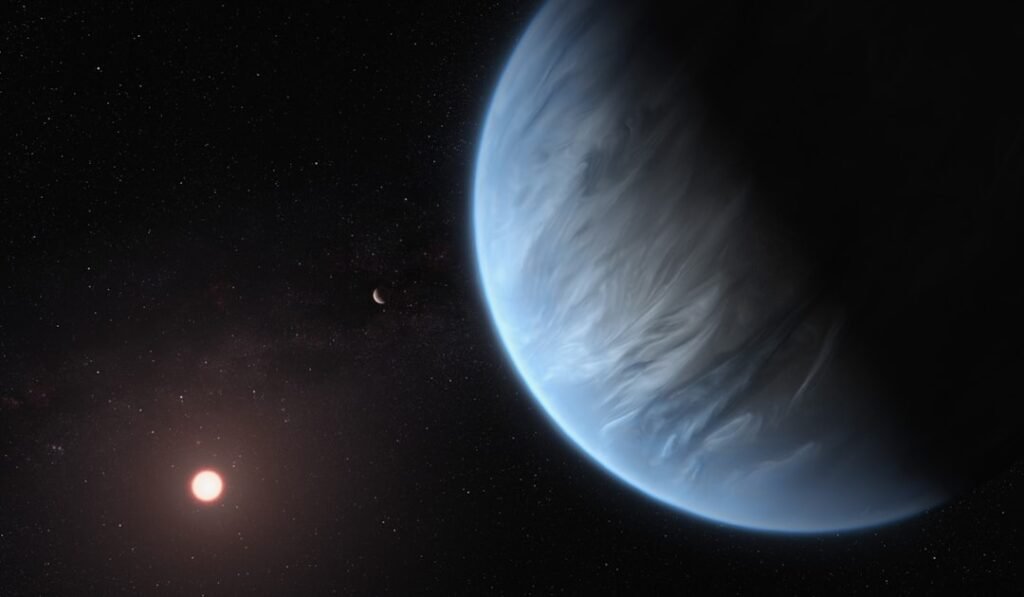

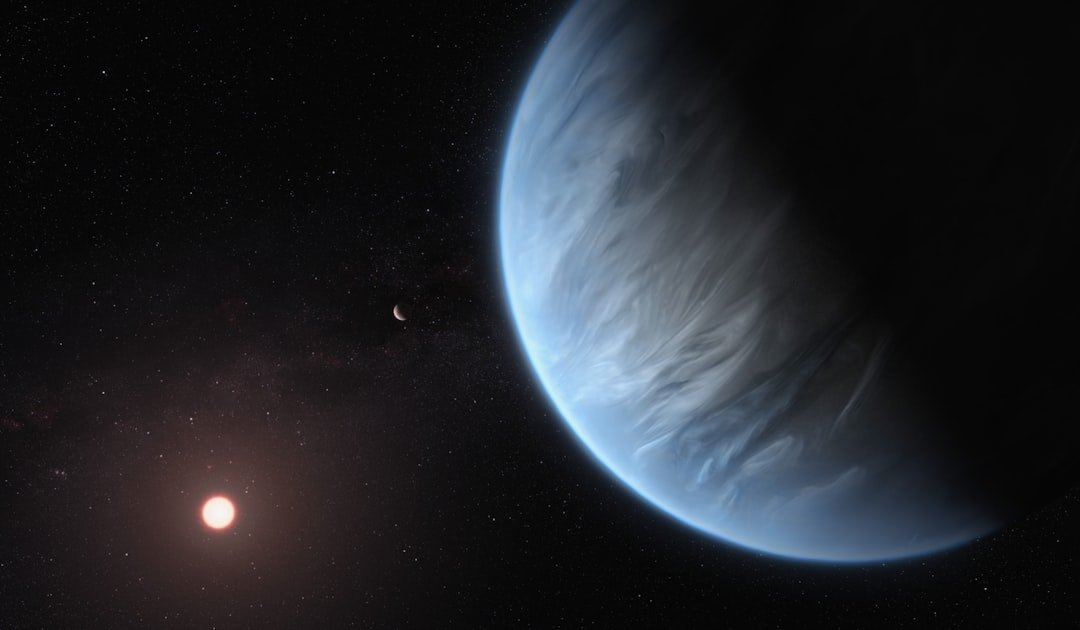
A Rocky Planet in the Wrong Place (Image Credits: Unsplash)
Astronomers announced the detection of a four-planet system around the red dwarf star LHS 1903 that features an unprecedented arrangement of worlds, prompting a reevaluation of how planetary systems assemble.[1][2]
A Rocky Planet in the Wrong Place
Researchers expected the familiar pattern of small rocky worlds hugging their star, followed by massive gas giants farther out. Instead, the LHS 1903 system delivered a shock: a rocky planet innermost, then two gas giants, capped by yet another rocky world at the edge.[1]
Thomas Wilson, lead author from the University of Warwick, described it starkly: “That makes this an inside-out system, with a planet order of rocky-gaseous-gaseous-and then rocky again.”[1] The outermost planet, dubbed LHS 1903 e, spans about 1.7 times Earth’s radius and resembles a super-Earth in density and makeup. This configuration defies predictions, as rocky bodies rarely materialize so distant from their host star.[2]
LHS 1903 itself, a cool and dim M-dwarf red dwarf located roughly 116 light-years away, hosts this anomaly. The star’s faint glow made precise observations challenging, yet instruments pierced the data to expose the surprise.[2]
Unraveling the Detection Story
NASA’s Transiting Exoplanet Survey Satellite first spotted signs of three planets transiting the star, dimming its light periodically. Ground-based telescopes worldwide refined those signals, classifying the inner rocky world and the pair of gas giants.[2]
The European Space Agency’s Cheops satellite provided the breakthrough. Closer scrutiny of its light curves revealed a fourth, subtler dip – the outermost rocky planet. Maximilian Günther, Cheops project scientist, noted that such clues align perfectly with the mission’s goal of probing planetary mysteries.[1] The team published their analysis in Science on February 12, 2026.[2]
- Innermost: Rocky planet, close-in orbit.
- Second: Gas giant.
- Third: Gas giant.
- Outermost (LHS 1903 e): Rocky super-Earth, farthest out.
Shattering Standard Formation Models
Standard theory holds that planets coalesce simultaneously within a protoplanetary disk of gas and dust. Intense heat near the star strips volatiles from inner cores, yielding rockies, while cooler outer zones allow gas giants to balloon.[3]
Yet LHS 1903 upends this. The outer rocky planet likely formed later, after the disk’s gas depleted, leaving scant material for atmospheres. Wilson explained: “By the time this outer planet formed, the system may have already run out of gas… It seems that we have found first evidence for a planet which formed in what we call a gas-depleted environment.”[1] Sequential formation, inner to outer, emerges as a viable alternative, first proposed a decade ago but now bolstered by data.
Isabel Rebollido of ESA observed: “Historically, our planet formation theories are based on what we see and know about our Solar System. As we are seeing more and more different exoplanet systems, we are starting to revisit these theories.”[4]
Implications for Cosmic Diversity
This discovery underscores the variety beyond our Solar System. Over 6,000 exoplanets cataloged since the 1990s reveal no universal blueprint. Red dwarfs, the galaxy’s most common stars, may favor such quirks, informing models for small-planet evolution.[4]
LHS 1903 e intrigues for potential atmospheres cool enough for water condensation, per experts like Heather Knutson of Caltech. Future scrutiny via the James Webb Space Telescope could unveil compositions and habitability hints.[2]
Key Takeaways
- The LHS 1903 system sports a rocky-gas-gas-rocky lineup, unseen before.
- Cheops confirmed the outer rocky world in a gas-starved disk.
- Sequential formation challenges disk-based simultaneous models.
As telescopes sharpen their gaze, oddballs like LHS 1903 remind scientists that our Solar System might be the outlier. This inside-out arrangement signals a broader cosmic playbook, urging bolder theories. What do you think about this planetary puzzle? Tell us in the comments.