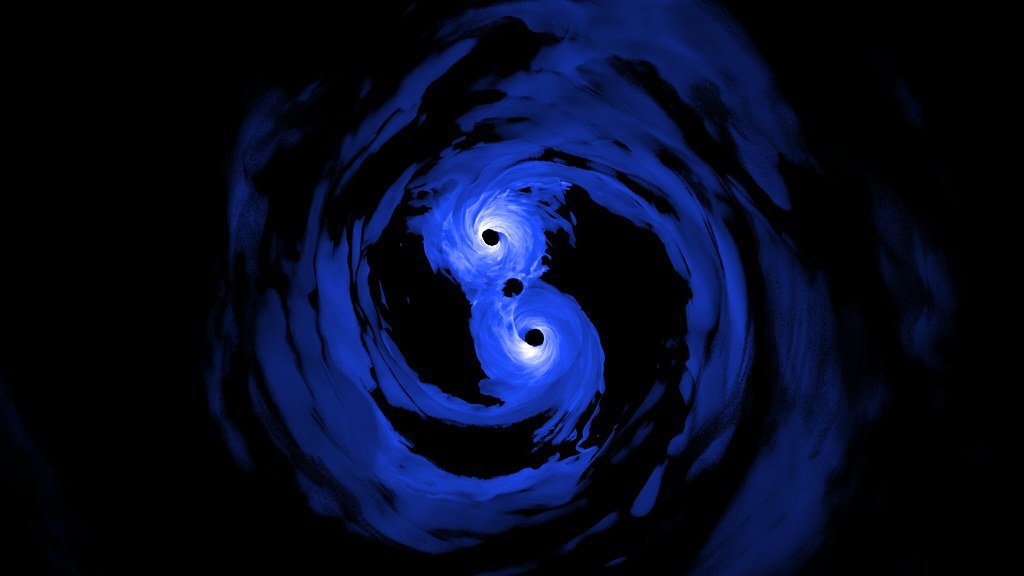
Cosmic Candidates Emerge from Pulsar Data (Image Credits: Flickr)
New Haven, Connecticut – Astrophysicists from Yale University and global partners developed a detection system that leverages gravitational waves to pinpoint supermassive black hole binaries scattered across the cosmos.[1][2]
Cosmic Candidates Emerge from Pulsar Data
Two promising black hole binary candidates surfaced in recent analysis, earning evocative names inspired by literature and teamwork. Rohan, designated SDSS J1536+0411, honors Yale student Rohan Shivakumar, who first scrutinized the signal. Gondor, or SDSS J0729+4008, nods to J.R.R. Tolkien’s realm where beacons summoned allies – a fitting metaphor for these gravitational signals.[3]
The North American Nanohertz Observatory for Gravitational Waves (NANOGrav) team identified these through targeted searches in the NANOGrav 15-year dataset. Researchers examined data from 68 pulsars, the spinning remnants of exploded stars that beam precise radio pulses. Subtle timing disruptions in these pulses hinted at passing gravitational waves. Although not confirmed detections, the candidates set benchmarks for future protocols.[1]
Quasars as Cosmic Lighthouses
Quasars, brilliant beacons powered by matter spiraling into black holes, served as prime search targets. Prior theory from Yale’s Chiara Mingarelli indicated mergers occur five times more often in quasar-hosting galaxies. The team focused on 114 active galactic nuclei, regions where black holes actively consume surrounding material.
This strategy combined gravitational wave background measurements with quasar brightness variations. Electromagnetic data fixed potential wave frequencies, sky positions, and distances, sharpening upper limits on wave strains by a factor of about two compared to all-sky scans. Bayesian analysis disfavored noise-only models for the top candidates, though follow-up tests aligned them with statistical fluctuations.[3]
Evolving from Background Buzz to Pinpoint Signals
NANOGrav built this system on its 2023 breakthrough: the first evidence of a low-frequency gravitational wave background. That hum arose from countless distant supermassive black hole pairs inching toward collision. Now, the protocol shifts to isolating individual “continuous waves” amid the chorus.
Pulsars act as galactic clocks, their millisecond rotations yielding timing precision to nanoseconds. Gravitational waves stretch and squeeze space-time, delaying pulses in correlated patterns across the array. The new framework tests for these signatures in targeted directions, paving the way for multimessenger astronomy.[2]
Charting a New Era in Astrophysics
Chiara Mingarelli, Yale assistant professor of physics and study lead author, highlighted the advance. “Our finding provides the scientific community with the first concrete benchmarks for developing and testing detection protocols for individual, continuous gravitational wave sources,” she stated. The work appeared in The Astrophysical Journal Letters.[1]
A handful of verified binaries could anchor a universe-spanning map, akin to how X-rays and radio waves revolutionized earlier astronomy. Yale contributors included Priyamvada Natarajan, Paolo Coppi, and students like Forrest Hutchison and Bjorn Larsen. NANOGrav plans ongoing hunts, promising insights into galaxy evolution and black hole growth.
Key Takeaways
- Targeted searches in 114 quasar regions yielded two top candidates, Rohan and Gondor, improving strain limits by a factor of two.
- Black hole mergers prove five times likelier near quasars, guiding efficient pulsar timing analysis.
- The protocol offers a roadmap from gravitational wave background to individual source localization.
This detection system heralds a transformative map of cosmic mergers, illuminating fundamental physics. What implications do you see for future gravitational wave hunts? Share your thoughts in the comments.