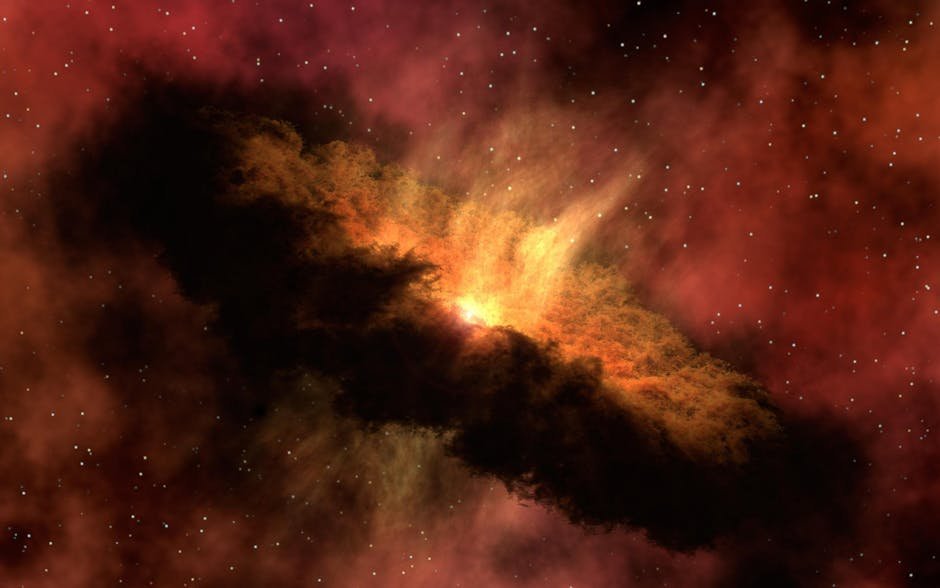
A Serendipitous Detection Halfway Across the Cosmos (Image Credits: Pexels)
MeerKAT telescope, South Africa – Astronomers have detected the most distant and luminous natural microwave laser in the known universe, originating from a violent collision between galaxies more than eight billion light-years away.[1][2] The signal, captured by South Africa’s powerful MeerKAT radio telescope, reveals a phenomenon from when the universe was less than half its current age. This discovery marks a milestone in radio astronomy, offering fresh insights into cosmic evolution during a formative era.[3]
A Serendipitous Detection Halfway Across the Cosmos
The breakthrough came through meticulous analysis of MeerKAT data, where researchers identified an intense radio emission at a wavelength of about 18 centimeters.[4] Led by Dr. Thato Manamela from the University of Pretoria, the team processed terabytes of observations using advanced algorithms and scalable computing infrastructure. This effort uncovered the source in HATLAS J142935.3–002836, a system previously noted in surveys but now confirmed as extraordinary.
“This system is truly extraordinary,” Manamela stated. “We are seeing the radio equivalent of a laser halfway across the universe.”[2] The light from this event traveled 7.82 billion light-years to reach Earth, shattering the prior distance record of five billion light-years for similar emissions.[1] Such detections push the boundaries of what telescopes like MeerKAT can achieve ahead of larger projects.
Unpacking the Gigamaser Phenomenon
A gigamaser represents an amplified form of a maser, where “m” stands for microwave and “giga” denotes its billion-fold greater luminosity compared to typical examples.[5] In this case, hydroxyl molecules in dense gas clouds become excited, emitting coherent radio waves through stimulated emission. The process mirrors how lasers work but operates in the microwave spectrum, producing a focused beam visible across vast distances.
Unlike ordinary masers found in our Milky Way, gigamasers thrive in extreme environments. They demand massive gas reservoirs and intense energy inputs, conditions rare beyond nearby galaxies until now. This specimen’s power earned it the “gigalaser” moniker, highlighting its unprecedented intensity.[3]
Galaxy Collisions Fuel the Cosmic Fireworks
The host system consists of two gas-rich galaxies locked in a merger, a common but chaotic event in the early universe.[4] Gravitational forces compressed interstellar gas, triggering bursts of star formation and exciting hydroxyl molecules. Newborn stars bathed the region in photons, stimulating the maser action and amplifying the signal exponentially.
These mergers provide critical tracers for astronomers studying galaxy growth. They reveal how gas fuels supermassive black holes and starbursts, shaping cosmic structures over billions of years. Observations of this event, at redshift 1.027, peer back to a time of heightened activity.[1]
- Hydroxyl molecules compressed in colliding gas clouds.
- Stimulated emission produces coherent microwaves.
- Billions of times brighter than Milky Way masers.
- Powered by star formation in merger remnants.
- Signals outflows and black hole feeding in host galaxies.
Gravitational Lensing: Nature’s Cosmic Magnifier
A foreground galaxy fortuitously aligned with the distant source acted as a gravitational lens, bending spacetime per Einstein’s general relativity.[2] This effect magnified the faint radio waves, creating a partial Einstein ring and boosting the signal enough for detection. Without this natural telescope, the gigamaser might have remained hidden.
“Not only that, during its journey to Earth, the radio waves are further amplified by a perfectly aligned, yet unrelated foreground galaxy,” Manamela explained. “This galaxy acts as a lens, the way a water droplet on a window pane would.”[3] Such lensing events are rare but invaluable for probing the distant universe.
| Feature | This Gigamaser | Previous Record |
|---|---|---|
| Distance (light-years) | 7.82 billion | 5 billion |
| Luminosity Class | Gigamaser | Megamaser |
| Wavelength | ~18 cm | Similar |
Key Takeaways
- MeerKAT’s sensitivity enables first high-redshift gigamaser detection.
- Gravitational lensing unlocks faint cosmic signals.
- Future surveys could reveal thousands more, mapping early galaxy evolution.
This gigalaser not only sets new benchmarks but also heralds an era of systematic hunts for similar beacons, potentially revolutionizing our view of cosmic history. As Manamela noted, “This is just the beginning. We don’t want to find just one system – we want to find hundreds to thousands.”[5] What do you think this discovery reveals about the universe’s past? Tell us in the comments.