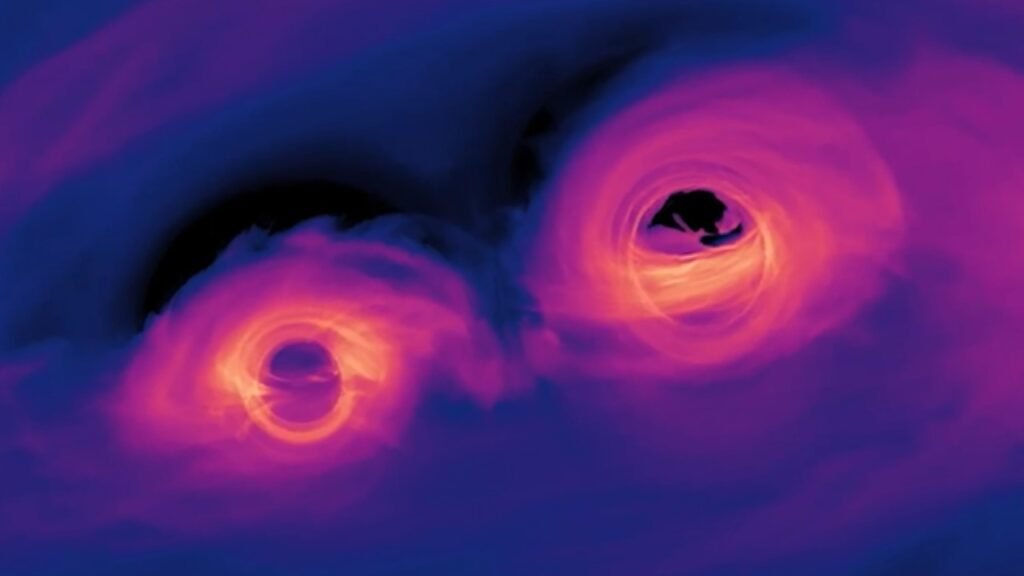

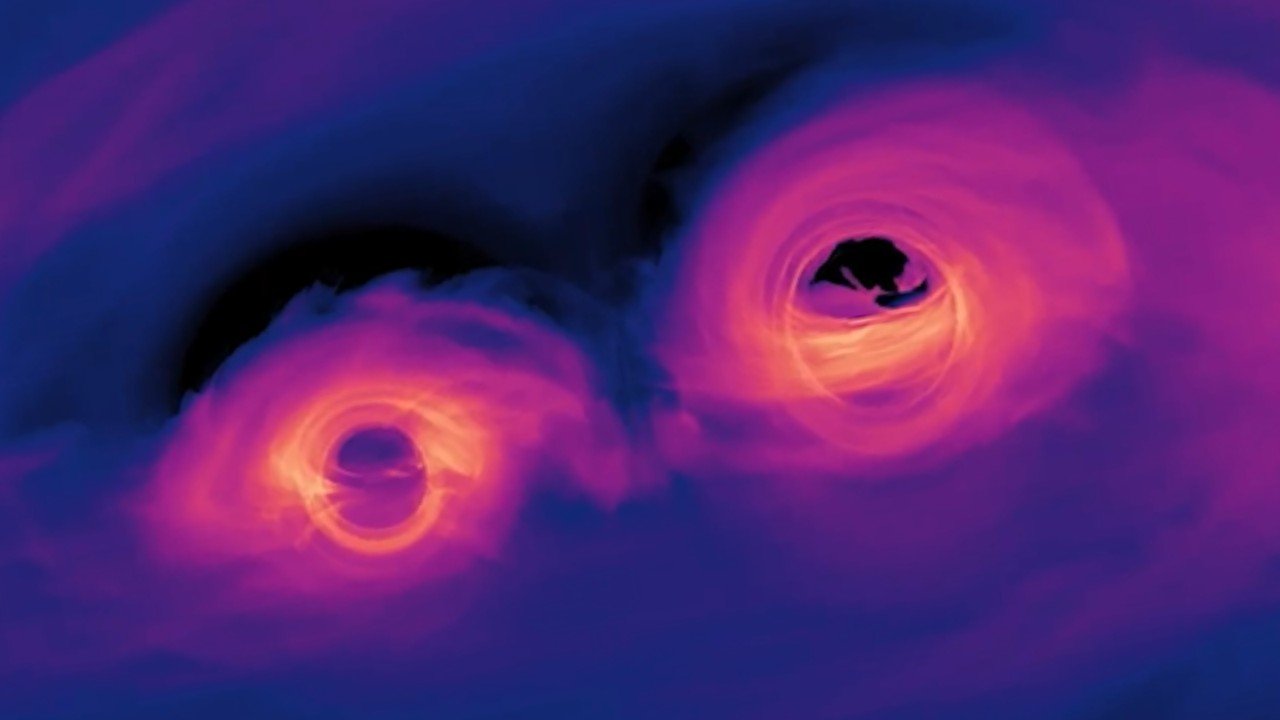
First Benchmarks for Hunting Cosmic Giants (Image Credits: Cdn.mos.cms.futurecdn.net)
Astrophysicists pinpointed two promising supermassive black hole pairs, dubbing them after realms from J.R.R. Tolkien’s epic fantasy saga.[1][2]
First Benchmarks for Hunting Cosmic Giants
Researchers delivered the initial solid standards for spotting individual gravitational waves from merging supermassive black holes.[1] The North American Nanohertz Observatory for Gravitational Waves (NANOGrav) tested a pioneering protocol that merges data on the gravitational wave background with fluctuations in quasar brightness. This approach targeted 114 active galactic nuclei, regions where black holes actively consume surrounding matter.
Earlier studies indicated such mergers occur five times more often in quasar-hosting galaxies. The effort built on NANOGrav’s 2023 revelation of a pervasive gravitational wave hum across the universe. Pulsar timing arrays played a crucial role, tracking precise radio pulses from neutron stars to detect subtle spacetime ripples.[1]
Unveiling Rohan and Gondor
SDSS J1536+0411, nicknamed Rohan, and SDSS J0729+4008, known as Gondor, emerged as top candidates from the search.[1] Yale graduate student Rohan Shivakumar first scrutinized the Rohan system, earning it his namesake. Gondor followed suit, evoking the moment in Tolkien’s tale when beacons summon allies across kingdoms.
These binaries represent potential continuous gravitational wave emitters amid the cosmic din. Confirmation would anchor maps of these elusive events. The discoveries motivate deeper observations in coming months. NANOGrav plans to refine locations and expand the catalog.[1]
Blending Science and Storytelling
Chiara Mingarelli, Yale assistant professor of physics and study lead author, explained the monikers blend homage and humor. “The names come from both people and pop culture,” she noted. “Rohan was first, for Rohan Shivakumar, the Yale student who first analyzed it, and Gondor was next, because, well – the beacons were lit!”[1]
This nod to “The Lord of the Rings” highlights how passion fuels discovery. Mingarelli’s team, including Yale astronomers Priyamvada Natarajan and Paolo Coppi, crafted an end-to-end framework. Their work appeared in the Astrophysical Journal Letters. Support came from the National Science Foundation and others. The protocol promises systematic hunts beyond these finds.[1]
Pathways to a Gravitational Wave Atlas
The protocol charts a course for broader detection efforts. Even a handful of verified sources could calibrate universe-spanning maps, akin to how radio astronomy reshaped views decades ago.
- Target quasar variability alongside wave backgrounds.
- Prioritize active galactic nuclei for efficiency.
- Leverage pulsar arrays for precision timing.
- Follow up promising signals with multi-wavelength data.
- Scale to international pulsar timing arrays.
Such maps would illuminate galaxy evolution, black hole growth, and merger rates. Mingarelli emphasized, “Our work has laid out a roadmap for a systemic supermassive black hole binary detection framework.”[1]
- NANOGrav’s method yields first benchmarks for individual black hole binary detection.
- Rohan and Gondor highlight quasars as merger hotspots.
- Future maps will transform gravitational wave astronomy.
These beacons signal a brighter future for probing the universe’s most massive mergers. What do you think of blending Tolkien with astrophysics? Tell us in the comments.