

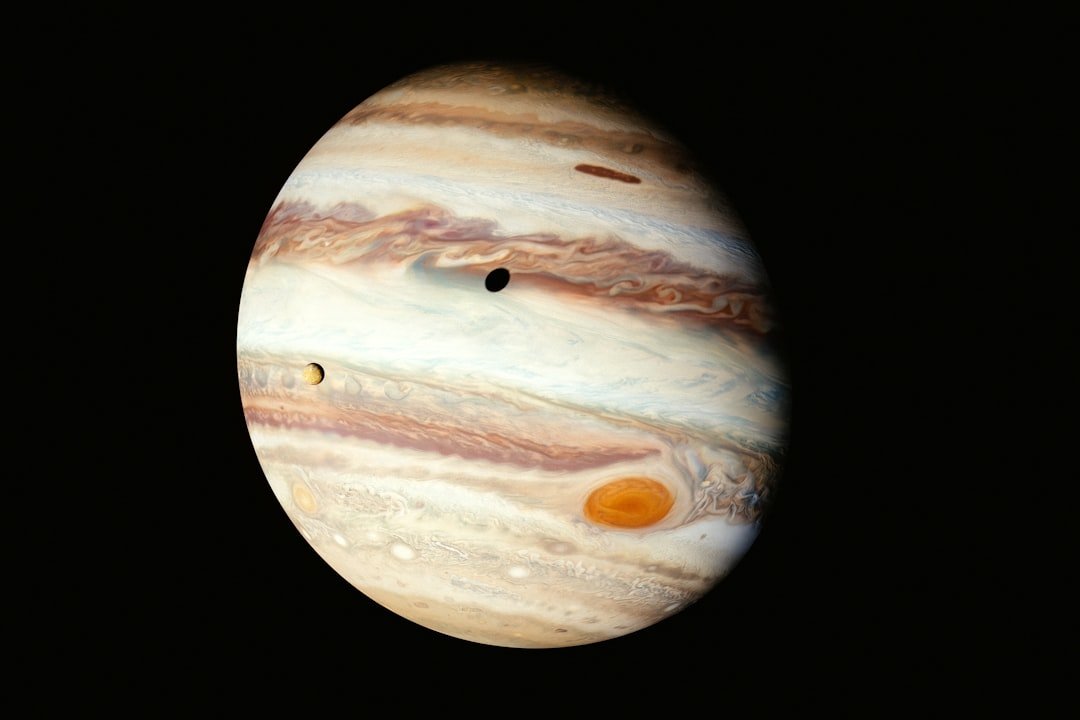
Surprise Additions to Jupiter’s Orbit (Image Credits: Unsplash)
Astronomers recently confirmed the existence of 15 additional moons circling Jupiter and Saturn, the solar system’s most prolific moon hosts. The Minor Planet Center made the announcement on March 16, 2026, updating the official tallies for these gas giants.[1][2] These faint satellites, long overlooked due to their dimness, highlight ongoing advances in telescope technology and data analysis techniques. The findings reinforce Saturn’s dominance in the moon count race while keeping Jupiter competitive.
Surprise Additions to Jupiter’s Orbit
Jupiter gained four new moons in the latest update, pushing its total to 101 confirmed satellites. The newly recognized objects carry provisional designations: S/2011 J 4, S/2011 J 5, S/2018 J 5, and S/2024 J 1.[1] Observations dating back to 2011 and as recent as 2024 confirmed their paths around the planet.
These moons measure roughly 2 to 3 kilometers across and shine at magnitudes between 25 and 27, rendering them invisible to most ground-based telescopes until now. Teams sifted through archival images and fresh data to track their motion against the starry backdrop. The discoveries appeared in Minor Planet Electronic Circulars MPEC 2026-F09 through F12.[2] Such irregular outer moons likely originated from captured asteroids disrupted by Jupiter’s immense gravity.
Saturn’s Moon Fleet Swells Dramatically
Saturn added 11 new irregular moons, elevating its count to 285 and solidifying its lead over Jupiter. The provisional names include S/2020 S 45 through S/2020 S 48 and S/2023 S 51 through S/2023 S 57.[1] A team led by Edward Ashton at the University of British Columbia identified this cluster by re-examining past observations.[3]
Like their Jovian counterparts, these moons span about 3 kilometers in diameter and orbit at vast distances from Saturn. From Earth, Saturn’s full moon array spans a patch of sky five times wider than our own Moon. Only 64 Saturnian moons bear proper names; the rest, too faint for routine naming, retain designations per International Astronomical Union guidelines.[1]
Advanced Tools Fuel the Moon Hunt
Improved observatories and computational power made these detections possible. The Vera C. Rubin Observatory, operational since June 2025, scans the entire visible sky repeatedly and flags moving objects through millions of alerts – 800,000 on February 24, 2026, alone.[1] Astronomers combined these real-time notices with historical data to confirm orbits.
Earlier this year, Saturn received 128 new moons in March 2025, part of a pattern where better instruments reveal ever-fainter satellites. The process involves stacking images to detect faint trails of motion amid stars. These efforts target outer, retrograde orbits prone to chaos from planetary interactions.
- Key detection steps: Archival image recovery from 2011–2024.
- Real-time alerts from Rubin Observatory.
- Orbital confirmation over multiple nights.
- Magnitude range: 25–27, size ~3 km.
- Focus on irregular, distant moons.
Planetary Moon Totals Compared
The latest finds underscore the gas giants’ moon disparities. Saturn’s rapid gains, including the recent 11 and prior 128, stem from dedicated surveys.
| Planet | Previous Total | New Additions | Current Total |
|---|---|---|---|
| Jupiter | 97 | 4 | 101 |
| Saturn | 274 | 11 | 285 |
This table reflects confirmed moons post-announcement.[1] Jupiter trails but benefits from similar hunting techniques. Future missions may refine these counts further.
Key Takeaways:
- Saturn now boasts 285 moons, far ahead of Jupiter’s 101.
- New moons are tiny (3 km), faint (mag 25–27), and orbit distantly.
- Discoveries rely on Rubin Observatory and data mining.
These revelations expand our view of solar system formation, where captured debris forms unstable outer moon groups. As surveys intensify, expect more such announcements. What surprises might the next scan reveal? Share your thoughts in the comments.