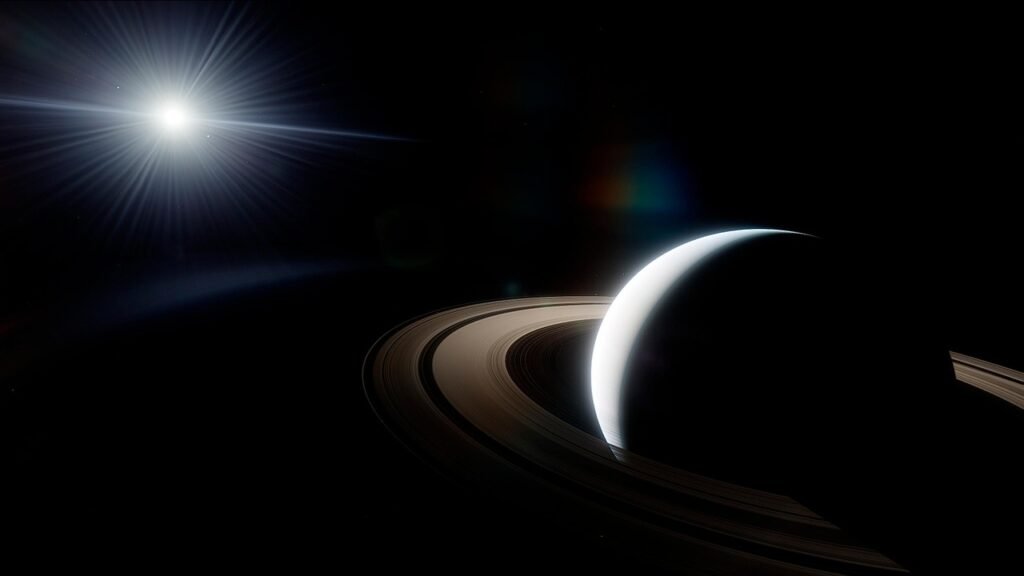


The Historic Detection Unfolds (Image Credits: Pixabay)
Astronomers have unlocked new details about a solitary world wandering the cosmos, far from any star’s embrace.
The Historic Detection Unfolds
Researchers captured a rare glimpse of a free-floating planet through a combination of ground telescopes and space instruments, marking the first direct measurement of such an object’s mass. This Saturn-mass world, detected via gravitational microlensing, revealed itself as it briefly bent the light of distant stars. The event, observed toward the Galactic bulge, allowed scientists to pinpoint the planet’s mass at roughly that of Saturn and its distance at about 10,000 light-years from Earth. Such precision had eluded previous studies, which identified only a few rogue planets without confirming their physical properties.
The breakthrough relied on data from the European Space Agency’s Gaia spacecraft alongside ground-based observatories. This synergy provided the parallax needed to calculate the planet’s position and size. Named OGLE-2024-BLG-0516, the planet drifts alone, ejected from its original system long ago. The discovery fills a gap in planetary science, often called the “Einstein desert,” where few objects of this mass range had been confirmed.
Unraveling the Mysteries of Free-Floating Worlds
Rogue planets like this one challenge traditional views of planetary formation. Most planets orbit stars, but these wanderers suggest violent histories in young star systems. Collisions, gravitational tugs from neighboring bodies, or instabilities during formation could hurl them into interstellar space. This Saturn-sized example, at about 22 percent the mass of Jupiter, hints at a population of gas giants adrift across the galaxy.
Previous detections relied on indirect methods, such as infrared glow from residual heat. Yet, without mass and distance data, their nature remained speculative. The new findings confirm that such planets exist in significant numbers, potentially outnumbering those bound to stars. Scientists now ponder how these loners survive the cold void, with atmospheres possibly retaining heat from formation or internal processes.
Techniques Behind the Triumph
Gravitational microlensing proved key, as the planet’s gravity acted like a lens, amplifying light from background stars. Ground telescopes first spotted the anomaly, but Gaia’s precise astrometry sealed the measurements. This dual approach overcame limitations of single-observatory efforts, which often left distances ambiguous.
The method’s success opens doors for routine characterization. Future events could reveal compositions, temperatures, or even moons orbiting these isolates. For now, the data underscores microlensing’s power in probing faint, distant objects.
Broader Implications for Cosmic Exploration
This detection signals a new era in exoplanet hunts. With only a handful of confirmed rogues so far, the galaxy likely harbors billions more. The findings illuminate ejection mechanisms, informing models of how solar systems evolve. They also bridge gaps in understanding planet formation, showing diverse outcomes beyond stable orbits.
Upcoming missions promise a surge in discoveries. The NASA Nancy Grace Roman Space Telescope, set for launch in 2027, will scan vast sky regions for microlensing signals. Paired with ground networks, it could catalog thousands of free-floaters, mapping their distribution and origins. Such insights might even reveal if life could arise on these cold nomads, warmed by internal heat.
Key aspects of rogue planet science include:
- Their prevalence: Potentially more common than star-bound planets, altering estimates of habitable worlds.
- Ejection causes: Dynamic interactions in dense clusters during early stellar evolution.
- Detection challenges: Faint signals require international collaboration for confirmation.
- Future impacts: Enhanced surveys could redefine the Milky Way’s planetary census.
- Scientific value: Tests of gravitational theories through precise lensing effects.
Key Takeaways
- This marks the inaugural mass measurement of a rogue planet, confirming its Saturn-like size.
- Joint observations bridged ground and space data for unprecedented accuracy.
- Expect a wave of similar finds with telescopes like Roman, reshaping planetary formation theories.
As astronomers peer deeper into the galaxy’s underbelly, this lone planet reminds us of the universe’s untamed diversity. What secrets might future rogues unveil about our cosmic neighborhood? Share your thoughts in the comments.