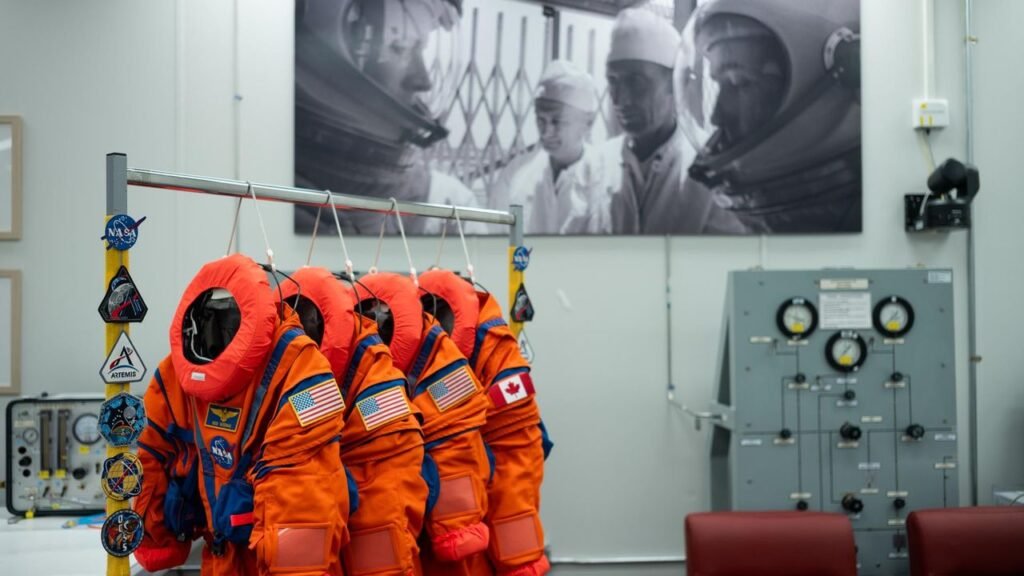


A Crew Poised for Lunar History (Image Credits: Cdn.mos.cms.futurecdn.net)
Kennedy Space Center, Florida – Four striking orange spacesuits prepared for NASA’s Artemis 2 crew now await their astronauts in a dedicated suit-up room at the agency’s Neil A. Armstrong Operations and Checkout Building.
A Crew Poised for Lunar History
The Artemis 2 mission marks the first crewed flight in NASA’s ambitious program to return humans to the vicinity of the moon after more than five decades. This 10-day journey will circle the moon without landing, serving as a critical test for systems bound for future surface missions.
Commander Reid Wiseman leads the team, joined by Pilot Victor Glover and Mission Specialist Christina Koch, all from NASA. Mission Specialist Jeremy Hansen represents the Canadian Space Agency, highlighting international collaboration in space exploration.
Designed for Orion’s Demands
These suits differ markedly from those used for moonwalks. Engineers tailored them specifically for operations inside the Orion spacecraft during launch, ascent, potential in-space emergencies, and reentry through Earth’s atmosphere.
The high-visibility orange color ensures crew members spot each other quickly in any scenario. Each suit integrates life-support systems to protect against cabin pressure loss, emphasizing reliability over lunar surface mobility.
- Protection during launch and ascent phases
- Support for in-space contingencies
- Safeguards for atmospheric reentry
- Compatibility with Orion’s oxygen and cooling interfaces
The Meticulous Suiting Process
Technicians guide astronauts through a precise sequence in the suit-up room. They assist each crew member into the garment, verifying fit and range of motion from the start.
Next comes securing gloves, helmets, and seals, followed by checks on every connection for airtight integrity. Teams test communications to confirm clear exchanges with fellow astronauts and ground control. Interfaces with the spacecraft receive final validation to guarantee seamless oxygen flow and thermal regulation.
This rigorous routine uncovers minor flaws before they escalate, much like preparations for the mission’s rocket components. Recent sessions captured the suits hanging in formation on January 17, 2026, ready for these final trials.
Stepping Stones to Sustainable Exploration
Artemis 2 calibrates technologies essential for Artemis 3, the program’s first lunar landing, and Artemis 4, which will advance sustainable presence on the moon. Success here builds confidence for crews tackling the lunar surface.
The United States last sent humans toward the moon during the Apollo era. Artemis represents a new chapter, blending proven engineering with innovations for long-term goals.
Key Takeaways
- Artemis 2 launches the first crewed Artemis flight, orbiting the moon in 10 days.
- Orange suits prioritize spacecraft operations, not surface EVAs.
- International crew underscores global partnerships in lunar return.
These spacesuits embody the precision defining NASA’s push back to the moon. As launch approaches, they promise a safe voyage that reignites human exploration beyond Earth orbit. What role do you see spacesuit technology playing in future missions? Share your thoughts in the comments.