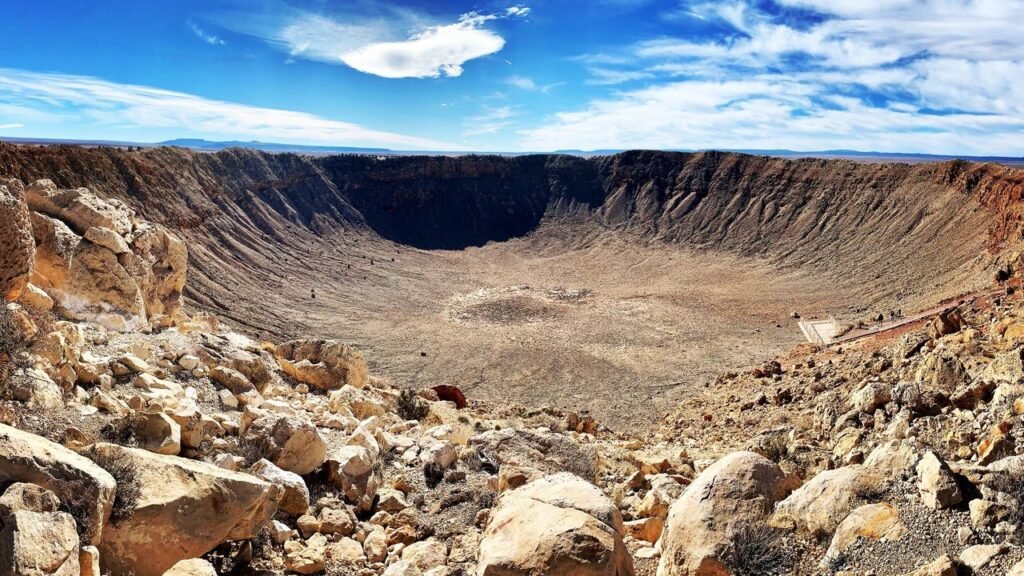

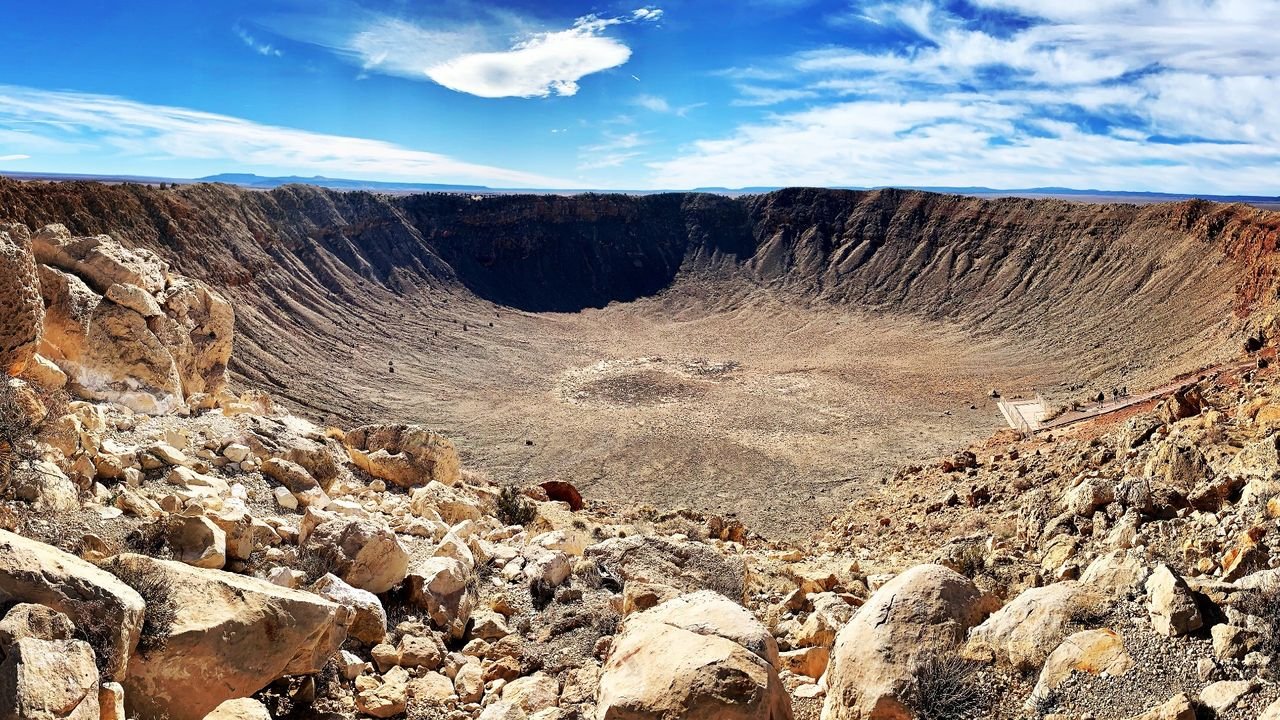
Earth’s Premier Impact Laboratory (Image Credits: Cdn.mos.cms.futurecdn.net)
Arizona – The vast bowl carved by a meteorite impact half a century of millennia ago stands as a vivid testament to the raw power of cosmic collisions.
Earth’s Premier Impact Laboratory
Researchers regard Meteor Crater, also known as Barringer Crater, as the most intact and accessible scar from a space rock strike on the planet.[1][2] Formed around 50,000 years ago, the site measures more than 4,000 feet across, reaches 700 feet deep, and spans a circumference of 2.4 miles.[1]
A nickel-iron meteorite, weighing roughly 300,000 tons, slammed into northern Arizona at 26,000 miles per hour. The explosion equaled 2.5 million tons of TNT – 150 times the yield of the Hiroshima bomb.[2] Dan Durda, a research scientist at the Southwest Research Institute, described it as “the best-preserved and exposed impact crater on Earth.”[1] He emphasized its value as “the perfect natural laboratory for impact crater studies,” where new insights emerge annually.
Pioneering Proof of Extraterrestrial Origins
Early 20th-century mining engineer Daniel Moreau Barringer championed the idea that the crater stemmed from a meteorite, challenging prevailing views of slow volcanic processes. Initial skepticism persisted until the 1960s, when geologist Eugene Shoemaker and colleagues identified shock-metamorphosed minerals like coesite and stishovite – hallmarks of hypervelocity impacts.[2]
These findings confirmed the site’s extraterrestrial cause and revolutionized planetary geology. Today, scientists rely on such features to verify around 200 confirmed impact structures worldwide.[1] The crater’s youth and minimal erosion preserve details of excavation, ejecta patterns, and subsurface shocks, offering unparalleled study opportunities.
Fueling Tomorrow’s Researchers
The Barringer Crater Company recently launched grants through the Barringer Family Fund, administered by the Meteoritical Society, to back students and early-career scientists probing terrestrial craters.[1] Christian Koeberl, chair of the company’s scientific advisory committee at the University of Vienna, highlighted the push to draw young talent into this vital field. Applications close April 1 each year.
These efforts underscore the crater’s role in decoding impacts’ roles in Earth’s evolution, from mass extinctions like the one 66 million years ago that doomed the dinosaurs to continent-shaping events.[1] Studies there reveal how brief, explosive events mimic nuclear blasts, producing unique mineral transformations and meteoritic traces.
Lessons for Planets Near and Far
Beyond Earth, Meteor Crater informs missions to the moon and Mars, where craters dominate landscapes. Its features mirror those on airless bodies, aiding interpretations of remote data. Geophysical surveys and geochemical analyses continue to uncover subsurface anomalies, linking impacts to biological upheavals and geological shifts.
- Preserved ejecta blankets reveal blast dynamics.
- Shattercones and planar features signal extreme pressures.
- Impact melts provide clues to meteorite composition.
- Reversed strata demonstrate explosive uplift.
- Minimal erosion exposes full crater morphology.
Key Takeaways
- Meteor Crater exemplifies hypervelocity impacts, with ongoing revelations every year.
- New grants empower the next generation of impact specialists.
- Its pristine state bridges Earth science and planetary exploration.
Meteor Crater endures not just as a geological marvel but as a dynamic hub for discovery, reminding us that ancient events still shape our scientific future. What secrets will it yield next?