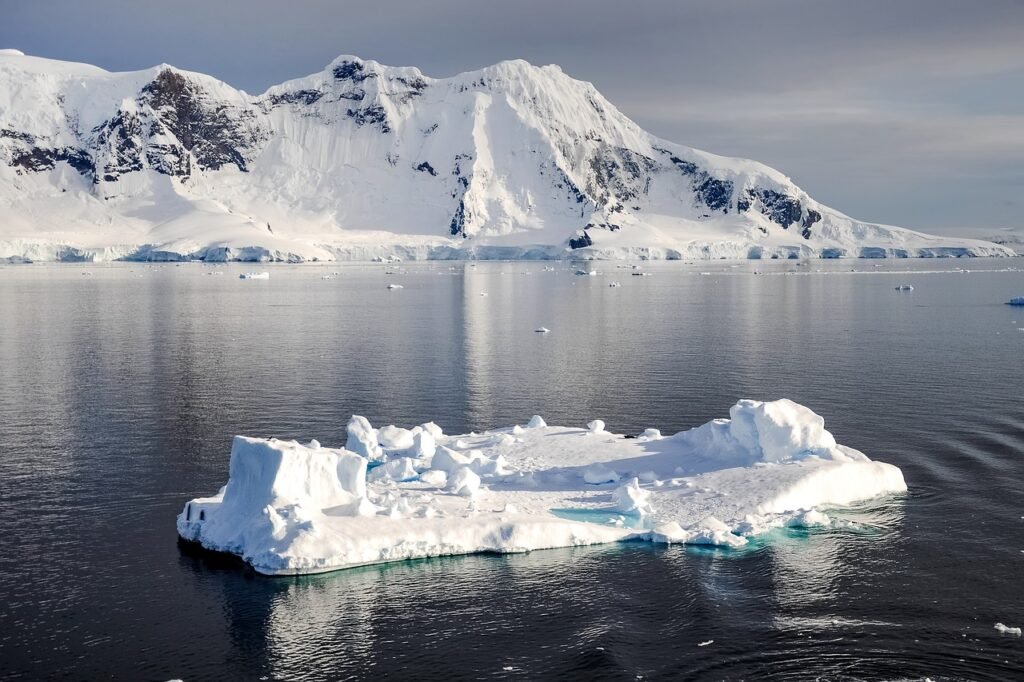

High Emissions Trigger Tipping Points (Image Credits: Pixabay)
Antarctic Peninsula – Fresh climate models project accelerating ice loss and ocean warming in the region unless global greenhouse gas emissions follow low pathways in the coming years.
High Emissions Trigger Tipping Points
Researchers outlined stark outcomes for the Antarctic Peninsula under a very high emissions scenario, corresponding to 4.4 degrees Celsius of global warming by 2100.[1][2] The area would warm by 6.1 degrees Celsius above pre-industrial levels, more than double the global average. Days above freezing would surge from 20 annually to nearly 48, extending melt seasons and shifting precipitation toward rain over snow.
Sea ice coverage could drop by 20 percent in winter, while Larsen C and Wilkins ice shelves face likely collapse by century’s end. Such losses would unleash faster glacier retreat, triggering marine ice sheet instability – a process experts describe as irreversible on human timescales. By 2300, contributions to global sea levels from Peninsula ice could reach 116 millimeters, plus or minus 67 millimeters.[3]
Low Emissions Offer Stability and Resilience
A low-emissions future, aligned with 1.8 degrees Celsius of global warming, presents a far milder picture. Peninsula temperatures would rise 2.3 degrees Celsius above pre-industrial baselines, adding just 0.55 degrees Celsius from current levels. Sea ice would shrink modestly, by less than 2 percent seasonally, preserving much of the present extent.
Land ice might even gain mass slightly, yielding a sea level equivalent of minus 8 millimeters by 2100 as accumulation outpaces melt. Ice shelves would endure with minimal firn depletion, and extreme events like ocean heat waves would persist at current intensities rather than intensify. Effective governance alongside these limits could bolster ecosystem resilience, researchers noted.
Divergent Paths Across Emission Scenarios
Medium-high emissions, tracking toward 3.6 degrees Celsius globally, fall between these extremes. Warming hits 5.2 degrees Celsius locally, doubling melt days to 39 per year and cutting sea ice by up to 13 percent in winter. Wilkins Ice Shelf shows vulnerability, but full collapses remain less certain than in the highest path.
| Scenario | Global Warming (2100) | Peninsula Warming | Days >0°C (Annual) | Sea Level Contribution (2100, mm) |
|---|---|---|---|---|
| Low (SSP1-2.6) | 1.8°C | +2.3°C | 21 | -7.8 ±11.8 |
| Medium-High (SSP3-7.0) | 3.6°C | +5.2°C | 39 | Sustained loss |
| Very High (SSP5-8.5) | 4.4°C | +6.1°C | 48 | +7.5 ±14.1 |
These projections, drawn from CMIP6 and ISMIP6 ensembles, underscore how decisions this decade shape long-term trajectories.[1]
Ecosystems and Global Repercussions
Warmer oceans would intrude via Circumpolar Deep Water, eroding shelves from below while surface melt ponds weaken them from above. Krill populations, vital for whales and penguins, would contract southward as sea ice dwindles and waters heat. Species like gentoo penguins and fur seals might thrive initially, but predators face starvation risks in high-emission worlds.
- Sea ice loss disrupts Antarctic Intermediate Water formation, amplifying global ocean warming.
- Atmospheric rivers and heat waves intensify, altering precipitation and boosting invasive species.
- By 2100, even low scenarios shift food webs, though higher paths devastate iconic wildlife.
- Changes ripple worldwide via sea level rise and circulation shifts.
“The future of the Peninsula depends on the choices made today,” lead author Bethan Davies stated. “Higher emissions scenarios will damage pristine systems [and] cause sustained, irreversible ice loss on human timescales.”[4][2]
Key Takeaways
- Limit warming below 2°C to preserve sea ice and avoid shelf collapses.
- High emissions lock in 100+ mm sea level rise from Peninsula by 2300.
- Act now: 2020s decisions prove pivotal for reversibility.
The Antarctic Peninsula serves as an early indicator for continental changes, where swift emission cuts preserve stability amid inevitable warming. What steps should world leaders prioritize next? Share your thoughts in the comments.