
A Legacy on the Brink (Image Credits: Cdn.mos.cms.futurecdn.net)
In the remote waters of the Weddell Sea, a colossal iceberg that has endured for four decades is undergoing a striking metamorphosis as warmer conditions accelerate its demise.
A Legacy on the Brink
Researchers have long tracked Iceberg A-23a since its calving from the Filchner-Ronne Ice Shelf in 1986, but recent observations reveal a pivotal shift.
The massive structure, once spanning more than 3,000 square kilometers – larger than New York City – has grounded itself near South Georgia Island after years of drifting.
Now, as austral summer temperatures rise, the berg absorbs sunlight and begins to fracture extensively.
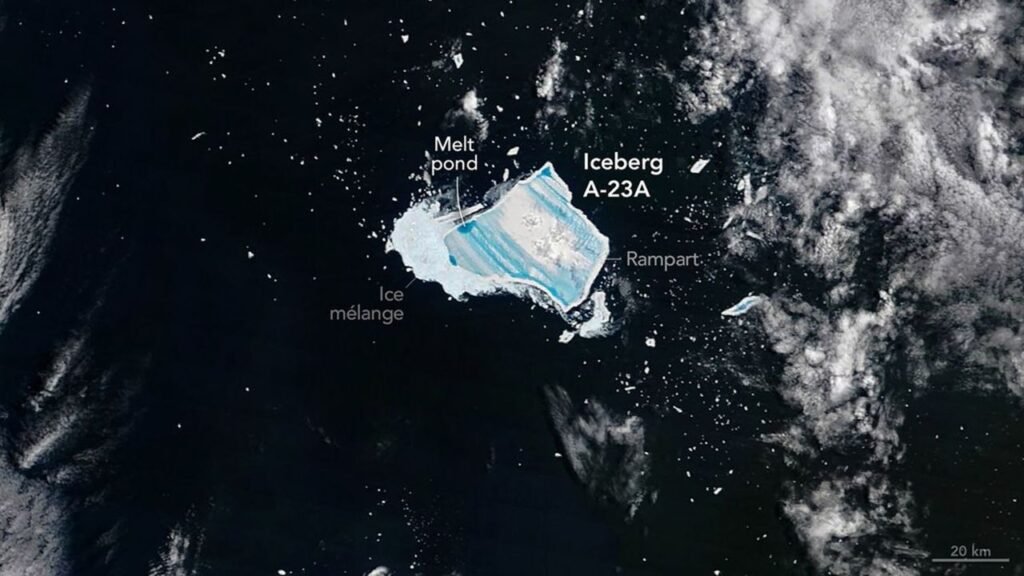
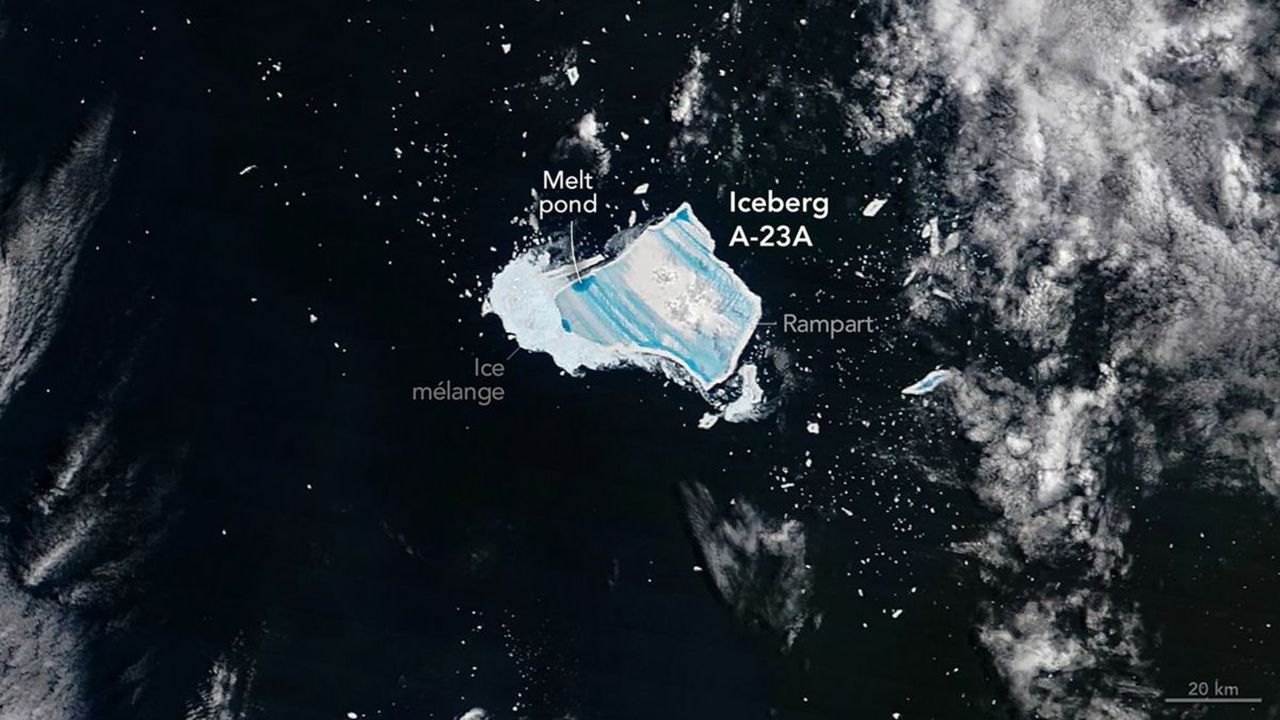
Satellite data captured this evolution, showing how surface melting exposes deeper layers compressed over time.
Experts note that such grounding often precedes rapid disintegration, with A-23a exhibiting clear signs of instability.
The Science Behind the Vivid Hue
What causes this 40-year-old behemoth to glow an intense blue? The answer lies in the physics of ice and water interaction.
As meltwater pools in surface crevices, it seeps into the iceberg’s porous structure, flushing out air bubbles trapped within the dense ice.
This process, known as the “blue ice” phenomenon, occurs when light passes through the purified ice without scattering, absorbing longer wavelengths and reflecting shorter blue ones.
NASA’s Earth Observatory documented the change in images from early January, where the berg transitioned from mottled white to a brilliant cyan within weeks.
Previously white expanses now shimmer with this hue, a visual marker of the berg’s waterlogged state.
Though visually captivating, this transformation underscores the berg’s vulnerability, as increased meltwater lubricates fractures and hastens breakup.
Tracking the Meltdown from Orbit
Advanced satellite technology has provided unprecedented views of A-23a’s decline, aiding scientists in understanding broader polar dynamics.
Instruments aboard NASA’s Landsat and MODIS satellites monitored the berg’s movement and color shift, revealing a shrinkage from its original size to about half by late 2025.
These observations highlight how ocean currents and wind patterns influenced the iceberg’s journey over 10,000 kilometers from Antarctica.
Grounding in shallower waters exposed it to more sunlight and wave action, accelerating the melt.
Such data not only tracks individual icebergs but also informs models of sea level rise and ecosystem impacts.
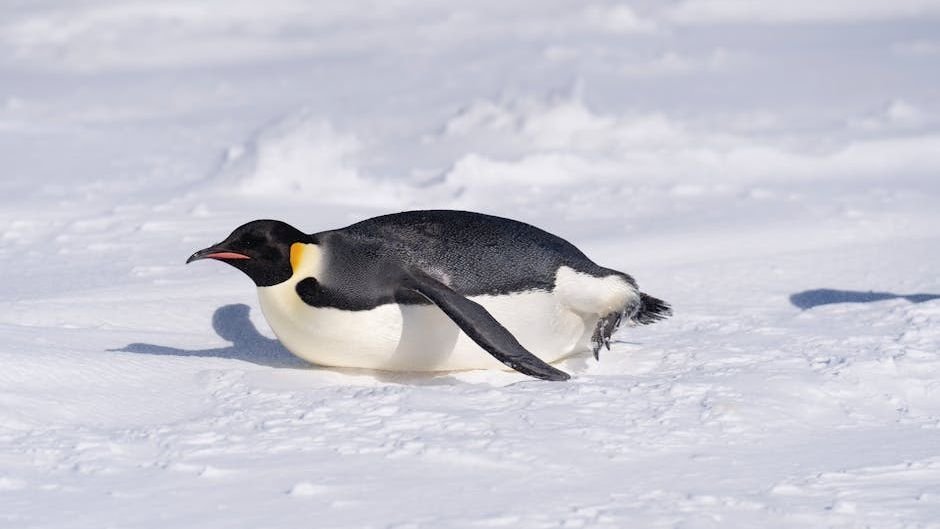
Marine biologists report potential disruptions to local wildlife, including penguin colonies on nearby islands, as the disintegrating berg releases freshwater into the sea.
Implications for a Warming World
The fate of A-23a serves as a microcosm of global climate challenges, where rising temperatures erode ancient ice formations at an alarming rate.
While this single berg’s collapse won’t drastically alter sea levels, it exemplifies the ongoing loss of Antarctic ice shelves that regulate ocean circulation.
Scientists emphasize that events like this contribute to cumulative effects, including altered weather patterns and biodiversity shifts.
International monitoring efforts, coordinated by organizations like NASA, continue to gather data to refine predictions.
- Calving origin: Filchner-Ronne Ice Shelf, 1986.
- Peak size: Over 3,000 square kilometers.
- Current status: Grounded near South Georgia, rapidly melting.
- Key observation: Blue transformation due to meltwater infiltration.
- Broader impact: Signals accelerating polar ice loss.
Key Takeaways
- A-23a’s blue hue results from dense, bubble-free ice formed under immense pressure.
- Satellite imagery confirms the berg could fully disintegrate within weeks.
- This event highlights the urgent need for climate action to preserve polar environments.
As Iceberg A-23a fades into the Southern Ocean, it leaves a poignant reminder of nature’s fragility in the face of environmental change – prompting reflection on our role in safeguarding these frozen giants. What steps can we take to address the forces driving such spectacles? Share your thoughts in the comments below.