A Surprising Find from 40 Million Years Ago (Image Credits: Flickr)
Researchers uncovered evidence in deep-sea sediments showing that Earth’s magnetic field sometimes lingered in transition during pole reversals for tens of thousands of years longer than typical.[1][2]
A Surprising Find from 40 Million Years Ago
A team of geoscientists documented two exceptionally prolonged geomagnetic reversals during the Eocene epoch, around 40 million years ago. One transition spanned 18,000 years, while the other extended to 70,000 years. These durations far exceeded the standard estimate of about 10,000 years derived from younger records.[1]
The discovery emerged from sediment cores drilled in the North Atlantic off Newfoundland’s coast. Scientists from the University of Utah, Japan’s Kochi University, and French institutions analyzed an 8-meter-thick layer that captured these events in fine detail. Lead author Yuhji Yamamoto first noticed unusual stable polarity segments separated by extended unstable intervals during initial data review. The group then sampled at centimeter-scale intervals to build precise timelines.[1]
This work built on a 2012 ocean drilling expedition aboard the JOIDES Resolution. The mission targeted Eocene climate records but yielded paleomagnetic insights as a bonus. Tiny magnetite crystals in the sediments locked in ancient field directions, acting like natural compasses.[2]
How Earth’s Dynamo Powers Pole Flips
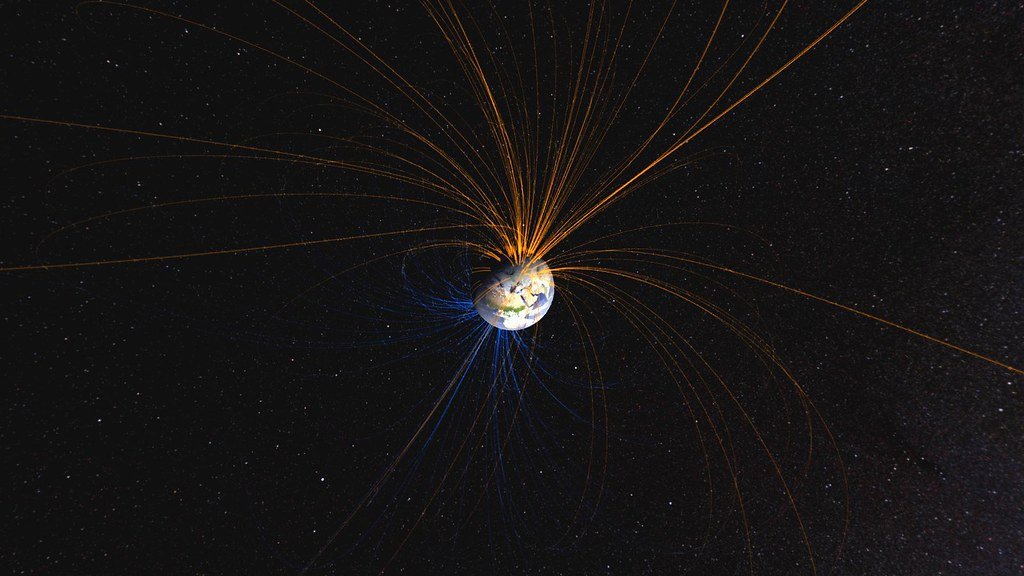
Earth’s magnetic field arises from swirling electric currents in the liquid nickel-iron outer core, a process known as the geodynamo. Over the past 170 million years, poles reversed 540 times, with the field weakening, wobbling, and relocating before stabilizing oppositely.[1]
Previous studies pegged most transitions at roughly 10,000 years based on records from the last 17 million years. Computer simulations of the geodynamo, however, predicted variability, including rare prolonged shifts up to 130,000 years. The new sediment data confirmed such outliers actually occurred.[2]
Paleomagnetists measure magnetization direction and intensity in cores to correlate with the geologic timescale. Each reversal creates a unique “barcode” in rocks and ocean floor deposits. Factors triggering flips remain unknown, but durations clearly varied.[1]
Consequences of a Weakened Shield
During reversals, the field drops significantly, reducing protection from solar radiation and cosmic rays. Prolonged weak phases, like those 40 million years ago, exposed ancient Earth to elevated radiation for extended periods. Co-author Peter Lippert highlighted the risks: “The amazing thing about the magnetic field is that it provides the safety net against radiation from outer space… If you are getting more solar radiation coming into the planet, it’ll change organisms’ ability to navigate.”[1]
Higher latitudes faced the brunt, but global effects likely followed. Lippert added, “It’s basically saying we are exposing higher latitudes in particular, but also the entire planet, to greater rates and greater durations of this cosmic radiation and therefore it’s logical to expect that there would be higher rates of genetic mutation. There could be atmospheric erosion.”[1]
- Increased mutations could drive evolutionary changes.
- Atmospheric chemistry might shift, altering climate.
- Navigation for migratory species would suffer.
- Biota in Eocene environments faced prolonged radiation stress.
- Overall shielding lapsed, inviting more space particles.
Comparing Reversal Durations
The table below contrasts typical reversals with the newly documented cases:
| Era | Duration (years) | Notes |
|---|---|---|
| Recent (<17 million years) | ~10,000 | Standard from prior records |
| Eocene (40 million years ago) | 18,000 | One documented case |
| Eocene (40 million years ago) | 70,000 | Prolonged outlier |
| Model predictions | Up to 130,000 | Geodynamo simulations |
These findings, published in Nature Communications Earth & Environment, reshape views on geodynamo behavior.[2]
Key Takeaways
- Reversals vary widely, defying uniform timelines.
- Ancient sediments preserve high-resolution reversal records.
- Weak fields amplify radiation risks over millennia.
Earth’s magnetic field demonstrates inherent unpredictability, with rare but significant long transitions shaping planetary history. As researchers refine models, these insights underscore the dynamo’s complexity and its role in life’s story. What implications might similar events hold today? Share your thoughts in the comments.