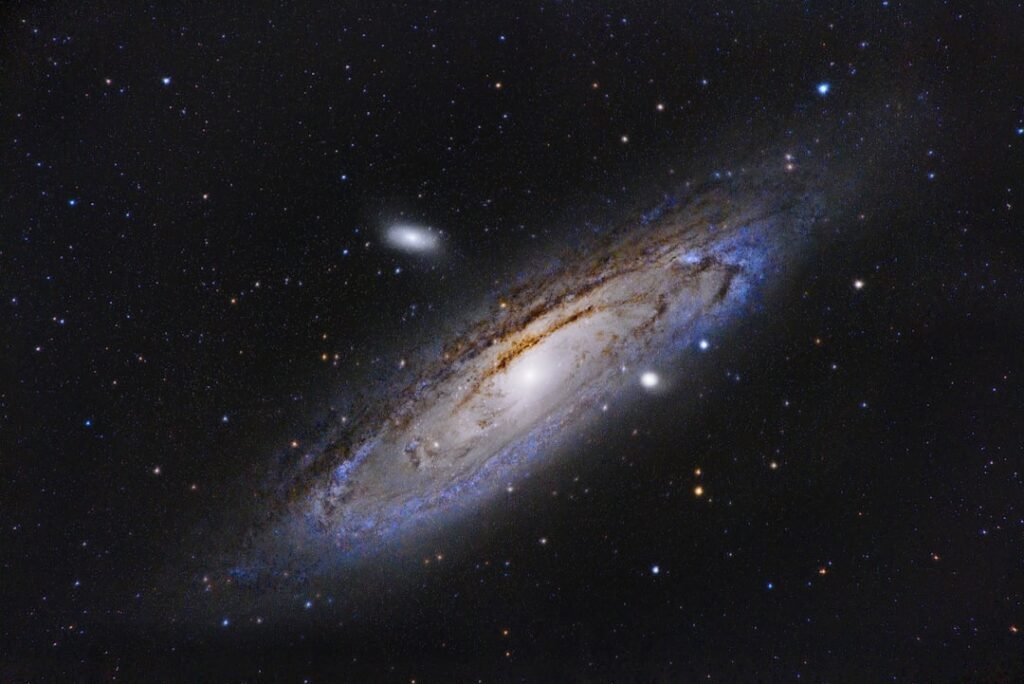

Peering Through the Cosmic Dust (Image Credits: Unsplash)
Astronomers have uncovered a hidden fleet of dusty, star-forming galaxies that took shape roughly one billion years after the Big Bang, offering fresh clues to the rapid buildup of the universe’s earliest massive structures.[1][2]
Peering Through the Cosmic Dust
Researchers long puzzled over how the universe forged its first giants so swiftly. A collaboration of 48 astronomers from 14 countries, led by Jorge Zavala at the University of Massachusetts Amherst, cracked the case by targeting faint signals from the observable universe’s edge.[1]
The team first cataloged about 400 bright, dusty galaxies using the Atacama Large Millimeter/submillimeter Array (ALMA) in Chile. They then sifted through near-infrared images from NASA’s James Webb Space Telescope (JWST) to spot 70 promising candidates, most unseen before. Stacking ALMA data at these positions confirmed the detections: genuine dusty, star-forming systems from nearly 13 billion years ago.[2]
This approach overcame the dust’s veil. Heavy cosmic dust absorbed ultraviolet and visible light, rendering the galaxies invisible to conventional telescopes. Submillimeter wavelengths, however, captured the infrared glow from heated dust, unveiling these obscured powerhouses.[3]
Profiles of Primordial Powerhouses
These galaxies stood out for their maturity. Massive and laden with metals and dust, they signaled that multiple generations of stars had already cycled through life and death by this early epoch.[1]
Zavala noted their significance: “Dusty galaxies are massive galaxies with large amounts of metals and cosmic dust. And these galaxies are very old, which means stars were being formed in the early universe, earlier than our current models predict.”[2]
Such composition implied accelerated star formation. Standard models failed to account for such advanced development just one billion years post-Big Bang, when the universe clocked in at about 13.7 billion years old overall.
Mapping a Galactic Lifecycle
The findings positioned these galaxies as a pivotal bridge. They linked ultrabright, starburst systems spotted by JWST around 13.3 billion years ago with massive quiescent galaxies that halted star formation by two billion years after the Big Bang.[3]
Zavala likened the sequence to life stages:
- Ultrabright galaxies: youthful, explosive growth phase.
- Newly found dusty galaxies: mature, vigorously star-forming adults.
- Quiescent giants: aged, dormant end stage.
Confirmation of this pathway would expose flaws in prevailing galaxy formation theories. Current simulations underestimated early star birth rates and overlooked key processes in the cosmos’s first few billion years.[1]
Implications for Cosmic History
The study appeared in The Astrophysical Journal Letters. It highlighted synergies between ALMA and JWST, tools that pierced veils once deemed impenetrable.
International teamwork proved essential, bolstered by U.S. National Science Foundation support. Future observations could solidify the evolutionary chain and refine models of the universe’s dawn.
Key Takeaways
- 70 faint dusty galaxies confirmed at cosmic dawn, challenging star formation timelines.
- They fill the gap between explosive young bursts and settled massive relics.
- Combined ALMA-JWST power reveals hidden populations, urging model updates.
These discoveries reshape our grasp of cosmic infancy, proving the early universe brewed giants faster than anticipated. What implications do they hold for the standard model? Share your thoughts in the comments.