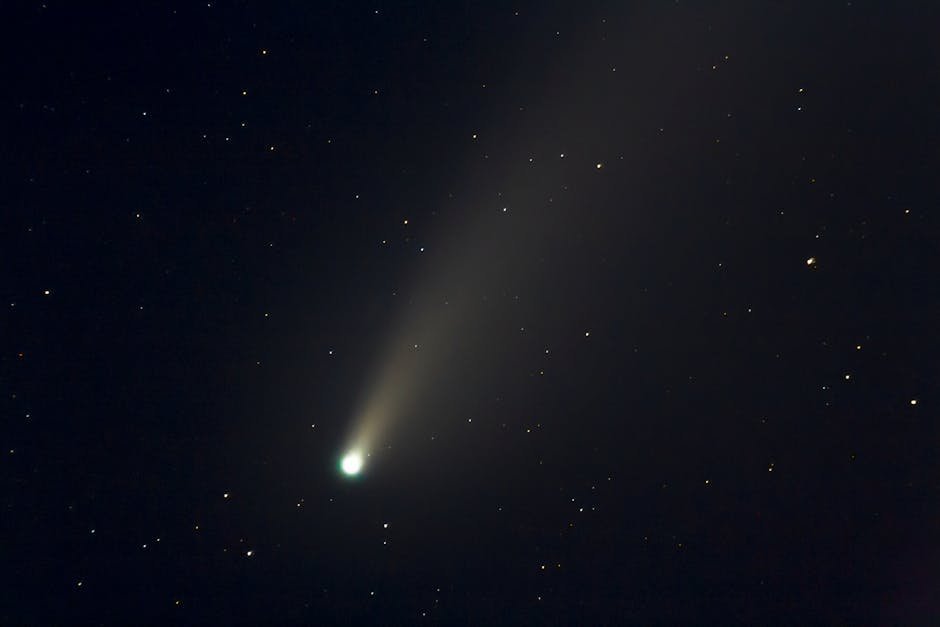
Unearthed from the Oort Cloud (Image Credits: Pexels)
A cosmic relic from humanity’s dawn graces the pre-dawn sky, reminding observers of the solar system’s vast timescales. Comet C/2025 R3 (Pan-STARRS) races toward its closest solar approach, visible low in the east for Northern Hemisphere viewers. This long-period wanderer, untouched by human eyes for millennia, promises a fleeting display before vanishing for eons.[1][2])
Unearthed from the Oort Cloud
Astronomers first spotted the comet on September 8, 2025, through the Pan-STARRS2 telescope atop Haleakala in Hawaii. Yudish Ramanjooloo captured the images using the 1.8-meter reflector, identifying the faint intruder from the distant Oort Cloud.[3] This discovery marked the start of intense monitoring as the object brightened on its inbound path.
The comet’s immense orbit sets it apart from shorter-period visitors. It completes a loop around the sun roughly every 170,000 years, placing its last perihelion during a time when early Homo sapiens shared Earth with Neanderthals and other hominins. No one alive today will witness its return.[1]
Current Position and Brightening Trajectory
As of April 11, 2026, the comet hovers at magnitude 5.0 to 5.4, detectable in binoculars from dark sites. It resides in Pegasus, tracing the base of the Great Square from near Markab toward Algenib before entering Pisces.[4][5] Positioned 90 minutes before sunrise, it sits just a few degrees above the eastern horizon amid twilight’s glow.
Predictions suggest a surge in brilliance soon. Perihelion arrives on April 19 at 0.499 AU from the sun, potentially pushing brightness to magnitude 3 or brighter – comparable to Big Dipper stars. Closest Earth approach follows on April 26 at 0.489 AU, though solar proximity complicates views.[2])[6]
Prime Viewing Window for Northern Observers
The optimal moment unfolds over the next week, balancing altitude and illumination. Earlier sightings favor height over luster; delays risk submersion in dawn haze. Seek pristine skies two hours before sunrise with a clear eastern vista, free of trees or buildings.[1]
Binoculars like 10×50 models reveal a diffuse glow, possibly with a tail exceeding 10 degrees. Telescopes suit wide fields over high magnification for this low target. Apps or star charts pinpoint it against Pegasus asterisms.
- Time: 90-120 minutes pre-sunrise.
- Location: Low east, 5-15 degrees elevation from mid-northern latitudes.
- Tools: Naked eye (marginal), binoculars (ideal), camera (200-400mm lens, ISO 1600-6400).
- Companions: Waning moon and Mercury nearby early April.
- Challenges: Horizon obstacles, light pollution, unpredictable outgassing.
Uncertain Fate and Southern Shift
Comets defy forecasts due to volatile ices and dust release. Solar heating could amplify reflectivity or trigger jets altering spin, yielding surprises in tail length or hue. Larger size suggests stability, yet history shows variability.[1]
Post-perihelion, the comet sinks below northern horizons, favoring southern viewers in Australia, South America, and Africa through May. Its hyperbolic trajectory hints at solar system ejection, sealing this as a singular event. Photography from sites like Crete already captures its ethereal form.[1]
Observers worldwide contribute data to databases like COBS, refining light curves amid the suspense.[7]
Key Takeaways
- Act now: Northern visibility peaks mid-April before perihelion.
- Dark skies essential: Magnitude may dip to naked-eye levels around April 17-20.
- Cosmic perspective: A 170,000-year orbit dwarfs human lifespans.
This comet embodies the solar system’s restless antiquity – a dirty snowball tumbling through void until sunlight awakens it briefly. Set an early alarm; the effort connects us to eras past and future. Have you glimpsed C/2025 R3 yet? Share your sightings in the comments.