Saturn’s Rings Defy Expectations (Image Credits: Cdn.mos.cms.futurecdn.net)
Researchers have unveiled a compelling model linking Saturn’s dazzling rings to a violent collision between ancient moons roughly 400 million years ago.
Saturn’s Rings Defy Expectations
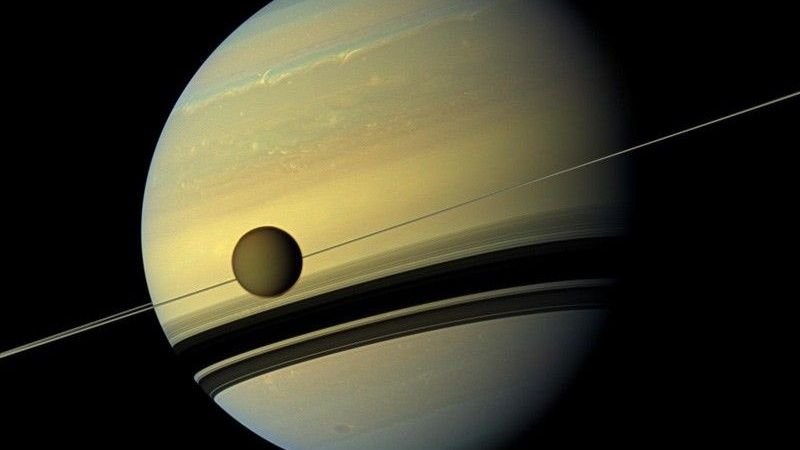
Saturn’s rings, visible even from Earth with a modest telescope, appear timeless yet hold a surprising secret. Evidence from spacecraft missions indicates they formed only a few hundred million years ago, far younger than the planet itself.[1][2]
This youth puzzled astronomers, as the rings’ icy particles should dissipate quickly under solar radiation and meteoroid impacts. Previous theories pointed to a lost moon spiraling into Saturn or solar gravitational tugs disrupting inner satellites. None fully accounted for related oddities like the planet’s axial tilt or specific moon orbits.
The new hypothesis, detailed in a study accepted for The Planetary Science Journal, reframes these enigmas through computer simulations of Saturn’s early dynamics.[3]
Hyperion Emerges as Crucial Evidence
Among Saturn’s 145 known moons, Hyperion stands out for its potato-like shape, chaotic tumbling, and low density. This small satellite shares a 4:3 orbital resonance with Titan, Saturn’s largest moon – a configuration estimated at just 400 to 500 million years old.[2]
“Hyperion, the smallest among Saturn’s major moons provided us the most important clue about the history of the system,” lead researcher Matija Ćuk of the SETI Institute noted.[1] Simulations revealed that Hyperion rarely survived past upheavals intact. Instead, it likely coalesced from debris of a recent cataclysm.
This resonance hints at dynamic youth, aligning with the rings’ timeline and challenging views of a stable, ancient Saturnian family.
A Chain Reaction from Moon Merger
The model describes a two-stage instability driven by Titan’s gradual outward migration, fueled by tidal forces within Saturn. An extra mid-sized moon, dubbed proto-Hyperion, once orbited between Titan and distant Iapetus. As Titan expanded its path, the system destabilized, sending proto-Hyperion crashing into proto-Titan.
Debris from this merger reformed as modern Hyperion near Titan’s orbit. “If the extra moon merged with Titan, it would likely produce fragments near Titan’s orbit. That is exactly where Hyperion would have formed,” Ćuk explained.[2]
The impact excited Titan’s eccentricity, which rippled inward. Resonant tugs elongated inner moons’ orbits, sparking collisions whose rubble spread to create the rings. Proto-Hyperion’s perturbations also tilted Iapetus’s orbit by 15 degrees during the chaos.[3]
Reshaping Titan and Saturn’s Tilt
Titan, larger than Mercury, boasts a thick nitrogen atmosphere and hydrocarbon lakes, but its surface shows few ancient craters – unlike expected for a primordial world. The merger offers an answer: violent resurfacing erased old scars, while heating may have outgassed its air envelope.
Titan’s orbit, once eccentric, now circularizes rapidly, matching post-collision damping. Saturn’s 26.7-degree obliquity stemmed from a broken spin-orbit resonance with the planets, triggered by the event.
- Rings: Debris from inner moon collisions.
- Hyperion: Accreted merger fragments.
- Titan: Fused proto-moons, youthful surface.
- Iapetus: Tilted by proto-Hyperion.
- Saturn: Altered spin axis.
Key Takeaways:
- Saturn’s system underwent dramatic reshaping 400 million years ago.
- One moon merger sparked rings, Hyperion, and orbital quirks.
- Simulations confirm high probability of this scenario.
This unified theory paints Saturn’s realm as dynamically alive, not frozen in time. As NASA’s Dragonfly mission prepares to explore Titan in the coming years, it may uncover merger remnants in the moon’s chemistry or geology. What secrets will Saturn still reveal? What do you think of this cosmic collision theory? Share in the comments.