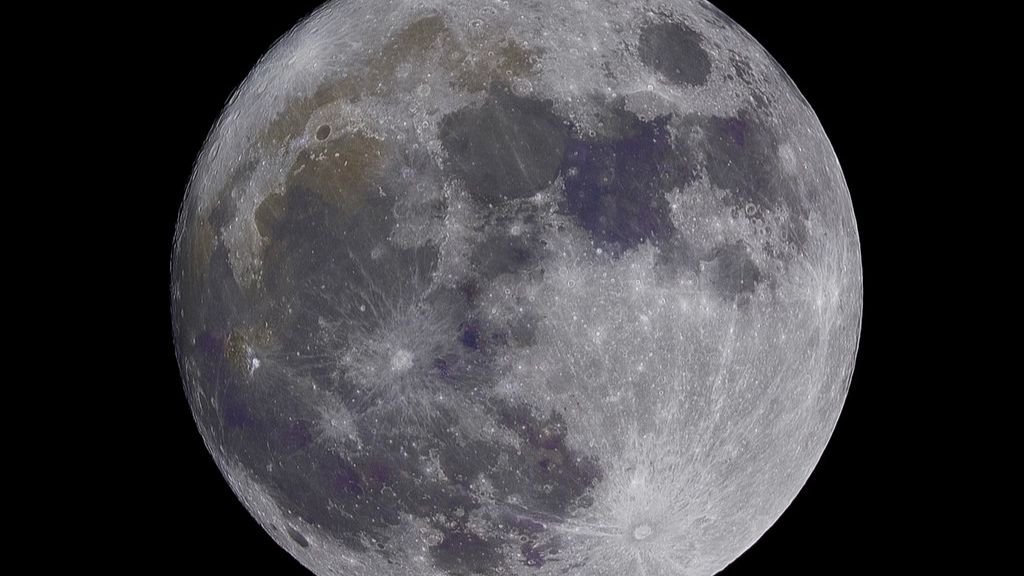

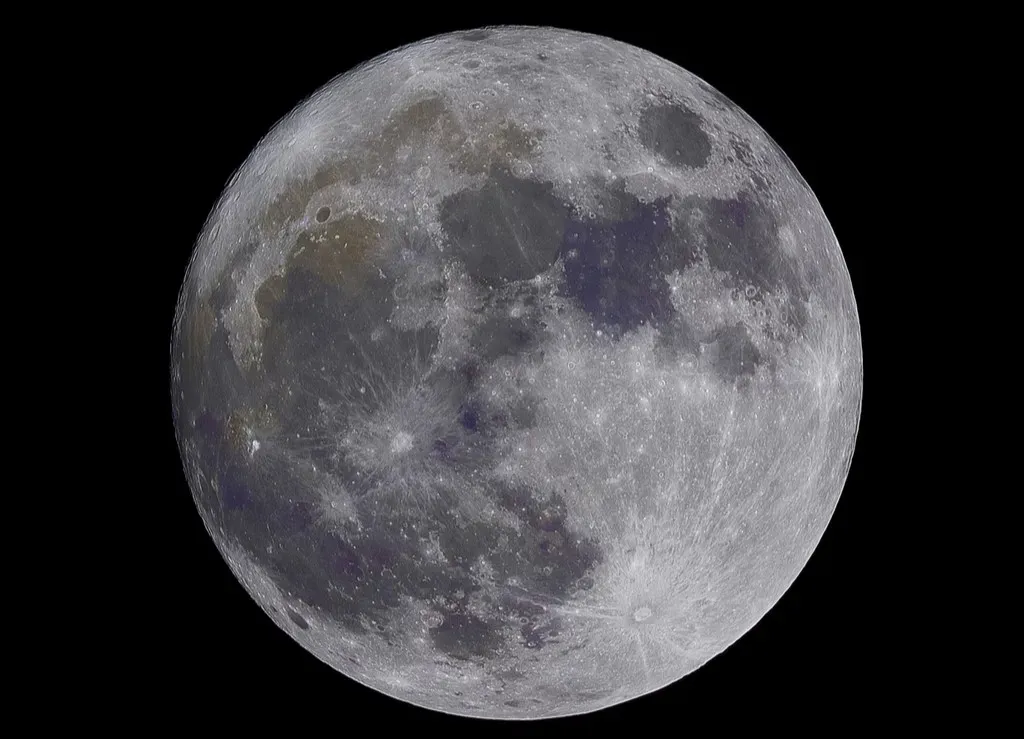
Scientists have long puzzled over the Moon’s lopsided appearance. One side looks dramatically different from the other, with vast dark patches visible even to the naked eye. Now researchers believe they may have cracked the case, and the culprit is a colossal asteroid that slammed into our lunar neighbor billions of years ago.
The theory suggests this massive impact didn’t just leave a crater. It actually warped the Moon’s internal structure, flipping its geology in ways we’re only beginning to understand. If true, this discovery rewrites what we thought we knew about the Moon’s formative years and raises intriguing questions about how violent collisions shape celestial bodies across the universe.
The South Pole-Aitken Basin Holds Critical Clues
The Moon’s South Pole-Aitken Basin ranks among the largest impact craters in our entire solar system. This enormous scar stretches roughly 1,600 miles across and plunges about 5 miles deep into the lunar surface. Scientists have studied it for decades, but new research suggests its influence runs far deeper than the visible crater itself.
Advanced computer simulations now indicate this ancient collision unleashed forces powerful enough to reshape the Moon’s interior layers. The impact likely occurred during the Late Heavy Bombardment period, roughly 4 billion years ago, when asteroids and comets pummeled the inner solar system relentlessly. What makes this particular strike special is how profoundly it may have reorganized the Moon’s internal architecture.
How an Impact Could Flip the Moon’s Geology
Here’s where things get fascinating. The collision apparently generated enough energy to displace massive amounts of dense material from deep within the Moon. Think of it like dropping a stone into thick mud and watching the displaced material splash upward and outward in slow motion, except this happened on a planetary scale with molten rock.
Researchers propose that lighter materials got pushed toward the impact site while heavier elements migrated in unexpected directions. This redistribution created the asymmetry we observe today, with the near side of the Moon appearing substantially different from its far side. The process essentially turned the Moon’s composition inside out, leaving a geological fingerprint that persists billions of years later.
The Mystery of the Lunar Nearside’s Dark Patches
Anyone who’s glanced at a full moon has noticed those dark splotches forming patterns some cultures interpret as a face or rabbit. These maria, as scientists call them, are actually vast plains of solidified lava that flooded the surface long ago. But why do they appear almost exclusively on the side facing Earth?
The new research offers a compelling explanation. The South Pole-Aitken impact may have triggered the conditions necessary for volcanic activity to concentrate on the nearside. By redistributing heat-producing radioactive elements beneath what became the Moon’s Earth-facing hemisphere, the collision essentially created a geological hot zone that encouraged volcanic eruptions to bubble up preferentially in certain regions rather than others.
Challenging Previous Theories About Lunar Formation
For years, scientists debated various explanations for the Moon’s two-faced appearance. Some suggested Earth’s gravitational pull created the asymmetry during the Moon’s formation. Others proposed that radioactive heating alone could account for the uneven distribution of volcanic features.
This asteroid impact theory doesn’t necessarily invalidate those earlier ideas completely. It’s more like adding a crucial missing piece to an incomplete puzzle. The collision likely worked in combination with other factors, but it may have been the primary driver that set everything else in motion. Honestly, it’s remarkable how one catastrophic event billions of years ago continues shaping what we see when we look up at night.
What This Means for Understanding Other Moons
The implications extend far beyond our own lunar neighbor. Throughout the solar system, moons and small planets bear the scars of ancient impacts. Jupiter’s moon Callisto and Saturn’s moon Mimas both sport enormous craters relative to their sizes.
If a single impact can fundamentally reorganize a body as large as our Moon, similar collisions might have sculpted the internal structures of countless other worlds. This research provides a framework for interpreting observations of distant moons we’ve only glimpsed through spacecraft flybys. Let’s be real, we’re basically realizing that cosmic violence played a far more creative role in planetary evolution than we previously imagined.
Future Missions Could Confirm the Theory
The beauty of this hypothesis is that it makes testable predictions. Future lunar missions equipped with advanced seismic instruments and drilling capabilities could search for the specific signatures this impact should have left behind. NASA’s upcoming Artemis program and various international lunar initiatives might provide the data needed to either validate or challenge these findings.
Scientists are particularly interested in studying the Moon’s far side more thoroughly. China’s Chang’e missions have already begun this work, but much remains unexplored. If researchers can map the distribution of specific minerals and measure variations in the Moon’s internal density with greater precision, they’ll know whether this inside-out scenario holds up under scrutiny.
A Cosmic Reminder of Our Violent Past
This research serves as a humbling reminder that our cosmic neighborhood wasn’t always the relatively calm place it appears today. The early solar system was a shooting gallery where massive objects collided with terrifying regularity. Earth itself likely suffered similar catastrophic impacts, including the theorized collision that may have created the Moon in the first place.
Understanding these ancient events helps us appreciate how contingent our existence really is. If that South Pole-Aitken impact had been slightly larger or struck at a different angle, our Moon might look completely different today. Perhaps its gravitational influence on Earth would have varied enough to alter our planet’s climate or tidal patterns in ways that affected the development of life itself.
The Moon has always captured human imagination, but knowing it carries the scars of a collision that literally turned it inside out adds a new layer of wonder. Next time you spot those dark patches on a clear night, you’ll be looking at evidence of one of the solar system’s most transformative moments. It’s hard to say for sure whether we’ll ever understand every detail of that ancient catastrophe, but each discovery brings us closer to reading the Moon’s geological diary. What do you think shaped your perception of the Moon more – its romantic symbolism or its violent history?