The Game-Changer That’s Just Happened in Orbit (Image Credits: Cdn.mos.cms.futurecdn.net)
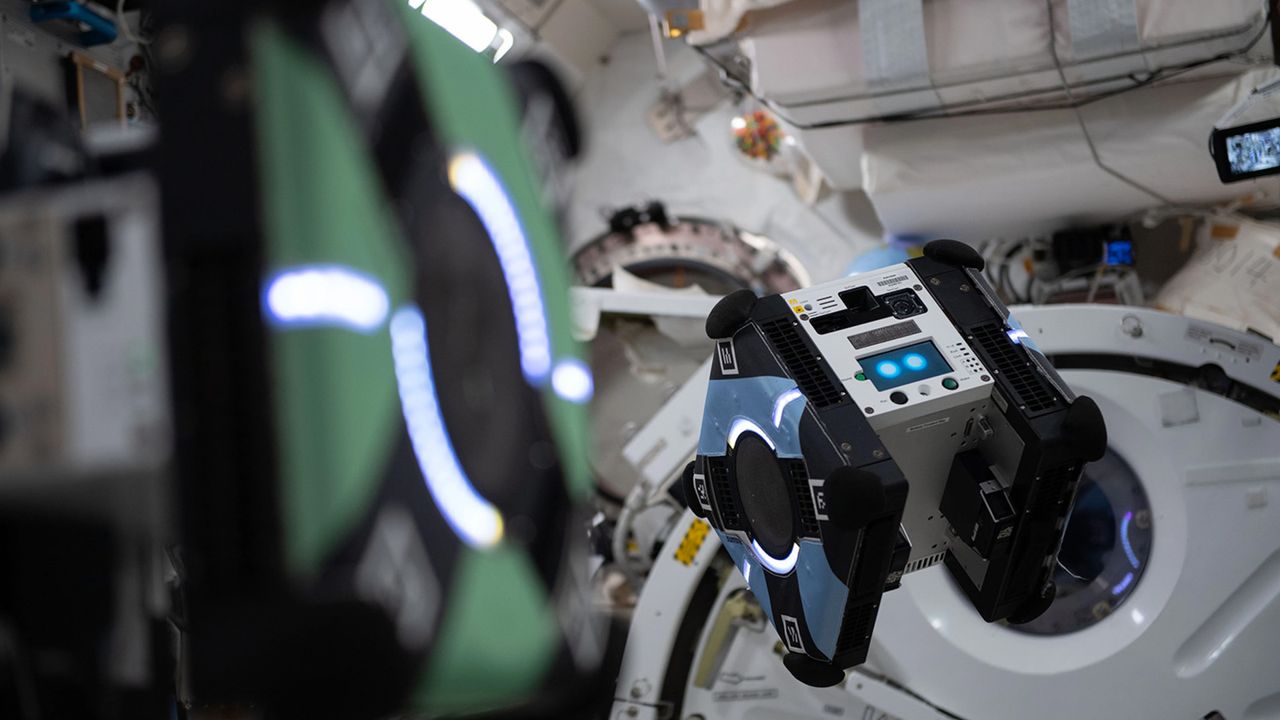
In the silent hum of zero-gravity corridors aboard the International Space Station, a compact robot glides effortlessly, making split-second decisions on its own.
The Game-Changer That’s Just Happened in Orbit
Imagine a robot zipping around a space station, dodging obstacles and charting paths faster than ever before, all thanks to artificial intelligence. That’s exactly what unfolded recently when researchers pulled off the first successful AI-guided flight of a free-flying robot on the ISS. This isn’t some sci-fi flick; it’s real progress happening right now in 2025.
The breakthrough came from a team at Stanford University, who integrated machine-learning controls into the robot’s system. For the first time, no human operator was calling the shots in real time. Instead, the AI handled navigation autonomously, proving it can thrive in the unpredictable environment of space.
This milestone feels like a quiet revolution. It shows how AI could free up astronauts for bigger challenges, letting robots tackle the routine stuff with speed and safety.
Spotlight on Astrobee: The Robot Making History
Astrobee isn’t your average drone. These cube-shaped bots have been floating around the ISS since 2019, helping with tasks like inventory checks and monitoring air quality. But until now, they relied on pre-programmed routes or remote control from Earth.
What sets this latest demo apart is the AI upgrade. The robot, one of NASA’s Astrobee fleet, used advanced algorithms to sense its surroundings and adjust on the fly. Picture it weaving through tight spaces, avoiding floating tools or crew members without missing a beat.
Launched as part of ongoing experiments, Astrobee now represents a step toward smarter space helpers. It’s like giving the robot a brain that learns from each trip, getting better with every orbit.
Behind the Scenes: How AI Navigates the Unknown
At its core, this AI relies on machine learning, trained on simulations that mimic the ISS’s quirky physics. No gravity means everything floats, so the system had to master propulsion bursts and collision avoidance in three dimensions.
During the test, the robot followed planned paths but adapted when needed, like rerouting around unexpected clutter. This real-time processing happens aboard the station, cutting down on communication delays with ground control.
Experts say it’s a big deal because traditional methods were rigid. AI brings flexibility, almost like intuition, allowing the robot to handle surprises that scripts can’t predict.
Faster Flights: Cutting Task Times by Over Half
One of the most exciting outcomes? Speed. The AI-piloted Astrobee completed routes 50 to 60 percent quicker than before. What used to take minutes now wraps up in seconds, boosting efficiency on a station where time is precious.
This isn’t just about going fast; it’s about safety too. The system ensures smoother paths, reducing the risk of bumps or delays. For astronauts juggling experiments and maintenance, that’s a huge relief.
Think of it as upgrading from a bicycle to a sports car in space. Routine patrols that once tied up resources now free them for exploration or science.
Why This Matters for Tomorrow’s Space Adventures
Autonomous robots like this could transform deep-space missions. On the ISS, they’re a proving ground, but imagine them scouting Mars habitats or repairing satellites solo. Less reliance on Earth means more independence for crews far from home.
NASA and partners see this as foundational. It paves the way for AI in everything from sample collection to emergency responses. Plus, it cuts costs by minimizing human oversight.
Still, it’s early days. Scaling this tech for longer journeys will test its limits, but the potential feels boundless.
Looking Ahead: Hurdles and High Hopes
Challenges remain, like ensuring AI reliability in radiation-heavy space or integrating it with other systems. Researchers are already planning follow-ups to refine the tech.
Yet the optimism is palpable. This test opens doors to hybrid teams of humans and machines, making space more accessible.
Here’s a quick look at key benefits:
- Boosted efficiency for daily ISS operations
- Enhanced safety through precise, adaptive navigation
- Foundation for autonomous deep-space exploration
- Reduced workload on astronauts and ground teams
- Path to cost savings in future missions
Key Takeaways
- AI achieved the first fully autonomous robot flight on the ISS, navigating 60% faster.
- Stanford’s machine-learning system adapts in real time, mimicking human-like decisions.
- This tech promises safer, more efficient space ops, eyeing Mars and beyond.
As AI takes bolder steps in orbit, it’s clear we’re on the cusp of a new era in space travel – one where robots aren’t just tools, but true partners. What excites you most about this? Share your thoughts in the comments.
Jan loves Wildlife and Animals and is one of the founders of Animals Around The Globe. He holds an MSc in Finance & Economics and is a passionate PADI Open Water Diver. His favorite animals are Mountain Gorillas, Tigers, and Great White Sharks. He lived in South Africa, Germany, the USA, Ireland, Italy, China, and Australia. Before AATG, Jan worked for Google, Axel Springer, BMW and others.