
There are few things on this planet quite as humbling as a piece of floating ice the size of a small country. For decades, one particular giant dominated headlines, baffled scientists, and drifted silently through the world’s most remote waters. Now, after nearly forty years, that journey has finally come to an end – and the finale is something nobody quite expected.
The story of iceberg A23a is one of extraordinary endurance, strange science, and a surprisingly beautiful death. It’s not every day that something so massive simply… dissolves into a swirl of electric blue. So let’s dive in.
A Giant Born From the Ice Shelf
A23a calved from Antarctica’s Filchner Ice Shelf back in 1986, which means this iceberg has been around longer than most people reading this article. When it first broke free, it was so enormous it essentially grounded itself on the seafloor of the Weddell Sea almost immediately, sitting motionless for decades like some frozen leviathan refusing to move.
To put its scale into perspective, at its peak A23a covered roughly one thousand square kilometers, which is larger than Greater London or the entire island of Mauritius. It wasn’t just an iceberg. It was a floating landmass. Honestly, calling it an “iceberg” almost feels like an understatement.
Decades Stranded, Then a Sudden Escape
For nearly thirty years, A23a barely budged. It sat anchored to the ocean floor by its sheer weight, which itself says something wild about how thick and dense this thing really was. Then, around 2020, something shifted. Ocean temperatures, currents, and the gradual thinning of its base finally conspired to set it loose.
By late 2023, A23a was drifting north at a pace that genuinely surprised researchers tracking it via satellite. It moved past the tip of the Antarctic Peninsula and into the Southern Ocean, heading toward what scientists call “Iceberg Alley,” a stretch of water notorious for swallowing these giants whole as warmer conditions chip away at them.
The Spin That Stunned Scientists
Here’s the thing most news coverage missed at the time. As A23a drifted into warmer waters, it began spinning. Slowly at first, then with increasing speed, rotating in place like a massive, ancient top winding down. This kind of rotational behavior in mega-icebergs is relatively rare, and researchers were genuinely fascinated watching it unfold in real time via satellite imagery.
The spinning was likely caused by a combination of ocean currents, wind shear, and the uneven melting of its undersides creating subtle imbalances in buoyancy. It’s a bit like watching a spinning coin slow and wobble before it finally falls flat. The physics are elegant in a strange, melancholy sort of way.
The Brilliant Blue Transformation
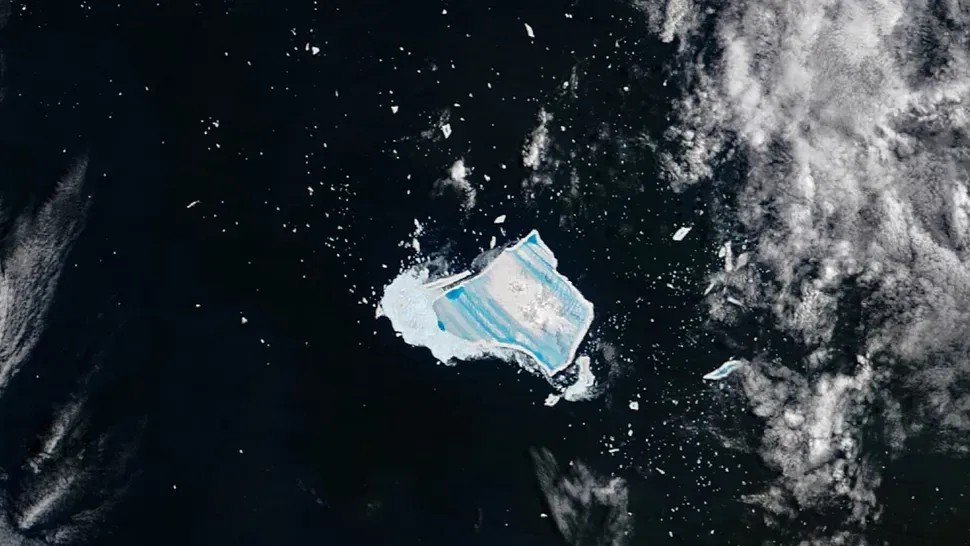
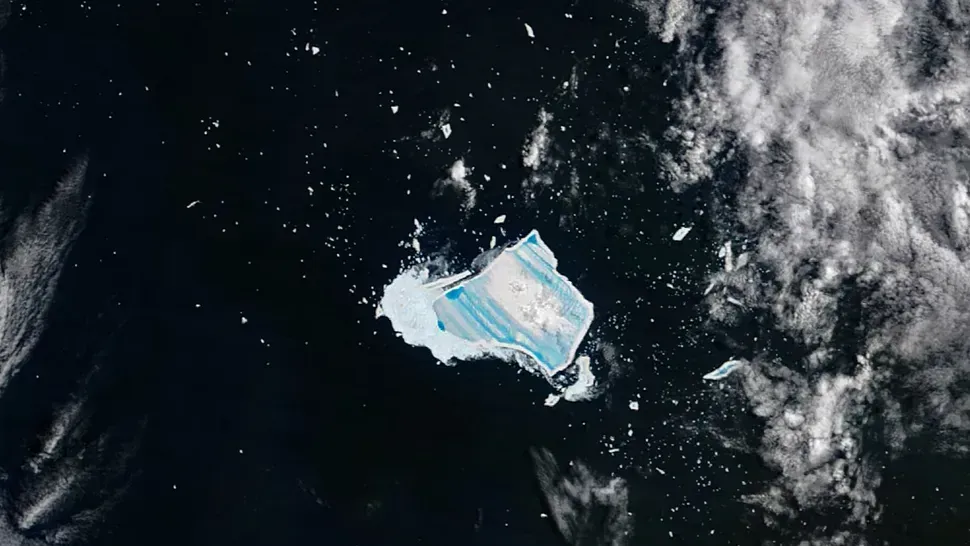
This is, without question, the most visually stunning part of A23a’s final chapter. As the iceberg broke apart, satellite images began capturing something almost otherworldly: vivid patches of electric blue against the white and grey of the surrounding ocean. That blue color isn’t just pretty. It tells a story.
When ice is compressed over thousands of years, air bubbles get squeezed out almost entirely. What remains absorbs red wavelengths of light and reflects blue ones, producing that deep, almost surreal turquoise color. The blue mush visible in the final images of A23a represents ancient, incredibly dense glacial ice finally releasing itself back into the sea after potentially thousands of years in frozen form. Few endings in nature are quite this photogenic.
What Happens When a Mega-Iceberg Dies
The breakup of A23a is technically classified as a “melange,” which refers to the scattered field of ice fragments, brash ice, and meltwater that replaces a large iceberg as it disintegrates. This melange can span dozens of kilometers and affects local ocean chemistry in ways that are still being actively studied.
Freshwater released from melting icebergs of this scale can temporarily alter salinity levels in surrounding waters, which in turn affects ocean circulation patterns. There’s also a huge nutrient dump involved. The iron and minerals locked inside Antarctic ice for millennia get released during melt events, triggering enormous phytoplankton blooms that are visible from space. So in a strange twist, the death of A23a may actually be feeding the Southern Ocean in a very real sense.
Forty Years: A Legacy in Ice
It’s hard to say for sure what A23a’s full scientific legacy will be, but researchers have already been gathering extraordinary data from its drift. The iceberg served as a kind of unintentional ocean buoy, giving scientists a rare long-term view of Southern Ocean dynamics, currents, and temperature shifts over nearly four decades.
I think what strikes me most is the timeline. This chunk of ice has been floating around since before the internet existed, before smartphones, before half the researchers now studying it were even born. It outlasted political regimes, technological revolutions, and entire generations of scientific understanding about climate and ice dynamics. That’s not just geology. That’s history.
What A23a Tells Us About Antarctica’s Future
The natural calving of A23a in 1986 was not considered directly caused by climate change. Large calving events are a normal part of ice shelf dynamics. However, the accelerating breakup once it reached warmer northern waters does reflect the broader reality of rising Southern Ocean temperatures in recent years.
Scientists are watching several other large sections of the Antarctic ice sheet with growing attention. The Thwaites Glacier and sections of the West Antarctic Ice Sheet in particular raise concerns that future calving events could have far more significant sea level implications than anything A23a represented. A23a was ancient, enormous, and fascinating. What comes next, though, is the conversation that really matters.
Conclusion: A Slow Death Worth Watching
A23a’s story is one of the most extraordinary natural sagas of the modern era, even if most of it unfolded in near total silence, far from any human eye. A forty-year journey from one of Earth’s most remote ice shelves to a scattered blue mush in the Southern Ocean is genuinely hard to wrap your head around.
There’s something almost philosophical about it. Something that ancient, that massive, that enduring simply dissolving into the sea. No dramatic collapse, no catastrophic event. Just time, warmth, and physics doing their quiet work. The oceans reclaimed it gradually, and in the process revealed something achingly beautiful.
What does it mean when the world’s largest iceberg is gone, and most people barely noticed? Think about that the next time you look at an ocean on a map.