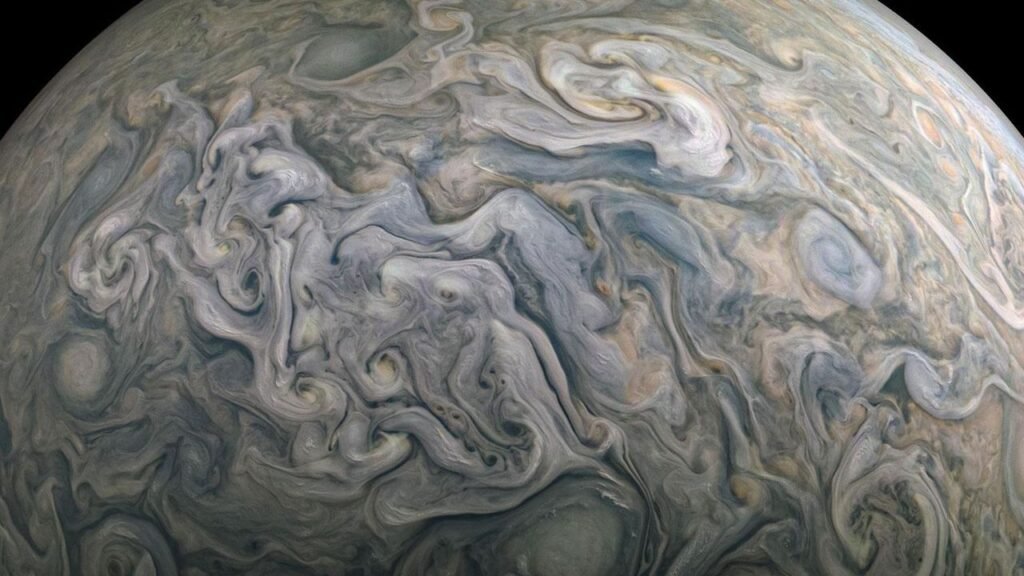

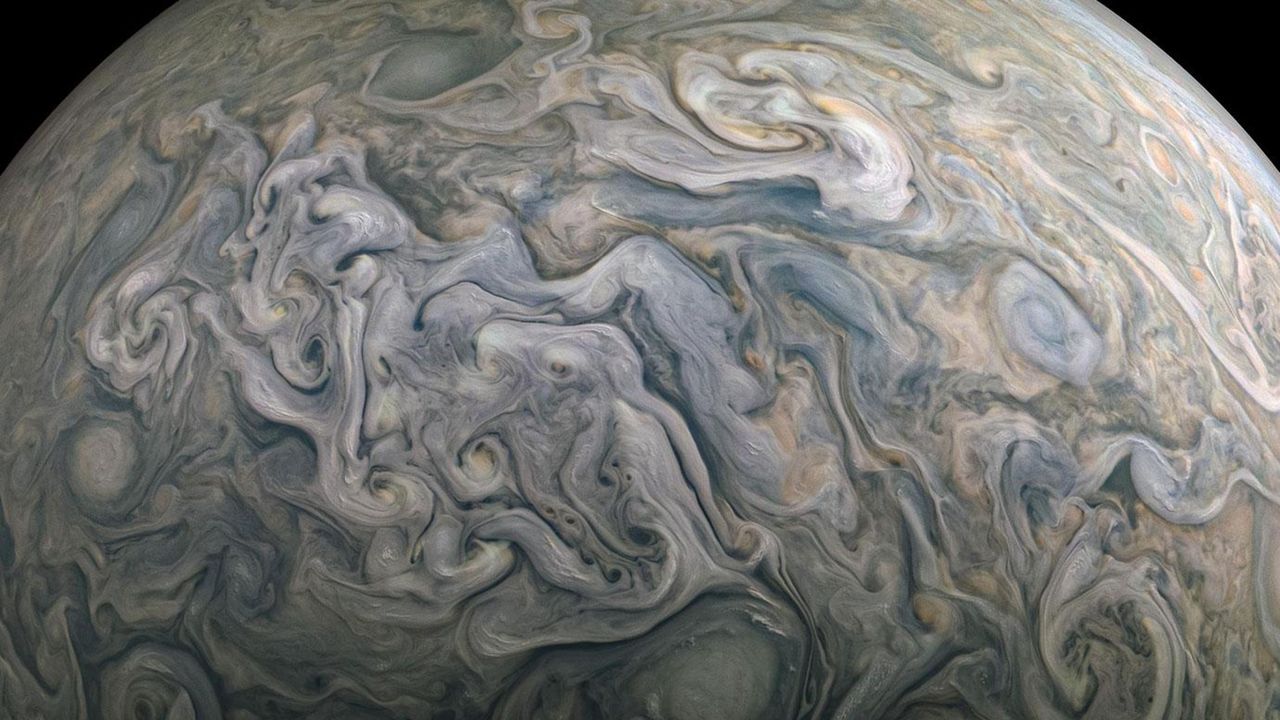
Unveiling the Oxygen Anomaly (Image Credits: Cdn.mos.cms.futurecdn.net)
Recent computer simulations have unveiled unexpected levels of oxygen deep within Jupiter’s turbulent atmosphere, challenging long-held assumptions about the gas giant’s composition.
Unveiling the Oxygen Anomaly
A team of astronomers recently developed advanced models that pierced through Jupiter’s dense cloud layers, revealing the planet’s oxygen content exceeds that of the sun by a factor of 1.5. This finding emerged from efforts to map the unseen depths beneath the planet’s iconic storms, where water vapor and other compounds hide from direct observation. For decades, spacecraft like NASA’s Juno mission provided glimpses of the upper atmosphere, but these new simulations delved deeper, simulating pressures and temperatures that mimic Jupiter’s interior.
The results indicate that Jupiter accumulated more oxygen-bearing materials during its formation than previously thought. Scientists noted that the planet’s oxygen levels suggest it formed in a region of the early solar system abundant with water ice. This discovery reframes how we understand the building blocks of giant planets, as Jupiter’s makeup now appears richer in volatile elements than our star’s.
Simulations That See Beyond the Clouds
Researchers at the University of Chicago led the effort, using computational models to recreate Jupiter’s atmospheric dynamics. These simulations accounted for the planet’s extreme conditions, including crushing pressures that prevent direct measurements by probes. By inputting data from past missions, the team predicted how oxygen distributes across different layers, from the visible ammonia clouds to deeper water-rich zones.
The models also highlighted slower circulation patterns than earlier estimates suggested. Molecules in Jupiter’s atmosphere move at a more leisurely pace, allowing oxygen to concentrate in certain regions. This slower mixing influences cloud formation and could explain variations observed in the planet’s banded appearance. Such insights stem from iterative testing of atmospheric physics, ensuring the simulations aligned with known data.
Clues to Solar System Origins
This oxygen surplus offers a window into the solar system’s formative years. Jupiter, as the largest planet, likely played a pivotal role in shaping the orbits of other bodies, and its composition reflects the materials available in the protoplanetary disk. The enhanced oxygen points to Jupiter migrating through zones rich in icy planetesimals, scooping up water and silicates that the sun largely missed.
Astronomers now see parallels with exoplanets detected by telescopes like the James Webb Space Telescope. Understanding Jupiter’s profile helps refine models for distant worlds, predicting where oxygen and water might abound. The study underscores how gas giants form differently from rocky planets or stars, emphasizing the role of location in chemical enrichment.
Key Factors in Jupiter’s Oxygen Profile
To illustrate the simulation outcomes, consider the following breakdown of atmospheric elements:
- Oxygen abundance: 1.5 times higher than solar levels, primarily bound in water vapor.
- Circulation speed: Slower molecular transport, leading to localized concentrations.
- Formation influence: Likely originated in outer solar system regions with abundant water ice.
- Measurement challenges: Dense clouds obscure direct probes, necessitating computational approaches.
- Implications for moons: Potential oxygen delivery to satellites like Europa via atmospheric interactions.
Looking Ahead to Deeper Probes
While these simulations mark a breakthrough, they pave the way for future missions equipped to sample Jupiter’s depths directly. Enhanced instruments could validate the models and explore oxygen’s role in the planet’s magnetic field or weather patterns. As research progresses, this finding enriches our cosmic narrative, showing how even our nearest giant neighbor holds secrets that redefine planetary science.
The abundance of oxygen in Jupiter not only surprises but also inspires wonder about the universe’s chemical diversity.
Key Takeaways
- Jupiter’s oxygen levels surpass the sun’s by 1.5 times, based on recent simulations.
- Slower atmospheric circulation contributes to uneven distribution of elements.
- These insights illuminate the processes behind solar system planet formation.
In a cosmos full of mysteries, Jupiter’s oxygen revelation reminds us that exploration continually reshapes our knowledge. What aspects of the gas giant intrigue you most? Share your thoughts in the comments.