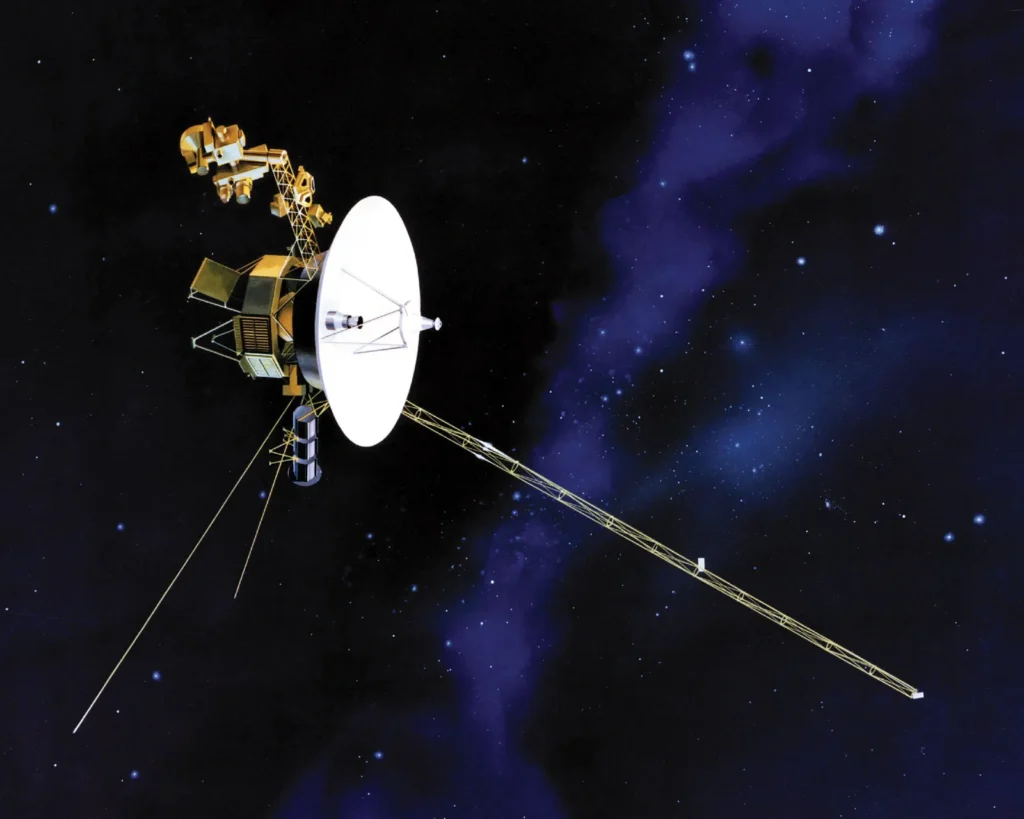
Voyager’s Trailblazing Path Beyond the Planets (Image Credits: Flickr)
NASA’s Voyager spacecraft, now deep in interstellar space, display a puzzling yearly trend where their distances from Earth temporarily contract despite their outward flight.
Voyager’s Trailblazing Path Beyond the Planets
Launched in 1977, Voyager 1 and Voyager 2 embarked on missions to survey the outer planets of our solar system. They flew past Jupiter, Saturn, Uranus, and Neptune, capturing unprecedented images and data during the late 1970s and 1980s.[1]
Gravity assists from these gas giants propelled the probes toward the solar system’s edge. Voyager 1 crossed into interstellar space in 2012, followed by Voyager 2 in 2018. Today, both continue transmitting faint signals back to Earth, offering glimpses of the space between stars.[1]
These aging ambassadors carry golden records etched with Earth’s sounds and images, a message for any potential extraterrestrial discoverers.
The Mechanics of Earth’s Swift Orbit
Astronomers track the probes’ positions meticulously, yet graphs reveal sawtooth patterns in their Earth distances – long-term increases punctuated by brief declines. The culprit lies in Earth’s rapid orbit around the Sun.[1]
Earth hurtles along at 30 kilometers per second, outpacing Voyager 1’s 17 km/s and Voyager 2’s 15 km/s relative to the Sun. The probes follow nearly straight paths outward, while Earth circles in an elliptical loop. During part of the year, our planet aligns on the orbital arc that points toward the Voyagers’ direction, effectively chasing them faster than they recede.[1]
This geometry produces a net closure in distance, though the probes never reverse course. No propulsion changes or anomalies cause the shift; pure orbital dynamics drive it.[2][3]
When and How Close Do They Get?
For Voyager 2, the approach phase spans late February through early June each year. As of early February 2026, it stood at 143.09 astronomical units (AU) from Earth – one AU equals the average Earth-Sun distance of 150 million kilometers.[1]
Distances bottom out around 143.4 AU before climbing again. Voyager 1 follows a similar cycle, offset by its position north of the ecliptic plane.[1]
Key orbital speeds highlight the mismatch:
- Earth’s orbital velocity: 30 km/s
- Voyager 1 velocity relative to Sun: 17 km/s
- Voyager 2 velocity relative to Sun: 15 km/s
Projections from sites like TheSkyLive.com extend this pattern through 2030, with wiggles superimposed on the upward trend.[1]
Implications for Distant Exploration
Though the annual dips intrigue observers, the Voyagers’ heliocentric distances grow unabated. Power from their radioisotope generators wanes, threatening communications by the 2030s.
Scientists rely on the Deep Space Network to capture ever-fainter signals. This orbital interplay underscores the complexity of tracking far-flung objects in a moving solar system.[4]
Key Takeaways
- Voyagers recede overall but experience yearly distance reductions due to Earth’s faster orbit.
- The effect peaks in spring for Voyager 2, lasting months.
- Orbital mechanics, not spacecraft maneuvers, explain the phenomenon.
These enduring probes remind us of humanity’s reach into the cosmos, where even as they fade, Earth’s motion keeps the connection tantalizingly alive. What aspect of the Voyager story captivates you most? Share in the comments.