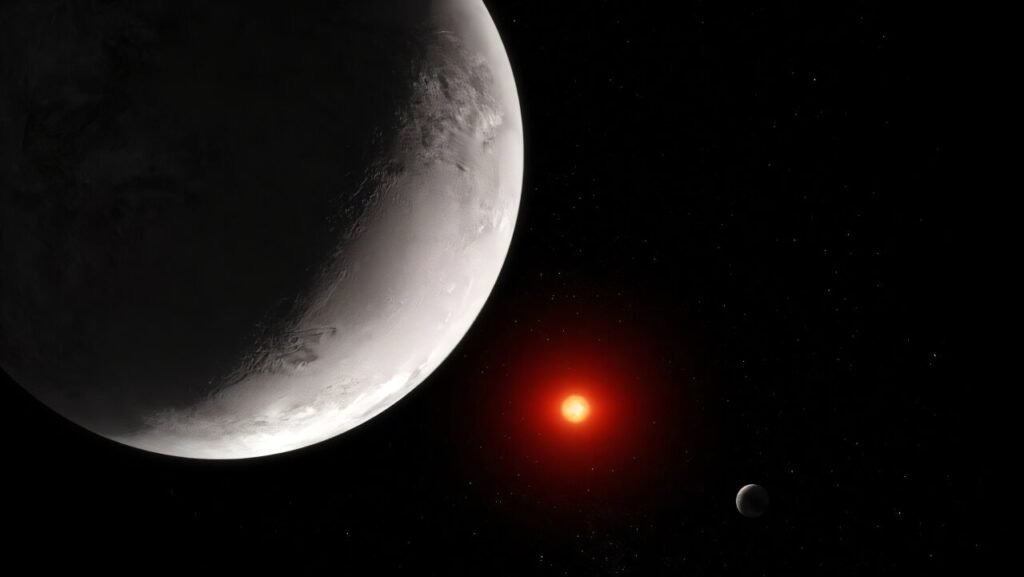
A Benchmark Planet for Atmospheric Research (Image Credits: NASA/ ESA/ CSA/ Joseph Olmsted (STScI)/ Webb Space Telescope)
The discovery of planets beyond our solar system has reshaped our understanding of how planetary systems form and evolve. Over the past three decades, astronomers have identified thousands of exoplanets—ranging from massive gas giants to small rocky worlds similar to Earth. Yet some discoveries stand out not because they are rare, but because they offer a clearer window into the complex physics shaping planetary atmospheres.
A newly studied rocky exoplanet orbiting a dim red dwarf star may be one such case. Astronomers say this world, while extremely hot and inhospitable, could serve as a reference system for studying highly irradiated rocky planets. Its characteristics make it an ideal laboratory for investigating how intense stellar radiation affects planetary atmospheres and surface conditions.
A Rocky Planet Orbiting a Red Dwarf Star
The planet, known as TOI‑4616 b, orbits a faint M‑type red dwarf star located roughly 91 light-years from Earth. It was first identified through observations by NASA’s Transiting Exoplanet Survey Satellite, which detects planets when they pass in front of their host stars and briefly dim the starlight.
Rocky planets are particularly common around red dwarf stars, which are the most abundant stars in the Milky Way. Because these stars are smaller and cooler than the Sun, even small planets can be detected relatively easily when they transit their host stars.
Despite the abundance of such worlds, scientists emphasize that TOI-4616 b is scientifically special. Its physical characteristics and orbit make it especially useful for studying how rocky planets behave under intense stellar radiation.
A Planet Bathed in Extreme Radiation
One defining feature of TOI-4616 b is its extremely close orbit around its host star. Like many planets around red dwarfs, it circles its star at a distance far smaller than the distance between Earth and the Sun.
This proximity means the planet receives an enormous amount of stellar radiation. As a result, its surface conditions are expected to be extremely hot, creating an environment where atmospheric gases could be rapidly stripped away. Such intense irradiation makes the planet an ideal case study for understanding how stellar energy interacts with rocky planetary surfaces and atmospheres.
Why Red Dwarf Systems Are So Important
Red dwarf stars dominate the galaxy. Astronomers estimate that roughly three-quarters of all stars in the Milky Way belong to this category. Because they are smaller and dimmer than stars like the Sun, their habitable zones lie much closer to the star.
This means planets orbiting red dwarfs often experience powerful stellar flares and radiation bursts. These energetic events can erode or completely remove planetary atmospheres over time. Studying planets like TOI-4616 b helps scientists determine whether rocky worlds around red dwarfs can retain atmospheres long enough to support stable environments.
A Benchmark Planet for Atmospheric Research
Researchers believe TOI-4616 b could become a benchmark system for studying highly irradiated rocky planets. In astronomy, benchmark objects serve as reference points for comparing and interpreting observations of other similar objects.
Because this planet transits its host star, astronomers can measure its size and study how starlight interacts with its atmosphere—or determine whether an atmosphere exists at all. Such measurements can reveal whether extreme radiation environments leave rocky planets bare or allow them to retain thin atmospheric layers.
Testing Planet Formation and Evolution Theories
The discovery also contributes to broader efforts to understand how planetary systems evolve. Planetary systems around red dwarfs often look very different from our own solar system. In many cases, rocky planets orbit extremely close to their stars, while larger gas giants are absent or rare. Scientists are still trying to determine why these systems develop such configurations.
Detailed studies of planets like TOI-4616 b could help researchers test theories about planetary migration, atmospheric loss, and the role of stellar radiation in shaping planetary environments.
A Future Target for Powerful Telescopes
The scientific value of TOI-4616 b extends beyond its initial discovery. Because it is relatively nearby in cosmic terms and regularly transits its star, it may become a target for future atmospheric observations. Next-generation telescopes—including space observatories capable of detecting faint atmospheric signals—could analyze the planet’s composition in detail.
Such observations might reveal whether the planet has retained even a thin atmosphere, or if it has been completely stripped down to its rocky core by stellar radiation.
What This Means for the Search for Habitable Worlds
Although TOI-4616 b itself is far too hot to support life, its importance lies in what it can teach scientists about other planets. Many potentially habitable worlds discovered so far orbit red dwarf stars. Understanding how radiation affects nearby rocky planets is therefore crucial for determining whether such worlds could sustain atmospheres and liquid water.
By studying extreme cases like TOI-4616 b, researchers can refine the models used to assess habitability in other planetary systems.
Conclusion: A Harsh World That Could Reveal the Secrets of Planetary Survival
At first glance, TOI-4616 b might seem like just another scorched rocky planet in the vast catalog of exoplanets. But in reality, it may hold the key to answering one of astronomy’s most pressing questions: how rocky planets survive under the intense radiation of their stars.
Science often advances not through the discovery of perfect Earth-like worlds, but through studying extreme environments that push planetary physics to its limits. In this sense, TOI-4616 b is a powerful natural experiment.
If astronomers can understand how this hostile world formed, evolved, and possibly lost its atmosphere, they will gain critical insight into the fate of countless other rocky planets across the galaxy. And in the long run, those insights may help determine which distant worlds could truly resemble our own.