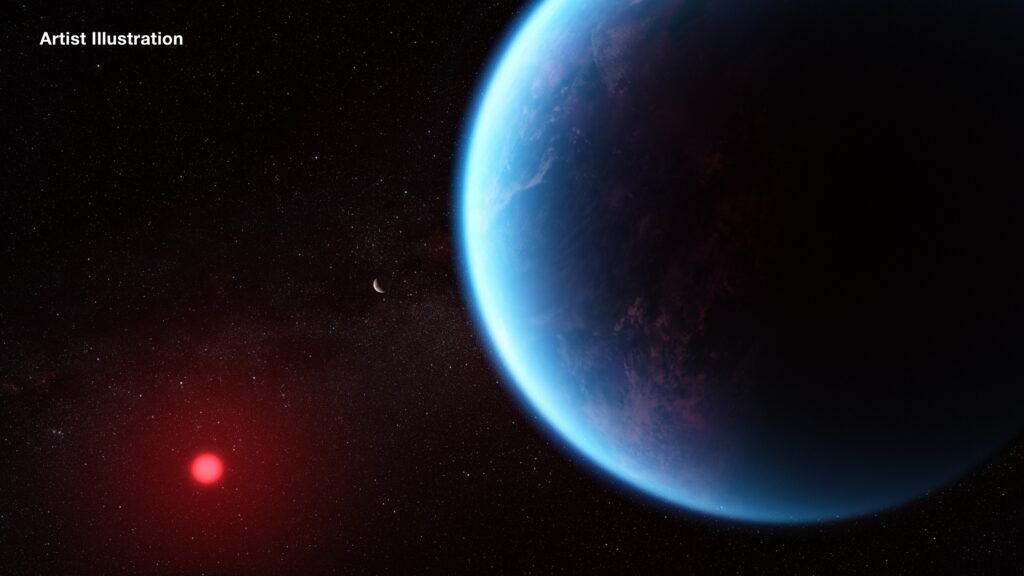
Astronomers using the James Webb Space Telescope (JWST) have uncovered one of the most bizarre planetary atmospheres ever seen: a Jupiter-sized exoplanet with skies thick with soot clouds and conditions that could condense carbon into diamonds, challenging existing models of how planets form and evolve. The planet—officially designated PSR J2322-2650 b—orbits a pulsar (a rapidly spinning neutron star), making it a rare and extreme world that doesn’t fit neatly into any known planetary category. Webb’s unprecedented infrared observations allowed researchers to probe its atmospheric composition despite the intense radiation environment around the pulsar, revealing a mix of unexpected elements and raising new questions about cosmic chemistry and planetary origins.
Located about 750 light-years from Earth, PSR J2322-2650 b completes a blisteringly fast orbit in just 7.8 hours, bringing it extremely close to its host pulsar—far closer than any gas giant in our own solar system lies to the Sun. Its proximity to the pulsar and strange atmospheric makeup make it one of the most mysterious objects seen by Webb yet, and scientists say this discovery could upend assumptions about how planetary atmospheres behave under intense radiation and exotic conditions.
A Planet Around a Pulsar: Extreme Orbit and Strange Origins
PSR J2322-2650 b is no ordinary exoplanet. It orbits a millisecond pulsar, a compact neutron star left over after a supernova explosion, which emits beams of radiation like a lighthouse. The planet’s orbit is incredibly tight, at roughly 1.6 million kilometers from the pulsar, completing a full cycle in only a few hours—an orbit much smaller than Mercury’s in our solar system and orders of magnitude closer than typical gas giants.
Such a tight orbit around an object that emits strong gamma-ray and X-ray radiation would seem inhospitable for any atmosphere, yet Webb’s infrared instruments were able to peer through the pulsar’s emissions to decode the planet’s atmospheric spectrum, offering a rare glimpse into a world shaped by extreme physics.
Unusual Atmosphere: Soot, Carbon, and Diamond Clouds
Webb’s data revealed that the atmosphere of PSR J2322-2650 b is dominated by helium and carbon, with very little of the familiar gases Earth’s atmosphere contains, such as nitrogen or oxygen. Scientists detected strong signatures of soot-like particles in the upper atmosphere, which scatter and absorb light, giving clues to a thick haze of carbon rich clouds unlike any known planetary atmosphere.
Beneath the haze, researchers suspect that extreme pressure and temperature conditions could allow carbon atoms to crystallize into diamonds—a long-theorized but rarely supported phenomenon for exoplanetary interiors. If confirmed, this would mark one of the most striking examples of exotic chemistry in planetary science.
Lemon Shape and Tidal Distortion
Because of the pulsar’s intense gravitational forces and its close orbit, PSR J2322-2650 b is not a perfect sphere. Instead, observations suggest the planet is stretched into a lemon-like shape, elongated along the line connecting it to its host star. This “tidal distortion” results from the relentless pull at such proximity, much like how Earth’s oceans bulge under the Moon’s influence, but on a much larger scale.
This distortion further complicates efforts to model the planet’s internal structure and atmosphere, as the shape influences how heat and materials are distributed across its surface and depth. Understanding such tidal effects could help explain the dynamics of other close-orbiting exoplanets.
Formation Mysteries: Black Widow Systems and Planetary Origins
PSR J2322-2650 b’s existence raises deep questions about how planets can form and survive in environments dominated by neutron stars. One leading hypothesis connects its origin with so-called “black widow” systems, where a pulsar gradually strips material from a companion star. Over time, this process could leave behind remnant planetary bodies or stitch new ones from the debris—but why this planet retains such an unusual atmosphere remains unclear.
The peculiar chemistry and dynamics of this system challenge conventional planetary formation theories, which typically involve gradual accumulation from protoplanetary disks around young stars. Instead, PSR J2322-2650 b points to a far more chaotic and violent planetary genesis involving extreme astrophysical processes.
Webb’s Unique Capabilities: Probing Beyond the Expected
A key reason this discovery was even possible is Webb’s infrared sensitivity, which can peer through intense radiation and dust that would overwhelm traditional telescopes. In this case, it allowed researchers to capture the atmospheric fingerprint of a planet in the extreme environment around a pulsar, something that was once thought inaccessible to detailed observation.
By dissecting the composition of exotic worlds like PSR J2322-2650 b, Webb is expanding our understanding of what planets can be made of, how they interact with their environments, and how diverse the universe’s planetary population truly is.
The discovery of PSR J2322-2650 b—a planet wrapped in soot, possibly with diamond-forming clouds, hugging a pulsar at blistering speed—reminds us just how wildly surprising the universe can be. This world defies nearly every expectation scientists bring from familiar planetary systems. Rather than fitting into neat categories, it sits at the intersection of astrophysics and extreme chemistry, challenging our models of planetary formation and atmospheric evolution. As Webb continues to uncover such oddities, we must remain ready not just to refine existing theories but to rethink them entirely. PSR J2322-2650 b shows that the universe’s planetary realm is far richer and stranger than once imagined, and although key mysteries remain, each new discovery pushes the frontier of human knowledge further into the unknown.