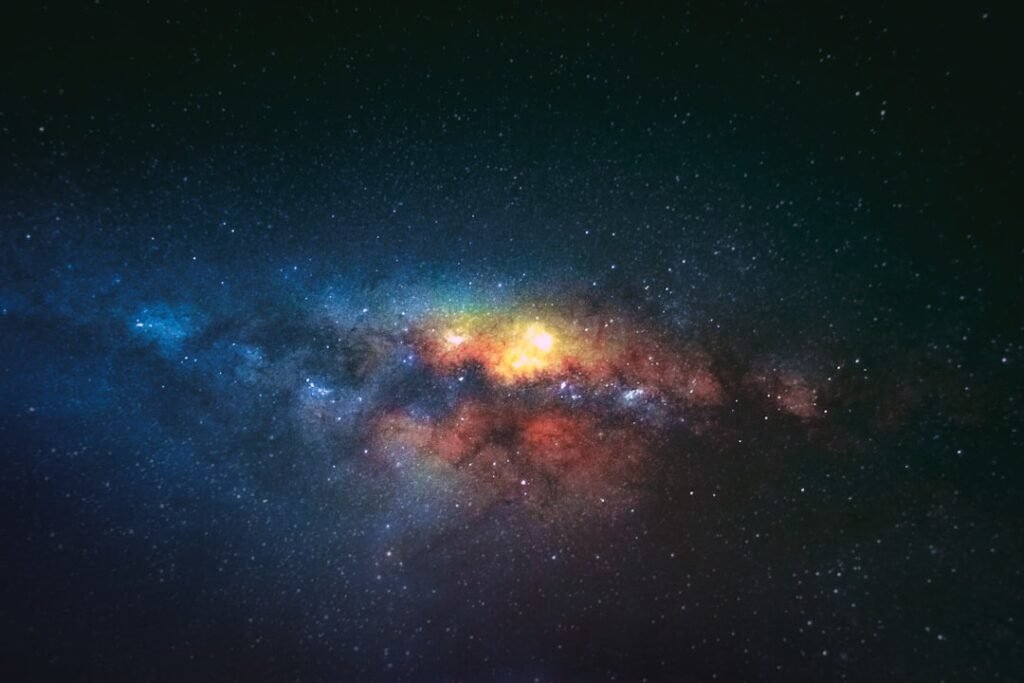

Unifying the Galaxy’s Dance from Center to Edge (Image Credits: Unsplash)
A fresh analysis of stellar motions and galactic rotation data points to a dense fermionic dark matter core at the heart of our galaxy, potentially displacing the supermassive black hole long thought to reside there.[1]
Unifying the Galaxy’s Dance from Center to Edge
Stars whip around the Milky Way’s nucleus at blistering speeds, yet their paths align seamlessly with the slower orbits far beyond. Researchers now argue this harmony stems from a single dark matter entity spanning vast scales.
Valentina Crespi and Carlos Argüelles, from Argentina’s Institute of Astrophysics La Plata, led an international team in crafting this model. They published their findings on February 5, 2026, in the Monthly Notices of the Royal Astronomical Society. The work integrates observations of inner S-stars and G-sources with the outer halo’s rotation profile.[1]
Argüelles emphasized the breakthrough: “This is the first time a dark matter model has successfully bridged these vastly different scales and various object orbits, including modern rotation curve and central stars data.”[1]
The fermionic dark matter – light subatomic particles – forms a super-dense central core enveloped by a diffuse halo. This structure exerts gravity akin to Sagittarius A*, the 4-million-solar-mass black hole candidate.
Stellar Orbits and Rotation Curves Align
S-stars hurtle at thousands of kilometers per second mere light-years from the core, while G-sources, shrouded in dust, trace similar tight paths. Data from the GAIA DR3 mission reveal a Keplerian decline in the outer halo’s rotation, a slowdown matching predictions when factoring in the disk and bulge.[1]
Traditional models struggle here. A central black hole alone fails to fully account for this outer behavior without extra tweaks. The dark matter approach ties it all together naturally.
| Feature | Fermionic Dark Matter Core | Supermassive Black Hole |
|---|---|---|
| Central Star Orbits (S-stars, G-sources) | Explains high speeds via compact density | Matches via point-mass gravity |
| Outer Halo Rotation | Unified halo predicts Keplerian decline | Requires additional mass components |
| Structural Unity | Core and halo as continuous substance | Separate central object and halo |
Recreating the Iconic Shadow
The Event Horizon Telescope’s famed image of Sagittarius A* shows a dark center ringed by light. A prior study by Pelle et al. in 2024 demonstrated that dense dark matter cores bend light similarly, producing this shadow effect.[1]
Crespi noted: “Our model not only explains the orbits of stars and the galaxy’s rotation but is also consistent with the famous ‘black hole shadow’ image.”[1]
No singularity exists in this scenario. Instead, quantum effects from fermionic particles create the compact profile, distinct from cold dark matter’s fluffier halos.
Shifting Paradigms and Next Steps
This proposal reimagines galaxy cores galaxy-wide. It suggests dark matter shapes dynamics from stellar nurseries to halo fringes, influencing formation theories.
Current data cannot yet distinguish the models definitively. Sharper measurements from the GRAVITY instrument on Chile’s Very Large Telescope promise clarity. Searches for photon rings – hallmarks of black holes absent here – could seal the debate.[1]
- GAIA DR3 maps confirm outer slowdown.
- Fermionic model fits inner and outer data uniformly.
- Light-bending matches EHT observations.
- Tighter halo tails than standard CDM.
- International team spans Argentina, Italy, Colombia, Germany.
- A fermionic dark matter core unifies Milky Way observations across scales.
- It rivals Sagittarius A* without invoking a singularity.
- Future telescope data will test the hypothesis.
The Milky Way’s heart may pulse with dark matter’s subtle force, urging astronomers to revisit foundational assumptions. What implications does this hold for other galaxies? Share your thoughts in the comments.