
A Surprising Deviation at Ultra-Low Accelerations (Image Credits: Upload.wikimedia.org)
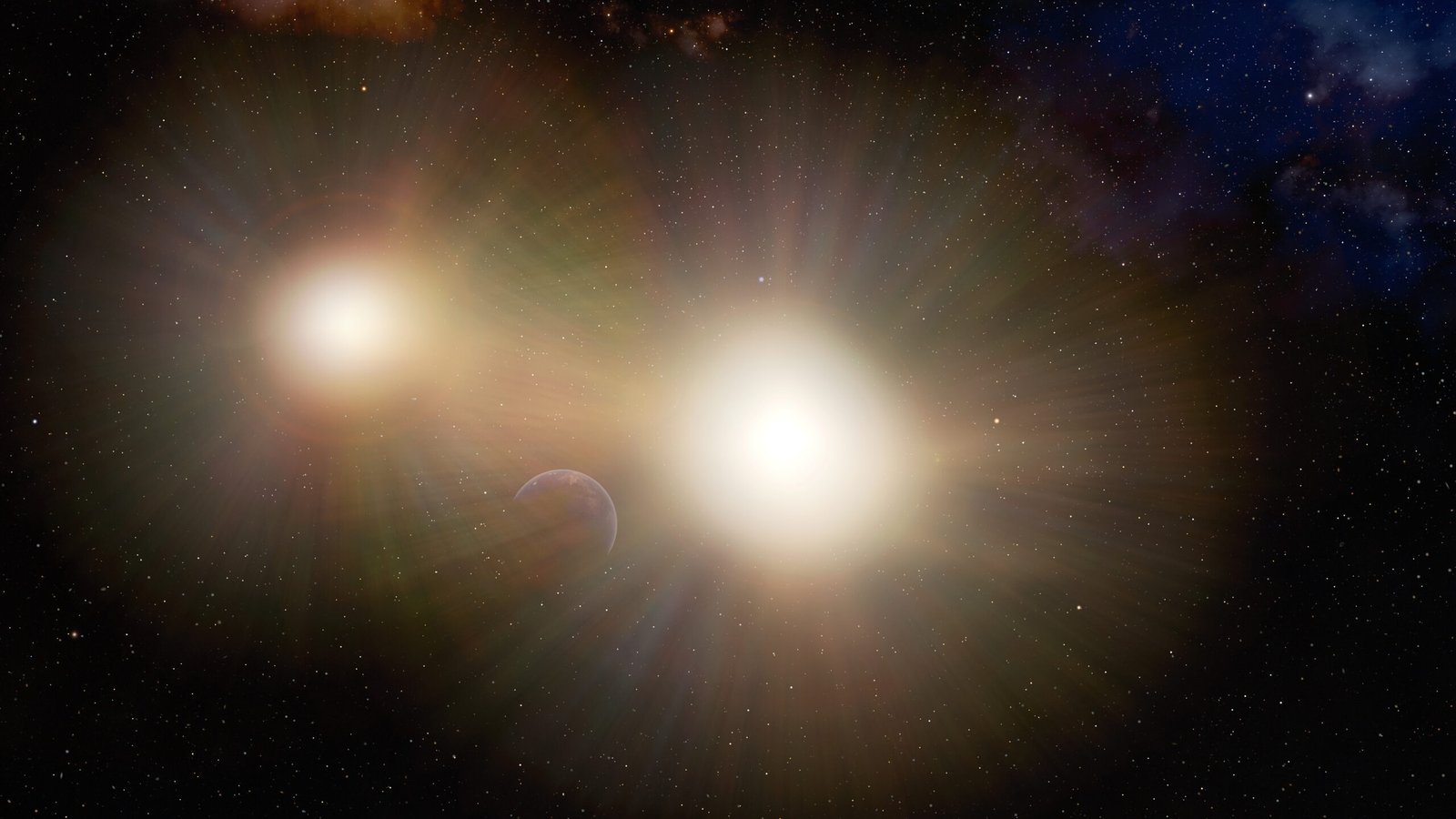
Researchers at Sejong University in South Korea analyzed the orbital motions of distant star pairs and uncovered a striking discrepancy in gravity’s behavior. Wide binary stars, separated by thousands of astronomical units, orbit each other under extremely weak gravitational pulls, around 1 nanometer per second squared or less. Their observed accelerations exceeded standard predictions by 40 to 50 percent, pointing to a potential breakdown in Newtonian and Einsteinian gravity at these scales.[1][2]
A Surprising Deviation at Ultra-Low Accelerations
Astrophysicist Kyu-Hyun Chae led the investigation using data from the European Space Agency’s Gaia mission. Wide binaries serve as ideal laboratories because their vast separations result in accelerations weaker than 10 nanometers per second squared, far below everyday gravity. At these levels, the stars’ relative motions revealed forces roughly 40 to 50 percent stronger than expected under Newtonian dynamics.[1]
The anomaly emerged clearly for separations greater than 2,000 astronomical units. Newtonian gravity matched observations precisely above 10 nanometers per second squared. Below 1 nanometer per second squared, however, standard models fell short, with the deviation reaching 4.2 sigma significance – outside the 99.997 percent probability range.[1] Chae noted that this represented direct evidence of gravity’s altered behavior in the deep weak-field regime.
Advanced 3D Analysis Revolutionizes Testing
Previous studies relied on two-dimensional sky-projected velocities, limiting precision. Chae developed a Bayesian method incorporating full three-dimensional velocities, including the challenging line-of-sight component. This approach used Markov Chain Monte Carlo simulations to derive probability distributions for gravity’s strength from snapshot observations of about 300 wide binaries.[1]
The technique accounted for uncertainties in stellar masses and distances from Gaia’s Data Release 3. Focused on 111 pure binaries free of hidden companions, it overcame prior limitations. Chae described it as “a sort of revolutionary and ultimate method for wide binaries whose motions can only be ‘snapshot-observed.'” Future data from ground-based observatories will refine these measurements further.[1]
Newtonian Shortfall Versus MOND Success
Standard gravity, rooted in Newton’s laws and Einstein’s general relativity, assumes constant behavior across scales. Yet wide binaries showed systematic deviations at accelerations around 10^{-10} meters per second squared – about 0.1 nanometers per second squared. Observed accelerations reached 1.43 times the Newtonian prediction, a 43 percent excess confirmed at 10 sigma in earlier work.[2]
Modified Newtonian Dynamics (MOND), proposed by Mordehai Milgrom four decades ago, predicts exactly this boost at low accelerations near its characteristic scale. Chae’s results aligned with MOND’s generic forecasts, particularly the AQUAL formulation for orbital motions. Dark matter offered no explanation here, as these isolated systems lack significant external mass influences.[1]
| Acceleration Regime | Newtonian Prediction | Observed (Wide Binaries) | MOND Prediction |
|---|---|---|---|
| >10 nm/s² | Matches | Matches | Matches |
| 1-10 nm/s² | Standard | ~20-30% higher | Agrees |
| <1 nm/s² | Standard | 40-50% higher | Agrees (4.2σ) |
Expert Endorsements and Ongoing Debates
Prominent physicists praised the rigor of Chae’s approach. Xavier Hernandez called it “a fully rigorous Bayesian approach which will surely become the standard in the field.” Pavel Kroupa highlighted its “major fundamentally important impact on theoretical physics and cosmology.” Milgrom affirmed that the anomaly “would indeed necessarily spell a breakdown of standard dynamics.”[1]
Critics have questioned sample purity and projection effects in earlier analyses. Recent efforts, including speckle photometry, aim to eliminate triples or hidden companions. Chae’s 3D method addresses many concerns, building on studies from 2023 onward that consistently favored MOND over Newton.[1]
- 2023: Initial Gaia DR3 analysis of 26,000+ binaries shows 10σ anomaly.[2]
- 2024: Reinforced with velocity profiles and pure samples.
- 2025: 3D Bayesian modeling confirms 40-50% boost.
- Upcoming: Enhanced radial velocities for >5σ distinction.
Key Takeaways
- Gravity strengthens by 40-50% at <1 nm/s², defying Newton-Einstein.
- MOND matches observations without invoking dark matter.
- New 3D methods promise decisive tests in coming years.
This accumulating evidence from wide binaries challenges foundational physics and cosmology. As cleaner data arrives, the field edges toward resolving whether gravity truly morphs in the cosmos’s emptiest corners. What do you think about these findings? Share your thoughts in the comments.