

Precision Probes into Fleeting Matter (Image Credits: Upload.wikimedia.org)
Astronomers have long puzzled over the violent processes that forge elements in the universe’s most extreme environments, and recent measurements of fleeting atomic structures are providing startling new insights.
Precision Probes into Fleeting Matter
Researchers recently achieved groundbreaking precision in examining two unstable atomic nuclei central to the dynamics . These nuclei, which exist for mere fractions of a second, dictate the speed and intensity of nuclear reactions during cosmic outbursts. The measurements, conducted with advanced experimental techniques, uncovered reaction rates that outpace earlier estimates by significant margins.
This discovery emerged from meticulous laboratory simulations mimicking the crushing pressures of neutron stars. Previously, models relied on approximations that underestimated the efficiency of these interactions. Now, with data confirming accelerated fusion processes, scientists can refine simulations of how matter behaves under stellar extremes. The findings highlight the nuclei’s role as catalysts in the chain of events leading to explosive releases of energy.
X-Ray Bursts: Windows into Stellar Fury
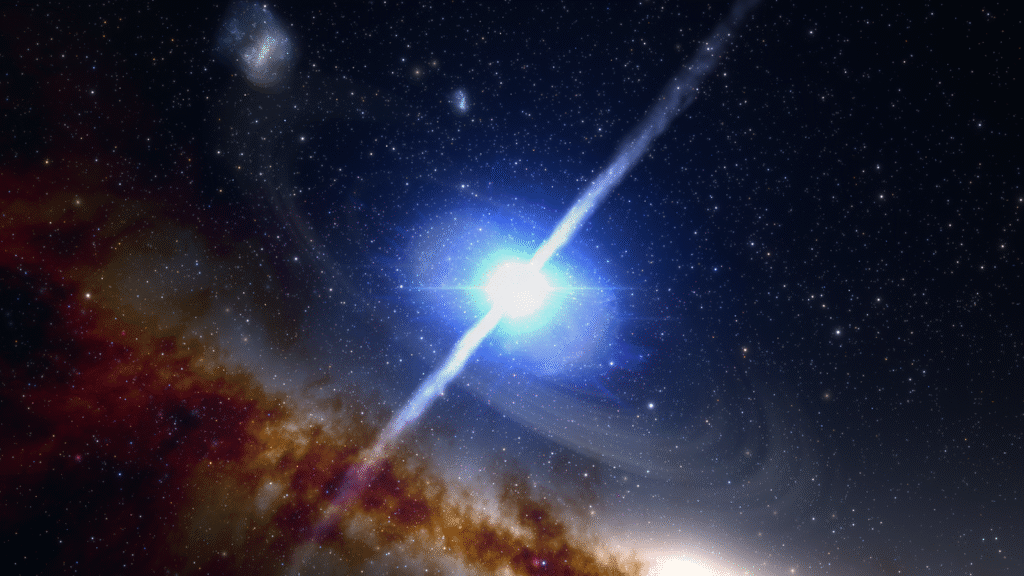
X-ray bursts on neutron stars represent some of the universe’s most intense displays, where accumulated material from companion stars ignites in thermonuclear firestorms. These events, lasting seconds to minutes, emit radiation detectable across vast distances and offer clues to element synthesis. The newly measured nuclei influence the ignition threshold and propagation of these bursts, making their properties pivotal.
In the dense layers atop a neutron star, unstable nuclei facilitate rapid proton captures that build heavier elements. Faster reactions mean bursts ignite more readily and burn more completely, altering the observed light curves and spectral signatures. Observatories like those monitoring these phenomena will need updated models to interpret future detections accurately. This shift promises to resolve discrepancies between theoretical predictions and telescope observations.
Reshaping the Story of Cosmic Element Formation
Element formation in the universe extends beyond the Big Bang’s light elements, relying on stellar interiors for heavier building blocks. Neutron star explosions contribute uniquely by providing conditions for processes that standard stars cannot achieve. The accelerated nuclear reactions revealed in these measurements suggest a more prolific role for such events in dispersing rare isotopes across galaxies.
Traditional views positioned these bursts as minor players compared to supernovae, but the data indicates they could account for a larger share of certain medium-mass elements. This reevaluation affects models of galactic chemical evolution, where the timing and distribution of elements influence star formation rates. Scientists now anticipate that incorporating these faster rates will yield more accurate abundance patterns observed in ancient stars.
Experimental Milestones and Broader Impacts
The precision measurements stemmed from collider experiments designed to replicate neutron star conditions, pushing the boundaries of nuclear physics. Facilities equipped with high-resolution detectors captured the decay signatures of the unstable nuclei, yielding data with unprecedented fidelity. This approach not only validated theoretical frameworks but also exposed gaps in our knowledge of exotic matter.
Beyond astrophysics, the results inform nuclear engineering and materials science by illuminating behaviors of unstable isotopes. Ongoing collaborations between observatories and particle labs will likely accelerate further discoveries. For instance, upcoming missions targeting X-ray sources could cross-verify these findings through real-time burst analysis.
- Enhanced reaction speeds increase burst frequency in binary systems.
- Improved models predict brighter, more variable X-ray emissions.
- Greater efficiency in element production aligns with observed cosmic abundances.
- New data refines predictions for gravitational wave counterparts to bursts.
- Interdisciplinary applications extend to fusion research on Earth.
Key Takeaways
- Faster nuclear reactions challenge prior models of X-ray burst dynamics.
- Unstable nuclei play a decisive role in forging elements during stellar explosions.
- These insights pave the way for more precise cosmic evolution simulations.
As these measurements redefine the mechanics , they remind us how the universe’s most violent events underpin the chemistry of life itself. What aspects of cosmic element formation intrigue you most? Share your thoughts in the comments below.