
You have probably watched a dog stare at a blank wall and felt a tiny shiver of unease. Are they seeing something you cannot, or are they just being weird in that uniquely dog way? When you dig into what modern veterinary neuroscience and sensory biology suggest, the simple answer is: your dog’s brain and senses really are picking up things that your own nervous system no longer notices. You are not dealing with anything mystical, but you are dealing with a very old story written into mammal brains over millions of years. Your dog, in many ways, is a living fossil of ancient sensory abilities, while you are the high-tech but slightly dulled upgrade. Wall-staring is where those two evolutionary paths collide in your living room, and once you understand what might be happening, you will never see that “blank” wall as truly blank again.
How Dogs’ Brains Process the World You No Longer Perceive

You and your dog walk through the same room, but your brains build totally different versions of it. Your visual cortex is tuned for detail, color, and faces; your dog’s brain devotes a huge amount of space to smell and subtle motion detection. To you, a wall is just a light-colored rectangle; to your dog, it is a layered map of scents, sounds, air currents, and faint movements that your brain quietly throws away as “irrelevant noise.” When your dog locks onto a blank wall, their brain is not going “nothing is there.” It is more like a radar station flagging odd little signals in the static. Tiny changes in light, a faint buzz in the wiring, the trace scent of a mouse that scurried behind the drywall last night – all of that becomes a meaningful pattern. You lost the wiring to turn those subtle cues into a full-blown “something is happening here” experience a very long time ago; your dog did not.
The Idea of Ancient Biosignatures: Traces of Life You’re Blind To

When you hear “biosignatures,” you might think of astronomers hunting for life on distant planets, but you deal with biosignatures every day without realizing it. A biosignature is any signal left by a living organism: chemical traces, heat, movement, sound, or electromagnetic changes. You still pick up some of these signals consciously – like the smell of smoke or the sound of footsteps – but your sensory world is a stripped-down, city version of what your ancestors knew in the wild. Your dog, by contrast, treats biosignatures as a full-sensory broadcast. That “empty” corner can carry the lingering heat of a body that leaned there, the faint chemical breaths from mold spores, the ultra-subtle vibration of insects inside the wall, or tiny airflow shifts that hint at hidden cavities and critters. You tend to notice only what directly threatens or interests your modern life; your dog’s nervous system is still tuned to a landscape where every small sign of life matters.
What You Lost 200,000 Years Ago: The Trade-Off of Being Human
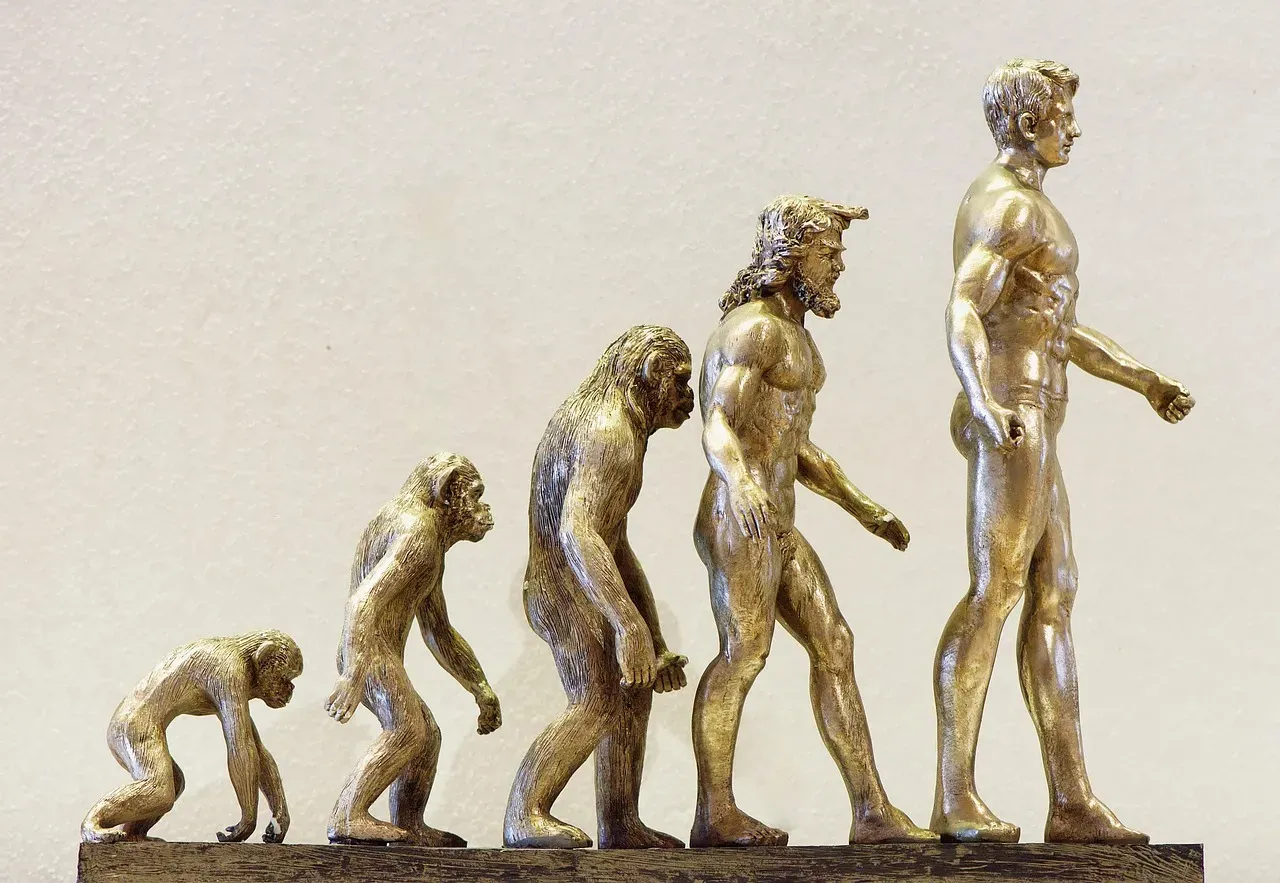
Around two hundred thousand years ago, humans took a sharp turn in brain evolution. You gained powerful frontal lobes, complex language, abstract thinking, and the ability to imagine futures and build cultures. To make room for that, your sensory system did not just become more powerful across the board; it became more selective. You got better at ignoring information than at adding new channels. This “filter upgrade” meant you could focus on tools, plans, stories, and social games instead of every rustle in the grass. Over many generations, you gradually lost the fine-grained awareness of faint smells, tiny motions, and small shifts in temperature or sound that your survival no longer depended on. Dogs, and other animals, kept more of those ancient detection abilities, because their daily reality still revolved around tracking prey, avoiding predators, and reading their environment second by second.
Why Dogs Fixate on Blank Walls: Not Ghosts, Just Hyper-Detection

So when your dog stares at a blank wall, try assuming they are not seeing a ghost but running a sophisticated surveillance scan. They might be following the slow path of a mouse behind the drywall, tracing where a lizard crawled hours ago, or listening to tiny structural creaks that signal a person moving on the other side of the house. Your brain hears “silence” and sees “nothing,” but their brain flags a puzzle worth solving. You know how you can get sucked into a TV show while someone else in the room is bored out of their mind? That wall is your dog’s version of an intense documentary. They are tracking biosignature clues that are genuinely meaningful to them: life, movement, history, risk, opportunity. To you, it is just paint on plaster; to them, it is a dense, living timeline written in signals you stopped reading a very long time ago.
What Veterinary Neuroscience Actually Supports – and What It Doesn’t

You will not find a serious veterinary neuroscience textbook saying, flat-out, that dogs are tracking some mystical category of biosignatures humans “lost” on a specific date. What you will find, over and over, is evidence that dogs can smell, hear, and detect certain cues at levels you simply cannot. You can see this in studies of their ability to detect medical conditions, track scents over long distances, and respond to extremely faint sounds or movements. So when you connect those dots, the idea that they are responding to real, physical, life-related signals in walls or corners is not far-fetched at all. What is more speculative is trying to pin that to a specific number of years or a single evolutionary event. It is safer, and more honest, to say: you narrowed your sensory world to favor complex thought, while dogs kept a more ancient, lower-level sensitivity. The headline version sounds dramatic; the science version says the same thing in slower, more cautious language.
Health Check: When Wall-Staring Is a Red Flag Instead of a Superpower

You should also know that sometimes, staring at walls is not a sign of impressive biosignature tracking but a possible health issue. In older dogs especially, prolonged fixation on corners or walls can be linked to cognitive dysfunction, vision or hearing problems, neurological disease, pain, or even seizures. If your dog seems disoriented, anxious, or unreachable while they stare, that is not just “being tuned into another dimension” – it is a cue to call your vet. Think of it the same way you would treat a friend who suddenly zones out in the middle of a conversation and seems confused. You would not just shrug and say they are deeply contemplative; you would want a doctor to check in. Your dog deserves the same caution. Enjoy the idea that they perceive more of the world than you do, but stay grounded: intense, repetitive, or new wall-staring behavior, especially with other changes in mood or movement, is a medical question first.
How to Live With a Creature That Sees a Different Universe

Once you accept that your dog’s sensory universe is richer and stranger than yours, your relationship subtly shifts. Instead of brushing off their “weird” behavior, you can start treating it as a piece of information: something in the room, the wall, or the environment is different for them, even if you cannot directly confirm it. You do not need to believe in anything supernatural to respect that difference. You can even start using it. If your dog repeatedly fixates on the same spot, maybe you check for drafts, pests, mold, or wiring issues. If they grow uneasy in one room at certain times, maybe you look for noises, smells, or vibrations you missed. You would not ignore an overly sensitive smoke alarm without at least checking the battery and the kitchen; your dog’s ancient sensory system deserves at least that level of curiosity.
Reclaiming a Tiny Piece of Your Lost Animal Awareness

You cannot regrow the sensory hardware you lost over hundreds of thousands of years, but you can train your attention. When your dog locks onto a wall, instead of rolling your eyes, pause and quietly tune in. Can you hear a faint buzz, feel a draft, smell something off, notice a tiny pattern of light or shadow? You will not catch everything they do, but you might be surprised by how much more you sense once you stop telling yourself “nothing is there.” In a way, your dog is offering you a shortcut back into a more ancient way of being in the world. They are like a guide pointing out details in a painting that you used to walk past without a glance. You still live in the same house, but with their help, the house becomes a little more alive, a little more layered, a little more worthy of your attention.
Conclusion: The Wall Is Not Empty – And Neither Is Your Dog’s Mind

When you watch a dog stare at a blank wall, you are seeing the clash between two evolutionary strategies. Yours favors ideas, language, and planning; theirs clings to old, finely tuned detection of life’s tiniest fingerprints. The poetic way to say it is that they are tracking biosignatures you lost long ago; the scientific way is that they are simply picking up real, subtle cues your brain has been trained to ignore. If you let that sink in, wall-staring stops being creepy and becomes a gentle reminder that you share your home with a mind that lives closer to your wild ancestors than you do. Maybe the real question is not “What is wrong with my dog?” but “What have I stopped noticing?” Next time your dog fixates on a blank space, will you dismiss it, or will you stand beside them and wonder, for just a moment, what they still sense that you no longer can?