
Unraveling the Galactic Center Enigma (Image Credits: Upload.wikimedia.org)
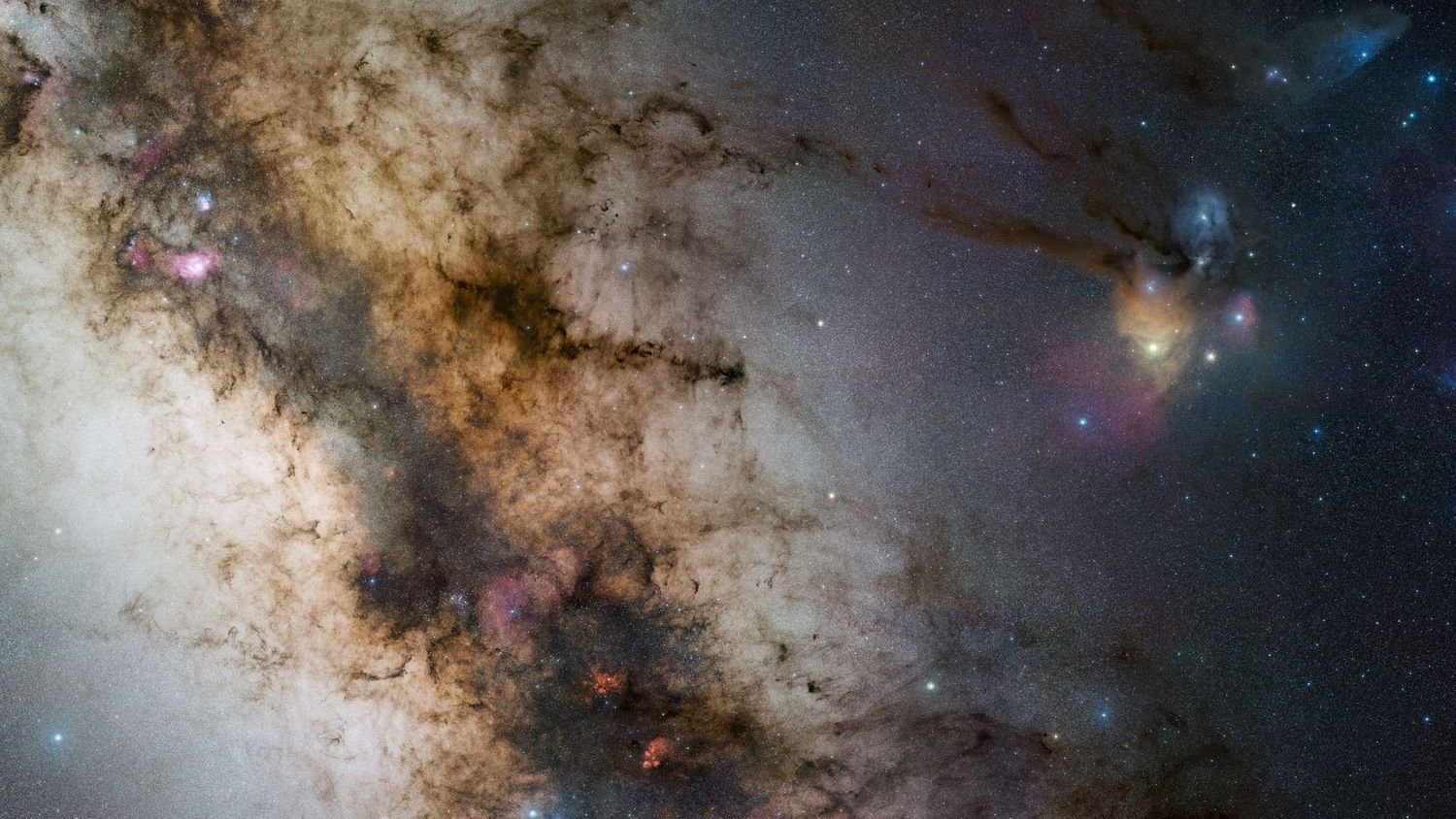
Deep within the Milky Way’s bustling core, compact clouds of ionized gas have intrigued astronomers for years as they traced elliptical paths around the supermassive black hole Sagittarius A*. These elusive structures, labeled G1, G2, and G2t, appeared too dense and organized to stem from random galactic debris. A new study spearheaded by researchers from the Max Planck Society now proposes a compelling origin story rooted in the violent interactions of a nearby massive binary star system.
Unraveling the Galactic Center Enigma
Astronomers first spotted these gas clouds through meticulous observations of the region surrounding Sagittarius A*, our galaxy’s central behemoth with a mass equivalent to four million suns. The clouds stood out for their compact nature and ionized state, meaning their gas atoms had lost electrons, likely due to intense radiation or high temperatures. Despite extensive monitoring, their formation mechanism remained elusive until recent advances in data analysis.
Each cloud follows a similar orbital trajectory, hugging close to the black hole without being swallowed, which hinted at a common birthplace. Past theories suggested tidal disruptions or other cataclysmic events, but none fully accounted for their shared characteristics. The Max Planck team shifted focus to the dynamic environment just beyond the black hole’s immediate influence.
Spotlight on IRS 16SW: A Massive Binary Powerhouse
Nestled near the Milky Way’s heart lies IRS 16SW, a binary star system comprising two enormous stars locked in mutual orbit. Such massive stars unleash powerful stellar winds – streams of charged particles ejected at high speeds from their surfaces due to extreme internal pressures. In isolation, these winds disperse harmlessly, but proximity in a binary setup changes everything.
When the winds from each star collide head-on, they create shock fronts where material compresses and heats up dramatically. This process generates dense, ionized clumps capable of surviving the harsh galactic center conditions. The researchers pinpointed IRS 16SW as the ideal candidate because its location and wind dynamics align precisely with the clouds’ positions.
Bridging Observations with Cutting-Edge Simulations
The breakthrough came from combining fresh observational data with sophisticated computer simulations. Telescopes captured the clouds’ motions and compositions, revealing consistencies in velocity and density that mirrored expected outputs from binary wind collisions. Simulations modeled the stellar winds’ behavior over time, replicating how periodic interactions could eject cloud-like blobs into nearby orbits.
Key to the match was the timing: the binary’s orbital period influences wind collision frequency, producing clouds at intervals that correspond to G1, G2, and G2t sightings. Researchers adjusted parameters like wind speeds and star masses to fine-tune the models, achieving striking agreement with real-world data. This longer investigative phase underscored the complexity of modeling such extreme environments, where gravity, radiation, and magnetism interplay fiercely.
One simulation sequence even predicted subtle variations in cloud shapes, echoing irregularities noted in observations. While not definitive proof, the alignment strongly favors this scenario over alternatives. The Max Planck-led effort drew on multi-wavelength data, from infrared to X-rays, to validate the ionized nature of both simulated and observed clouds.
Orbits Align, Puzzle Pieces Fit
The clouds’ synchronized paths around Sagittarius A* provided crucial evidence. G1, G2, and G2t all trace elongated ellipses perturbed by the black hole’s gravity, yet retain structural integrity suggestive of recent formation. IRS 16SW’s position allows wind-ejected material to be captured into these orbits, explaining the proximity without direct black hole involvement.
This orbital kinship rules out unrelated origins, as coincidental alignments would be statistically improbable in the crowded core.
Glimpses into a Turbulent Cosmic Nursery
This discovery illuminates the lively stellar activity sustaining the galactic center’s ecosystem. Binary stars like IRS 16SW act as factories for exotic structures, influencing black hole environs without direct accretion. Future observations may track additional clouds or refine wind models, potentially revealing more about Sagittarius A*’s quiescent state.
Though uncertainties linger – such as exact wind compositions – the work marks a pivotal step in decoding the Milky Way’s heart. Astronomers anticipate refined telescopes will test these predictions, bringing sharper clarity to one of the sky’s most formidable realms.