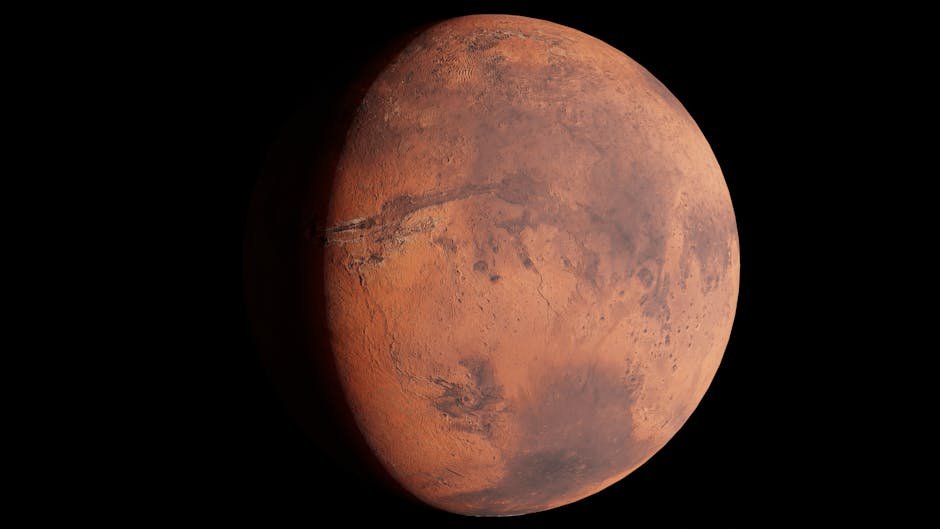
Chasma Boreale: A Canyon Carved in Ice (Image Credits: Pexels)
Future missions to Mars will need to navigate the planet’s harsh seasonal shifts, particularly around its poles where ice covers vast regions. A recent image from NASA’s Mars Reconnaissance Orbiter captures this dynamic process in action at Chasma Boreale, a massive canyon in the northern polar cap. As spring advances, the seasonal ice recedes, exposing underlying dunes and offering clues about the Red Planet’s climate and winds.[1][2]
Chasma Boreale: A Canyon Carved in Ice
The landscape of Chasma Boreale stretches across the northern polar region of Mars, forming a deep valley that slices into the planet’s layered ice deposits. Towering walls rise up to 4,600 feet, or about 1,400 meters, above the flat floor below, creating a dramatic chasm hundreds of kilometers long.[1] This feature exposes layers of ice and dust that record millions of years of the planet’s history.
During the Martian winter, seasonal frost blankets the area, primarily composed of carbon dioxide ice. Spring brings warmer temperatures relative to winter, triggering changes that reshape the surface. Scientists monitor these shifts closely because they reveal how volatiles cycle on Mars, influencing the thin atmosphere.
Spring Sublimation in the Northern Cap
On Mars, what appears as melting is actually sublimation – the direct transition of ice from solid to gas without a liquid phase. The seasonal polar cap consists mostly of dry ice, or frozen CO2, which evaporates under the strengthening sunlight of spring. Dark patches emerge first where this process accelerates, often around dunes that absorb heat.[3]
This phenomenon repeats each Martian year, with the northern cap retreating significantly by summer. Observations from the High Resolution Imaging Science Experiment, or HiRISE camera, aboard the Mars Reconnaissance Orbiter document these transitions in remarkable detail. The latest view highlights receding ice edges, underscoring the active nature of Mars’ poles.
Dunes as Wind Recorders
Crescent-shaped dunes dominate the floor of Chasma Boreale, their sharp horns pointing in the direction of prevailing winds. These barchan dunes migrate slowly across the surface, shaped by gusts that sweep through the canyon. As the overlying frost sublimates, the dunes become fully visible, providing a snapshot of atmospheric circulation.[1]
Wind patterns here differ from those at lower latitudes, influenced by the polar topography and seasonal CO2 release. Researchers use repeated HiRISE images to track dune movement, estimating wind speeds and directions over time. Such data helps model Mars’ weather, essential for rover operations and future lander designs.
- Crescent-shaped barchans indicate unidirectional winds.
- Dunes emerge post-sublimation, revealing darker sand.
- Movement rates offer insights into polar wind regimes.
- Similar features appear annually, allowing year-to-year comparisons.
Monitoring Seasonal Dynamics
NASA’s long-term observations at Chasma Boreale build on images dating back to the orbiter’s arrival in 2006. Earlier captures, such as one from northern spring in 2008, showed similar dark patches of sublimating ice amid dunes.[3] These repeat visits confirm the predictability of the cycle while noting subtle variations, possibly due to dust storms or orbital changes.
The HiRISE team targets this region frequently because it exemplifies polar processes. Sublimation releases CO2 into the atmosphere, temporarily thickening it and fueling global winds. Understanding these exchanges remains crucial, as they affect surface temperatures and potential habitability zones.
Lessons for Mars Exploration
Images like this one inform site selection for missions, highlighting risks from shifting ice and dust. Polar regions hold water ice reserves, vital for propellant production in human outposts, but seasonal extremes demand robust planning. The visual parallel to Earth’s springs reminds us that Mars, though alien, follows orbital rhythms familiar to life here.
Yet uncertainties persist: how much water ice lies beneath the CO2, and how climate change might alter these patterns. Ongoing HiRISE monitoring will continue to refine models, bridging the gap between remote sensing and boots on the ground. For now, Chasma Boreale stands as a testament to Mars’ enduring geological vitality.