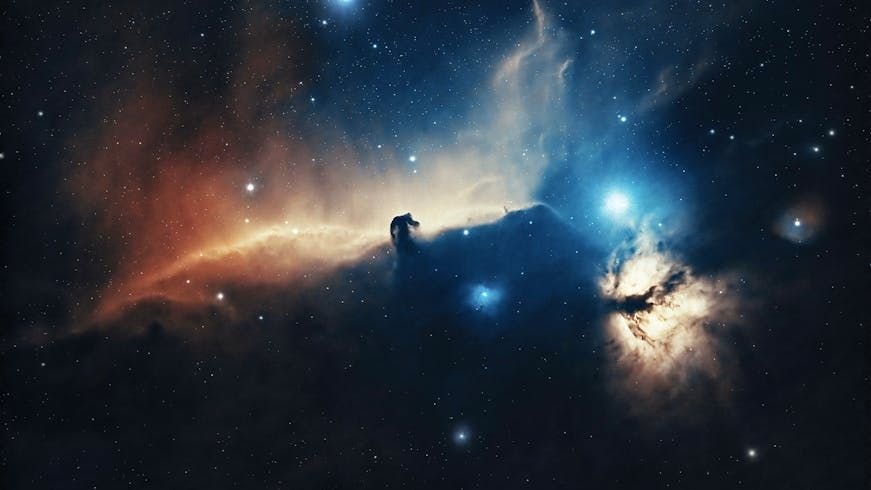
A Glowing Anomaly in the Early Cosmos (Image Credits: Pexels)
Astronomers have identified a distant gas clump that glows with the signature of extreme radiation, offering what may be the strongest clue yet to the existence of the universe’s inaugural stars. Located just 450 million years after the Big Bang, this pristine cloud shows no trace of heavy elements, only the primordial mix of hydrogen and helium forged in the cosmic dawn. Observations from the James Webb Space Telescope suggest powerful sources within it, potentially the massive, short-lived stars that kickstarted cosmic evolution.[1]
A Glowing Anomaly in the Early Cosmos
The gas clump, nicknamed Hebe after the Greek goddess of youth, first appeared in telescope images in 2024. Follow-up observations in 2025 with James Webb’s advanced instruments captured its spectrum in unprecedented detail. Researchers noted bright emissions from highly ionized helium, known as HeII, alongside energized hydrogen lines. These signals point to an intense source of ultraviolet radiation capable of stripping electrons from atoms deep within the cloud.[1]
Hebe spans up to 1,200 light-years and contains two distinct clusters with a total mass equivalent to 10,000 to several hundred thousand suns. Such heft in a compact region implies a sparse population of enormous stars rather than a dense swarm of smaller ones. The absence of spectral lines from carbon, oxygen, or other metals seals its status as chemically untouched, a relic from before stellar fusion enriched the universe.
Signatures of Population III Stars
Population III stars represent the theoretical first generation, born solely from Big Bang remnants without heavier elements to inhibit collapse. Models predict these behemoths reached 300 to 1,000 times the sun’s mass, burning fiercely for mere millions of years before exploding as supernovae. Their intense radiation would ionize surrounding gas, producing the exact helium and hydrogen glow observed in Hebe.
“It’s a textbook case for the first generation of stars,” stated Roberto Maiolino of the University of Cambridge, a lead researcher on the studies. He emphasized that alternative explanations, such as active black holes or exotic phenomena, fail to match the pristine chemistry and emission profile.[1]
Prior hints of these stars surfaced around one billion years post-Big Bang, but Hebe pushes the timeline back dramatically. This earlier detection aligns with simulations placing their debut a few hundred million years after cosmic inception, over 13.5 billion years ago.
Unusual Neighborhood Raises Questions
Hebe resides near GN-z11, a galaxy boasting one billion solar masses despite its youth. This proximity puzzles theorists, as evolved galaxies typically spew metals that contaminate nearby gas. Some simulations argue such environments preclude pristine star formation, yet others propose gravitational tides could funnel untouched gas pockets inward.
| Property | Hebe Gas Clump | Typical Early Galaxy Gas |
|---|---|---|
| Heavy Elements | None detected | Present (C, O, etc.) |
| Key Emissions | HeII, H lines | Broader metal lines |
| Age Post-Big Bang | 450 million years | ~1 billion years (prior candidates) |
Seiji Fujimoto of the University of Toronto, who analyzed the findings independently, noted that Hebe’s position “opens up new questions about how such systems form and survive.”[1] Resolving this tension will refine models of early galaxy assembly.
Three Studies Bolster the Claim
The evidence stems from three preprints posted to arXiv on March 20, 2026. One confirms the lack of metal lines at redshift z=10.6, corresponding to Hebe’s distance. Another details the pristine gas confirmation using JWST’s GA-NIFS and JADES instruments. A third constrains the stellar mass distribution, favoring a handful of giants over multitudes of dwarfs.
- Searched for Population III signatures via HeII emitter without metals.
- Mapped gas dynamics near GN-z11.
- Estimated cluster properties from luminosity and size.
These coordinated analyses minimize observational biases, strengthening the case amid JWST’s growing catalog of high-redshift oddities.
Toward Unlocking Cosmic Origins
Hebe’s discovery boosts prospects for spotting more Population III remnants, illuminating the epoch when darkness yielded to light. As JWST peers deeper, it promises to map these stars’ role in reionizing the universe and seeding the first galaxies. Yet uncertainties linger: Is Hebe truly isolated in its purity, or does it herald a hidden population blending old and new chemistries? Future spectra may confirm if these ancient forges truly ignited the stellar age.