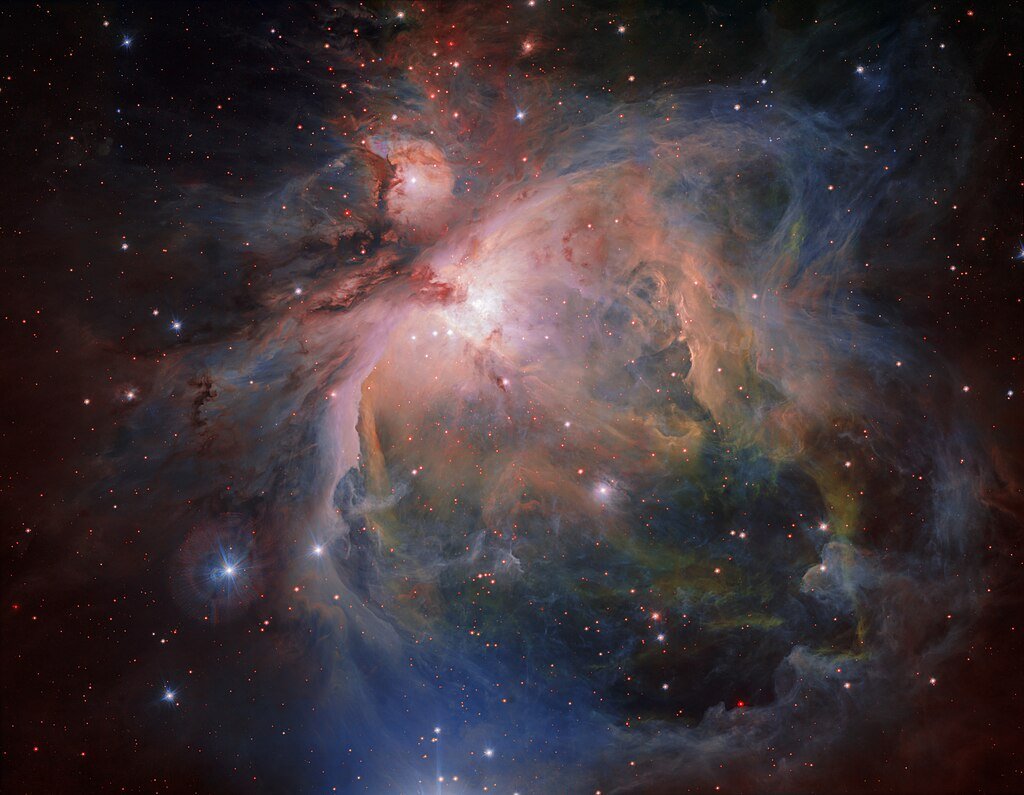
In a stunning new view that blends beauty with deep scientific insight, the Hubble Space Telescope has once again turned its gaze toward one of the most dynamic stellar nurseries in our galaxy. The result is a vivid, almost surreal portrait of young stars emerging within the turbulent heart of the Trifid Nebula—a region where cosmic creation is actively unfolding.
Captured to mark Hubble’s 36th anniversary, the image does more than dazzle. It offers a rare opportunity to observe changes in a star-forming region over human timescales, revealing a universe that is far more dynamic and alive than static images might suggest.
A Stellar Nursery Frozen and Unfrozen in Time
The Trifid Nebula, located roughly 5,000 light-years from Earth, is a relatively young and active region of star formation. It is filled with dense clouds of gas and dust where gravity is constantly pulling material together to form new stars.
What makes this latest observation remarkable is its comparison to earlier images taken in 1997. Over nearly three decades, subtle but measurable changes have occurred, offering astronomers a rare glimpse of evolution happening in real time.
This is not just a snapshot—it is part of a long-term cosmic time-lapse.
The Cosmic Sea and Its Hidden Engine
At the center of the image lies a striking structure often described as resembling a “cosmic sea lemon.” This dusty formation appears to glide through space, shaped by intense radiation and stellar winds.
Embedded within it is a young protostar that is actively ejecting jets of plasma. These jets, known as Herbig-Haro objects, are visible as streaks of energized gas shooting outward over centuries.
They act like cosmic fingerprints, allowing scientists to measure energy output and better understand how young stars influence their surroundings.
Light That Creates and Destroys
The nebula’s glowing appearance is driven by powerful ultraviolet radiation from massive nearby stars. This radiation carves cavities into the surrounding gas, creating the intricate patterns seen in the image.
At the same time, this process triggers new waves of star formation by compressing nearby material. It is a paradoxical cycle—destruction fueling creation on a grand scale.
In essence, the nebula is both being shaped and reshaped by the very stars it produces.
A Living Laboratory for Star Formation
Astronomers are particularly excited about what this image reveals scientifically. By comparing data across decades, they can track how fast gas flows, how much energy is injected into the environment, and how stars interact with their birth clouds.
These insights are crucial for understanding how stars like our Sun formed billions of years ago. The Trifid Nebula serves as a nearby laboratory where these processes can be studied in detail.
It transforms abstract theories into observable, measurable phenomena.
Technology That Keeps Revealing More
One reason this new image is so detailed is the upgraded instrumentation aboard Hubble. Its Wide Field Camera 3 offers greater sensitivity and a broader view than earlier instruments.
This technological evolution allows astronomers to revisit familiar objects and uncover entirely new details. Even regions observed decades ago can yield fresh discoveries when seen through more advanced tools.
It is a reminder that scientific progress often comes not from new targets, but from new ways of seeing.
A Universe That Refuses to Stand Still
What makes this discovery so compelling is not just the beauty of the image, but the realization that the cosmos is constantly changing—even on timescales we can observe.
In my view, this is where astronomy becomes deeply humbling. The Trifid Nebula is not a distant, frozen relic—it is a living system, evolving, shifting, and creating new stars before our eyes. And if a nebula 5,000 light-years away can change within a human lifetime, it raises a profound thought—perhaps the universe is far more immediate, dynamic, and connected to us than we ever imagined.