
Most of what you can see, touch, or measure operates by rules that feel intuitive. Objects fall, light travels in straight lines, and causes produce predictable effects. Go small enough, though, and every one of those rules starts to quietly break down.
At the scale of atoms and subatomic particles, physics enters genuinely unfamiliar territory. The macroscopic realm, which consists of everything from falling balls to orbiting planets, can be explained by the laws of classical mechanics. When nature reaches the smallest scales, stranger quantum rules kick in, where particles do not have definite positions and can remain connected across vast distances. This is the quantum realm, and understanding it changes how you see absolutely everything.
The Building Blocks Beneath the Building Blocks

You’ve probably heard that atoms are the building blocks of matter. That’s true as far as it goes. Atoms are the building blocks of matter, but each atom is itself composed of electrons surrounding a heavy nucleus, bound together by the electromagnetic force. The nucleus is composed of protons and neutrons, which are themselves composed of quarks, bound together by the strong force.
Zoom in further and things get stranger still. The building blocks of atoms are particles, and the forces that bind the building blocks are also described by particles. All known subatomic phenomena can be described by particles and their interactions. When you look deeper, you see a rich landscape of quantum effects that rule the subatomic realm.
Quantum mechanics is often the only theory that can reveal the individual behaviors of the subatomic particles that make up all forms of matter, including electrons, protons, neutrons, and photons. It’s not a supplement to classical physics. At these scales, it’s the only description that actually works.
Superposition: Being in Two Places at Once Is Surprisingly Literal
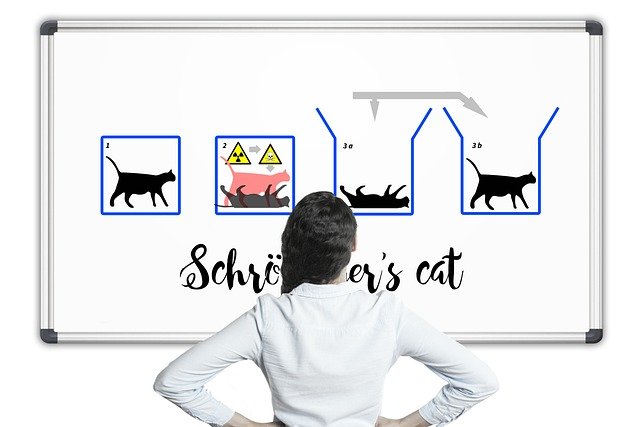
Of all the concepts in quantum physics, superposition tends to stop people in their tracks. One oddity of the quantum world is called superposition, in which a particle can exist in multiple locations at once, until it is observed. That’s not a metaphor or a shorthand. It’s a real physical condition that has been demonstrated experimentally across many decades.
Before measurement, a particle can exist in a superposition of states. The act of measurement collapses this superposition into one outcome. This is not about human consciousness; any physical interaction that extracts information counts as a measurement. The moment something interacts with the particle in a way that pins down its state, the range of possibilities narrows to one outcome.
Superposition is the doorway because it explains why quantum mechanics doesn’t behave like common-sense probability. It gives you interference, and interference gives you the patterns that make quantum experiments famous. It also explains how atoms can be stable, why energy levels are discrete, why particles can tunnel, and how entanglement creates correlations that aren’t built from independent pieces.
Quantum Entanglement: The Connection That Puzzled Einstein

Entanglement is the phenomenon that led Einstein to use the phrase “spooky action at a distance,” and it’s one of the most tested and verified features of quantum physics. Quantum entanglement describes a strange and powerful connection between quantum objects that remains intact even across vast distances. When two particles such as photons or electrons are entangled, their states are linked in such a way that the state of one instantly determines the state of the other, no matter how far apart they are.
Today, experimental work leaves no doubt that entanglement is real. Physicists have demonstrated its peculiar effects across hundreds of kilometers; in 2017, a Chinese satellite named Micius sent entangled photons to three different ground stations, each separated by more than 1,200 kilometers, and broke the distance record for entangled particles. That’s not a lab curiosity. That’s a global-scale experimental confirmation.
One common misconception is worth clearing up directly. It seems strange, because it appears that one of the entangled particles “feels” that a measurement is performed on the other and “knows” what the outcome should be, but this is not the case. This happens without any information exchange between the entangled particles. They could even be billions of miles away from each other and this entanglement would still be present.
Quantum Tunneling: How Particles Walk Through Walls
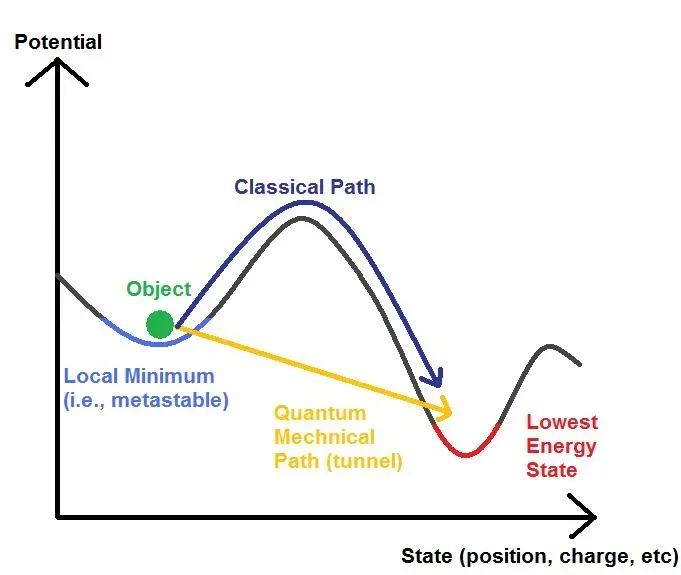
Quantum tunneling sounds like science fiction. In classical physics, if a particle doesn’t have enough energy to get over a barrier, it simply can’t cross. Quantum mechanics disagrees. Quantum tunneling happens when a particle passes through a barrier it couldn’t cross in classical physics. Imagine a ball trying to roll over a hill without enough energy – it just can’t. But a quantum particle, behaving like a wave, has a chance of appearing on the other side.
This isn’t just a theoretical curiosity. Tunneling plays an essential role in physical phenomena such as nuclear fusion and alpha radioactive decay of atomic nuclei. Tunneling applications include the tunnel diode, quantum computing, flash memory, and the scanning tunneling microscope. The Sun itself relies on quantum tunneling to sustain the nuclear fusion reactions that produce its energy.
Tunneling diodes use this effect to enable fast current switching, while newer transistors reduce power consumption by controlling particle tunneling. Flash memory devices also rely on quantum tunneling to store data, making electronic devices more power-efficient and smaller. Every time you save a file on your phone, quantum tunneling is part of the mechanism making it possible.
The Standard Model: Physics’ Most Successful Rulebook
If you want a single framework that organizes everything known about subatomic particles and the forces between them, the Standard Model is it. The Standard Model of particle physics is the theory describing three of the four known fundamental forces – electromagnetic, weak, and strong interactions, excluding gravity – in the universe and classifying all known elementary particles. It was developed in stages throughout the latter half of the 20th century, with the current formulation being finalized in the mid-1970s upon experimental confirmation of the existence of quarks.
Fermions, particles with spin-1/2, are the building blocks of matter, categorized into quarks and leptons. Quarks possess fractional electric charges and participate in all four fundamental forces, notably the strong interaction mediated by gluons. These particles combine in specific ways to form the protons and neutrons inside every atomic nucleus you’ve ever encountered.
The model is powerful, but it isn’t complete. It does not explain everything. Where dark matter fits into all this remains an open question. Why the universe is made of matter and not antimatter is another. And how to slide gravity into the Standard Model is yet another big challenge, since the Standard Model describes three fundamental forces important at the subatomic scale but doesn’t include gravity.
The Higgs Boson: The Particle That Gives Matter Its Mass
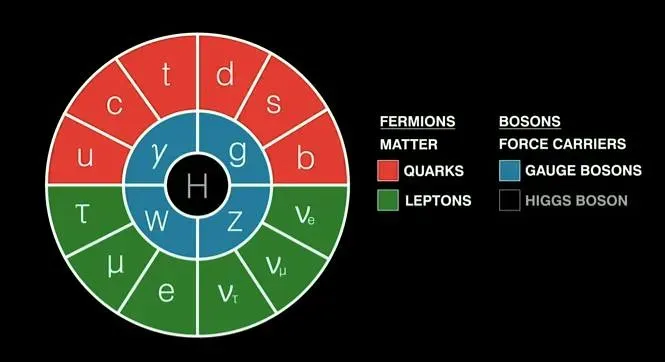
Of all the particles confirmed by experiment, the Higgs boson has probably generated the most public attention. It was confirmed on July 4, 2012, at CERN’s Large Hadron Collider after decades of searching. The Higgs boson is an elementary particle in the Standard Model of particle physics, produced by the quantum excitation of the Higgs field, one of the fields in particle physics theory. Without it, our understanding of why particles have mass would have a gaping hole in the center.
The Higgs boson is the carrier particle for the Higgs field, a field present throughout our universe, which gives particles their mass. The more a particle interacts with the Higgs field, the higher its mass. Think of it as an invisible medium filling all of space, and different particles wading through it with different amounts of resistance.
Subsequent investigations have revealed that the metastable vacuum in the Standard Model puts the universe on a knife-edge of cosmic collapse. Determining the ultimate fate of the universe and looking for physics beyond the Standard Model motivates further scrutiny of the Higgs sector. The Higgs boson answered one major question and immediately opened several more.
Quantum Mechanics in the Technology You Use Every Day
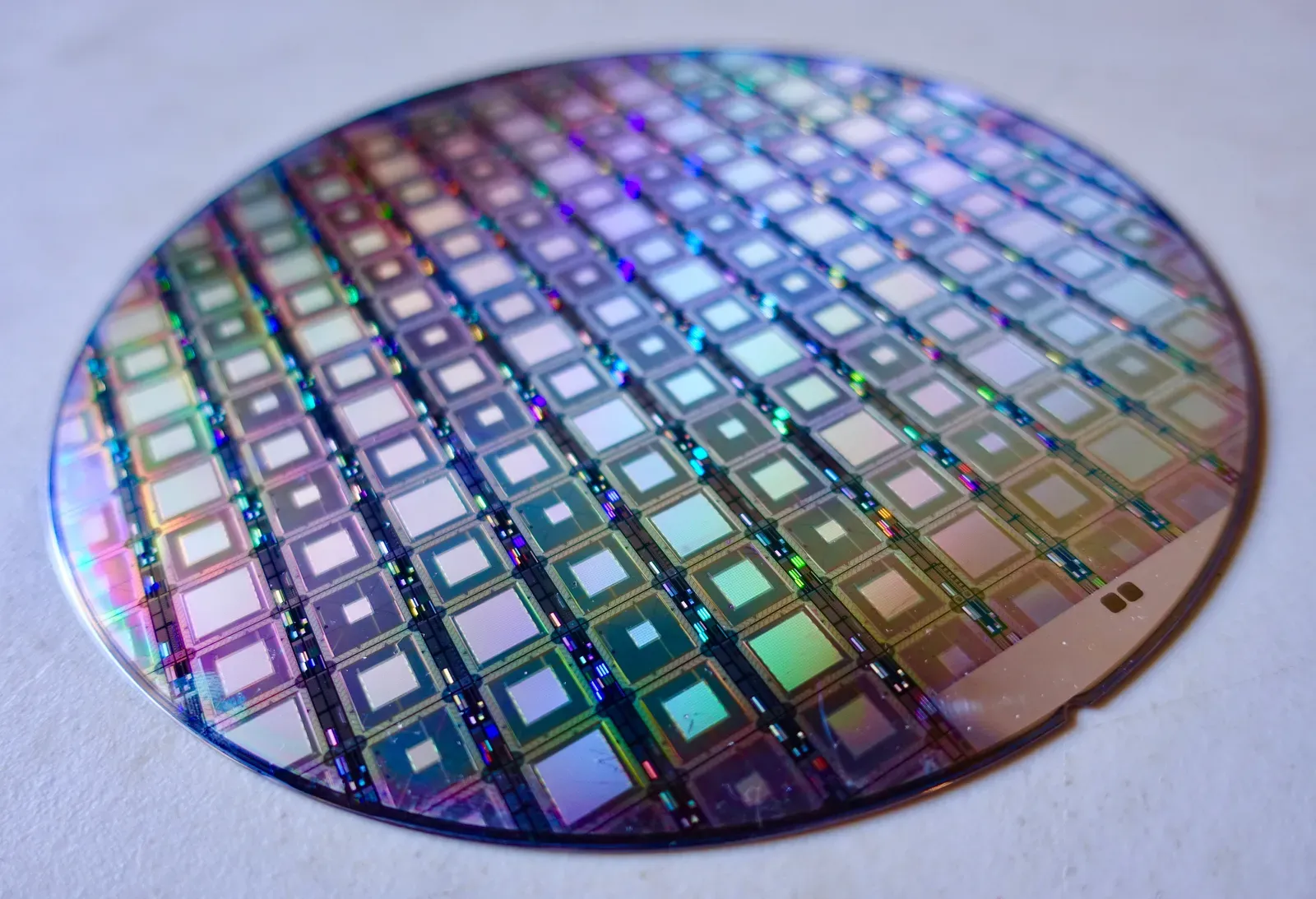
It’s easy to think of quantum physics as purely abstract. The reality is that it’s already deeply embedded in the technology surrounding you right now. Quantum physics underpins most modern technology. Semiconductors, lasers, LED screens, MRI scanners, and GPS satellites all rely on quantum effects. It also provides the theoretical foundation for understanding chemistry, materials science, and the behavior of stars.
Looking ahead, the next wave of quantum applications is already taking shape. In quantum computing, superposition enables the parallel processing and transmission of large amounts of information. Since quantum bits, or qubits, can exist in multiple states at once, quantum computers can process vast amounts of information in parallel. This capability boosts performance dramatically, allowing machines to run complex algorithms far more efficiently than traditional computers.
Quantum technologies make it possible to control, manipulate, and measure the states and interactions of individual quantum particles, opening the door to entirely new devices and systems built on quantum mechanical principles. Key developments include atomic clocks, quantum gravimeters, quantum computers, and quantum magnetometers. Quantum technology is no longer a purely theoretical field – it has already begun to enter the marketplace.
Conclusion: The Small Shapes Everything Large
The quantum realm is not a distant or abstract domain. It is the underlying layer of physical reality from which every macroscopic thing you’ve ever seen or touched emerges. The chair you sit in, the light you read by, the stars you look up at – all of it is the result of quantum rules playing out at scales far too small to observe directly.
Quantum mechanics has had enormous success in explaining many of the features of our universe, with regard to small-scale and discrete quantities and interactions which cannot be explained by classical methods. It is often the only theory that can reveal the individual behaviors of the subatomic particles that make up all forms of matter. That’s not a narrow achievement. It’s a description of the foundation beneath everything.
What makes the quantum realm genuinely fascinating is not just its strangeness, but the fact that its strangeness is productive. Superposition builds computers. Entanglement secures communications. Tunneling stores your data. The deeper science goes into the fabric of the universe, the more useful it becomes. That, more than any single discovery, is the real story of quantum physics.