A Founding Gift That Outlasted a Famine-Ravaged Dream (Image Credits: Instagram)
Southern Chile – Archaeologists recently unearthed a ceremonial silver coin that precisely locates the lost 16th-century Spanish colony known as Rey Don Felipe.[1]
Established amid fierce European rivalries over the Strait of Magellan, the outpost endured less than three years before succumbing to relentless harsh weather and isolation. The artifact, tucked beneath a church cornerstone, aligns perfectly with historical records and opens doors to mapping the entire settlement.[1]
A Founding Gift That Outlasted a Famine-Ravaged Dream
Over 350 settlers arrived with high hopes, only to face starvation and death in the unforgiving Patagonian wilderness. Most perished within a few years, their ambitious outpost reduced to ruins and later rechristened Puerto del Hambre – Port Famine – by English explorer Thomas Cavendish.[1]
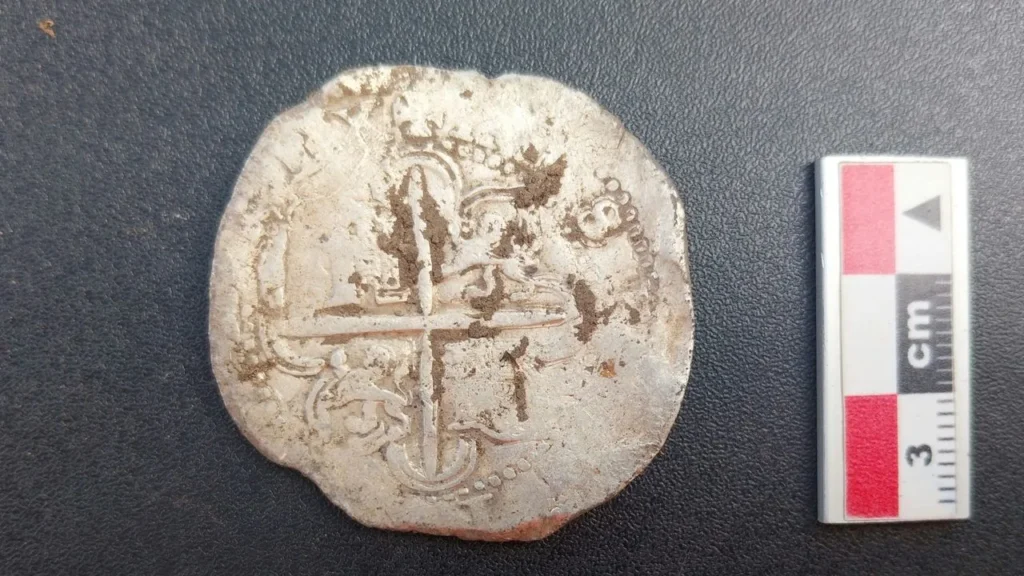
Yet one item survived intact: a silver coin placed deliberately on March 25, 1584, during the colony’s ceremonial founding. This relic endured where human endeavor failed, preserving a tangible link to Spain’s bold but doomed expansion into the New World’s southern frontier.[1]
Pedro Sarmiento de Gamboa’s Strategic Outpost
Spanish navigator Pedro Sarmiento de Gamboa spearheaded the creation of Rey Don Felipe to secure Spanish dominance around the Strait of Magellan. He positioned the settlement at what felt like the edge of the known world, constructing essential buildings including a modest church, homes, and storage facilities.[1]
Historical maps from the era depicted these structures, but their precise whereabouts faded into obscurity after the colony’s collapse. De Gamboa’s own writings detailed the coin’s placement upon a stone in the church, a detail that would prove crucial centuries later.[1]
High-Tech Hunt Yields Historic Breakthrough
A team led by historian Soledad Gonzalez Diaz from Bernardo O’Higgins University in Santiago employed advanced tools to revive the site. High-precision geolocation and metal detectors guided excavations to promising spots, building on the 2019 recovery of two bronze cannons from the same location.[1]
Researchers from Chile’s Center for Historical Studies and Humanities and Austral University of Chile uncovered the coin exactly as de Gamboa described: resting on a stone under the church’s cornerstone. “Most impressively, it was uncovered in the exact location and position described by Sarmiento in his writing on the Strait of Magellan: resting upon the surface of a stone within the small church they had built,” stated a joint release from the institutions.[1]
Secrets Encoded in a Global Currency
The artifact proved to be a silver “real de a ocho,” minted in Potosí, present-day Bolivia. One side bore a Jerusalem cross, the other Philip II’s coat of arms, marking it as one of history’s first truly international coins used across Europe, the Americas, and Asia.[1]
Placed as a ceremonial offering, the coin symbolized the colony’s aspirations. Gonzalez Diaz highlighted its value: “This discovery provides a rare and powerful point of convergence between written sources and archaeological evidence. It not only helps to confirm the location and layout of key structures within the settlement but also opens new possibilities for reconstructing its spatial organization.”[1]
- 1584: Colony founded; coin placed in church foundation on March 25.
- Late 1580s: Most settlers die; site abandoned.
- ~1587: Thomas Cavendish renames it Port Famine.
- 2019: Two bronze cannons found.
- 2024: Ceremonial coin excavated after 440 years.
Key Takeaways
- The coin verifies de Gamboa’s accounts and the settlement’s layout.
- It enables future digs into homes and storage areas shown on 16th-century maps.
- This convergence of text and artifact illuminates Spain’s failed Patagonian venture.
This unassuming silver piece has resurrected a forgotten chapter of exploration and tragedy, anchoring history to the soil of southern Chile. As excavations continue, more layers of the past may emerge from Puerto del Hambre. What other relics might surface next? Tell us in the comments.[1]