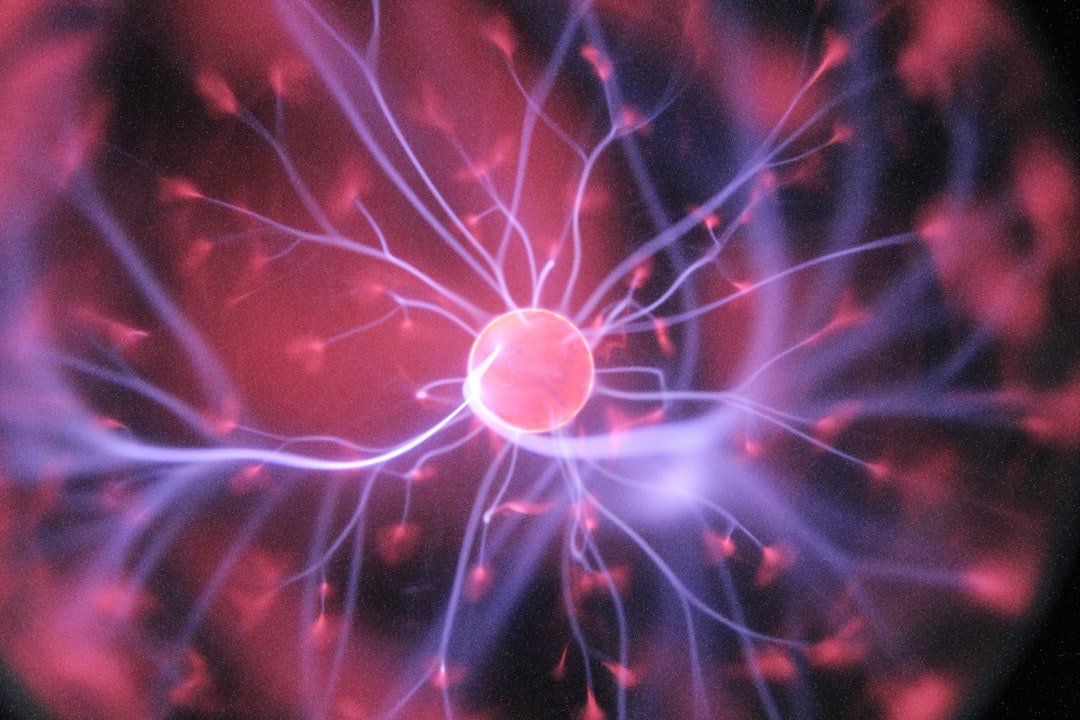
Overcoming Long-Standing Simulation Hurdles (Image Credits: Unsplash)
Researchers have achieved a significant advance in understanding the strong nuclear force through sophisticated computer simulations of particle interactions. For the first time, scientists observed entanglement between a meson and a baryon during a collision, providing fresh insights into quantum behaviors at the subatomic scale. This development moves beyond earlier limitations and promises to deepen knowledge of hadron physics.
Overcoming Long-Standing Simulation Hurdles
Simulating collisions between baryons and mesons has long demanded crude approximations of the fundamental forces at play. These particles, fundamental building blocks of atomic nuclei, interact via the complex strong force governed by quantum chromodynamics. Traditional approaches simplified these dynamics, often neglecting key quantum effects.
Recent work eliminated many of those shortcuts. By leveraging advanced computational methods, the team modeled the interactions with unprecedented fidelity. This allowed a direct examination of wavepacket behaviors during high-energy encounters.
First Real-Time Glimpse of Particle Entanglement
In a striking result, the simulation captured entanglement between the meson and baryon wavepackets as they collided within a non-Abelian gauge theory framework. The slower particle’s wavefunction spread dramatically, while the faster one maintained its path without disruption. This dynamic revealed how quantum correlations link the particles’ states instantaneously.
Such observations mark a milestone in quantum simulation techniques. Previously, real-time tracking of these effects proved elusive due to computational intensity. The success highlights the power of modern algorithms in probing elusive quantum phenomena.
Expanding Beyond Simpler Abelian Frameworks
Earlier models relied on Abelian gauge theories, which treated interactions in a more straightforward manner but overlooked critical features like baryon number conservation. The new simulation incorporated these elements alongside a broader array of hadron types. This richer setup better mirrors the complexities of real-world strong interactions.
Key advancements include:
- Full integration of non-Abelian gauge structures for accurate force mediation.
- Tracking of baryon number throughout the collision process.
- Expanded hadron spectrum, capturing diverse particle outcomes.
- Real-time evolution of entangled wavepackets without approximations.
These enhancements provide a more complete picture of how quarks and gluons behave under extreme conditions.
Unlocking Doors to Strong Interaction Research
The findings open promising pathways for future studies in hadron physics. Researchers can now test hypotheses about confinement and chiral symmetry breaking with greater precision. Such simulations could guide experiments at facilities like the Large Hadron Collider.
Moreover, the approach scales to more complex scenarios, potentially including multi-particle entanglements. This could illuminate asymmetries between matter and antimatter, a enduring puzzle in cosmology.
- First observation of meson-baryon entanglement in non-Abelian simulations.
- Slower particle spreads while faster one proceeds unimpeded.
- Extends models with baryon number and diverse hadrons.
In summary, this simulation breakthrough transforms how scientists approach the strong force. It bridges theory and observation, paving the way for discoveries in quantum field theory. What do you think this means for future particle physics experiments? Share your thoughts in the comments.