
There are things you do every single day that feel so normal you barely notice them: flipping a light switch, tasting your coffee, yawning in meetings, or wondering why your phone screen looks weird in bright sunlight. Most of us just shrug and move on. Yet behind these simple moments, there’s often a surprisingly deep stack of physics, biology, and psychology quietly running the show.
Once you start pulling on those little threads of curiosity, everyday life suddenly looks a lot more fascinating. In my own life, the more I’ve learned about the science behind these tiny habits and sensations, the more “ordinary” has started to feel anything but. Let’s unpack seven of those background mysteries you’ve probably never stopped to question – until now.
Why Your Fingers Wrinkle in Water

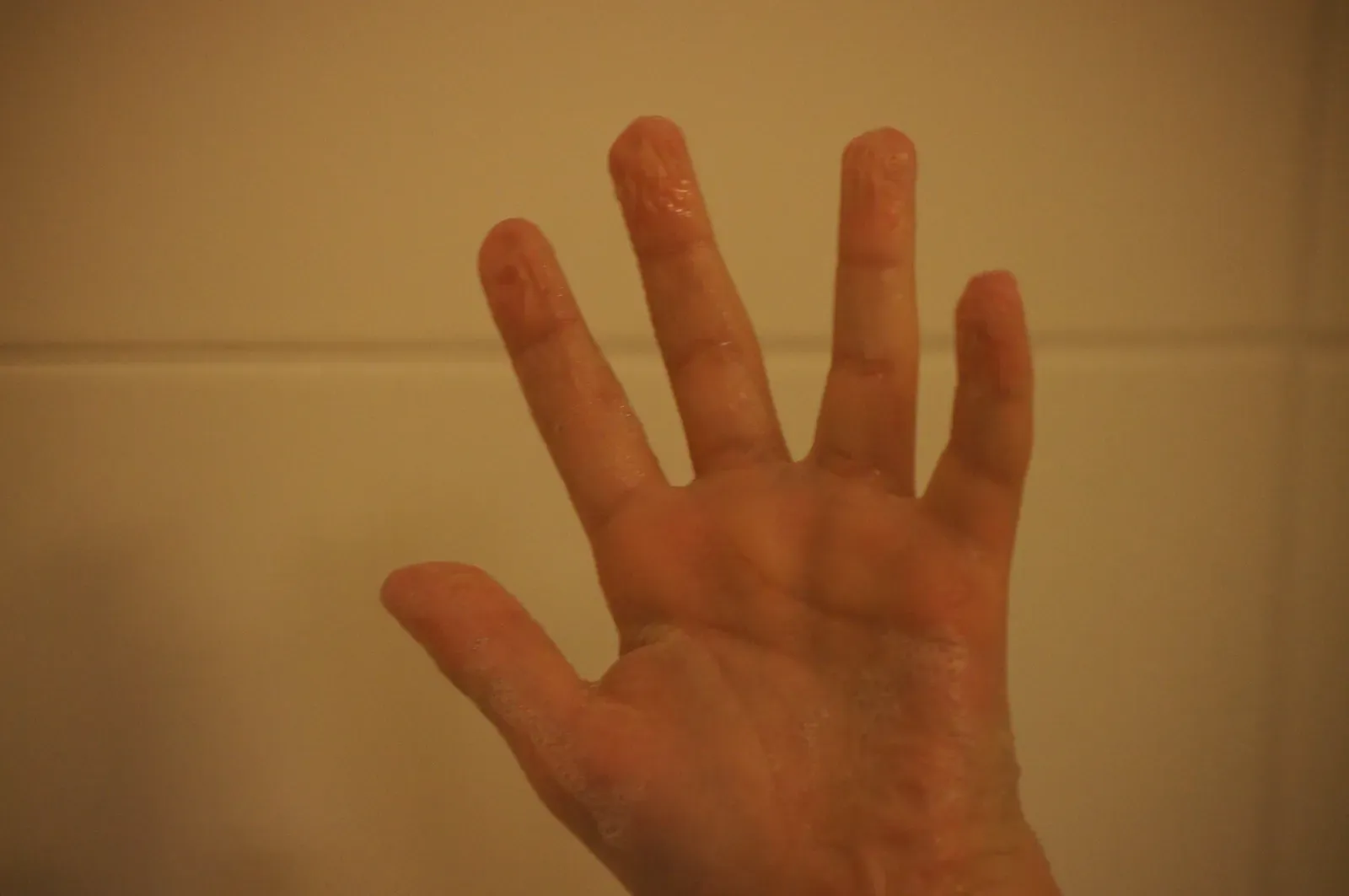
That strange, raisin-like texture your fingers get in the bath or pool looks like your skin is simply waterlogged, but the cause is more interesting than that. For a long time, scientists thought it was just passive swelling as water moved into the outer layer of your skin. But research has shown that finger wrinkling actually depends on your nervous system: if certain nerves in a finger are damaged, that finger may not wrinkle properly in water.
The leading explanation is that wrinkled fingers might help improve grip in wet conditions, like the treads on a tire. The furrows on your fingertips change how water is displaced, giving you better control over slippery objects. You can even test this yourself: try picking up small wet objects before and after your fingers wrinkle – you may notice it feels just a bit easier after you’ve soaked for a while. What looks like a harmless bath-time quirk is probably an ancient adaptation still quietly working for you.
Why You See “Stars” When You Stand Up Too Fast

That moment when you stand up quickly and the world briefly sparkles, darkens, or feels like a tunnel can be a bit alarming. What’s happening is usually a short-lived drop in blood pressure known as orthostatic hypotension. When you go from sitting or lying down to standing, gravity suddenly pulls blood toward your legs and lower body, which can briefly reduce blood flow to your brain and eyes.
Your body normally compensates in a heartbeat – literally – by tightening blood vessels and increasing heart rate to push blood back up. But if that adjustment lags slightly, the cells in your retina and brain don’t get enough oxygen for a few seconds. They respond with those flickers, sparkles, or dimming sensations you perceive as “seeing stars.” For most healthy people, it’s usually harmless, but frequent or intense episodes can be a clue to talk with a doctor and check what’s going on under the hood.
Why Your Voice Sounds So Weird in Recordings

Almost everyone cringes the first time they hear their voice recorded and thinks, “There’s no way I sound like that.” The reason is that you’re used to hearing yourself in a way no one else ever does. When you speak, sound reaches your ears by two paths: through the air (like everyone else hears you) and through vibrations traveling in your skull bones and tissues.
Those internal vibrations emphasize lower frequencies, so your voice sounds richer and deeper to you than it actually is. A recording only captures the sound carried through the air, which means you’re suddenly hearing yourself the way the outside world does – thinner, higher, and often more nasal than you expected. That mismatch between your internal “self-audio” and the recording can be jarring, but it’s just physics and anatomy exposing a little gap between how you think you are and how you actually appear to others.
Why Time Feels Slower When You’re Bored and Faster as You Age

As a kid, a school day felt endless; as an adult, entire months seem to vanish. Psychologists think this has less to do with actual clock time and more to do with how your brain processes novelty and memory. When you’re doing something new or intense, your brain lays down more detailed memories, so that period feels dense and substantial when you look back on it.
By contrast, when days blend into a predictable routine, your brain doesn’t bother storing much detail, and your memory compresses that time into what feels like a blur. There’s also evidence that as you age, your internal sense of timing and your baseline level of arousal shift, changing how you estimate intervals. The result: boring moments drag in the present but vanish in hindsight, and whole years in adulthood can feel oddly thin unless you deliberately inject novelty, challenge, or variation into them.
Why Your Coffee Tastes Different When It Cools

If you’ve ever loved your first hot sip of coffee and then grimaced at a lukewarm swallow ten minutes later, temperature is only part of the story. Your sense of taste is actually a team effort involving temperature-sensitive receptors, smell, and even a bit of pain perception. Many of the flavor molecules in coffee are volatile, meaning they evaporate and travel to your nose much more easily when the drink is hot.
As the coffee cools, fewer aroma compounds reach your nose, and some bitter notes become more noticeable because of how temperature affects your taste receptors. There are also dozens of different chemical compounds in coffee that change subtly as they sit, which can shift the balance from pleasant bitterness to harsher flavors. That’s why people who drink cold brew often adjust the roast, grind, or concentration: they’re compensating for the way cooler temperatures reshape what your tongue and nose actually pick up.
Why Streetlights and Screens Look Like They Have “Halos” at Night

Those glowing halos around streetlights or the starburst effect around car headlights at night can feel almost magical, but they’re rooted in the optics of your eye. Light entering your eye is supposed to be tightly focused by your cornea and lens onto your retina. If the surface of your cornea isn’t perfectly smooth or your lens or tear film scatters light just a bit, that light spreads instead of focusing sharply, creating halos or rays.
Dry eyes, smudged glasses, contact lenses, or mild refractive errors like astigmatism can all make the effect more dramatic. Bright point sources of light in a dark environment are especially likely to show these patterns because your pupils are wide open and there’s a strong contrast between the light and the background. In most cases, it’s normal and just mildly annoying, but sudden changes in halos, especially around both eyes, can sometimes signal an eye issue that needs professional attention.
Why You Yawn When You’re Not Even Tired

Yawning is one of those behaviors that seems too ordinary to be mysterious, yet scientists still don’t agree on a single definitive purpose. One prominent idea is that yawning helps regulate brain temperature: taking in a big gulp of air, stretching facial muscles, and shifting blood flow around your head might help cool an overheated brain slightly. There’s some experimental support showing that people yawn less when their heads are already cooled.
Then there’s contagious yawning, which usually shows up in social animals, including humans. When you see or even think about someone yawning, you’re more likely to yawn yourself, and this effect tends to be stronger with close friends or family. That suggests yawning might have a social or communication function tied to empathy and group coordination. The next time you yawn in a boring meeting, it might not just be fatigue – your brain could be quietly syncing up with the people around you.
Why You Get Goosebumps from Cold or Powerful Music

Goosebumps are a tiny fossil of our evolutionary past playing out on your skin. When you’re cold, tiny muscles at the base of each hair follicle contract, making the hairs stand up. In furry animals, this puffs up their coat to trap air and improve insulation or to make them look larger in a threat situation. Humans lost most of the thick body hair that made this really useful, but the reflex stuck around.
The strange part is that you can get goosebumps not just from cold, but also from emotional experiences like music, awe, or fear. Brain imaging studies suggest that in those moments, reward and emotion circuits fire together with systems that control bodily arousal, triggering the same ancient reflex. It’s like your nervous system is using a very old physical language to express something very modern and psychological. That quiet shiver on your arms during a powerful song is your body’s way of saying, “Pay attention, this matters.”
Conclusion: The Hidden Science Beneath the Ordinary
Once you start noticing, it’s hard to unsee how much science is humming underneath everyday life. Wrinkled fingers, off-putting voice recordings, coffee that turns bitter, halos around streetlights – none of these are random quirks. They’re the visible ripple of deep biological and physical systems doing exactly what they were shaped to do, even if you never gave them a second thought.
You don’t need a lab coat to feel a bit of wonder every time your fingers prune in the bath or a song gives you goosebumps. Curiosity is enough to turn an ordinary Tuesday into a little science expedition, where your own body and environment become the experiment. The world hasn’t gotten less magical just because we understand it better – in a strange way, understanding is the magic. Which of these everyday mysteries will you look at differently the next time it happens to you?