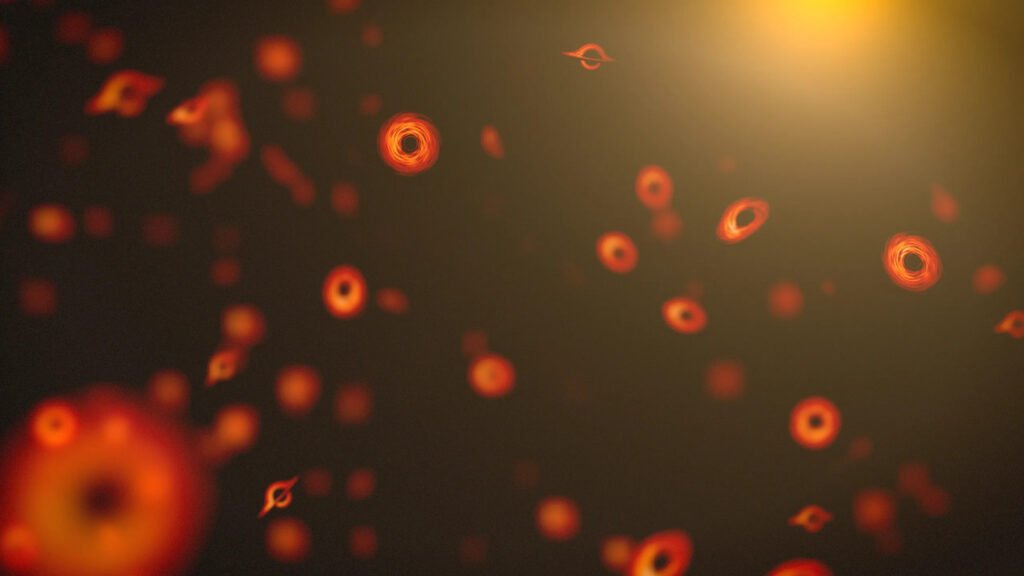
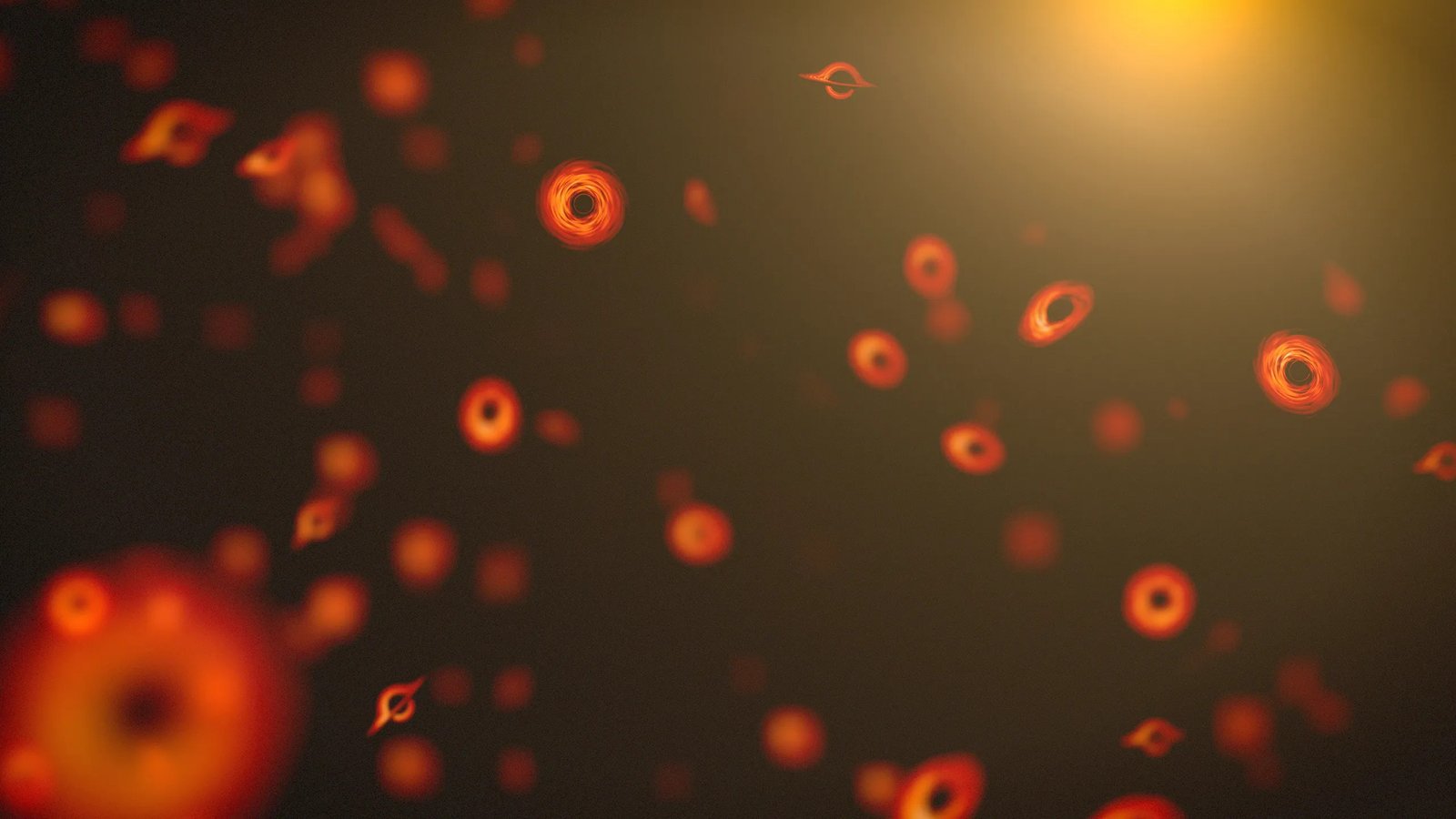
A Puzzling Signal Challenges Black Hole Norms (Image Credits: Upload.wikimedia.org)
Astronomers have long sought clues to the universe’s greatest mysteries, including the nature of dark matter that binds galaxies together. Recent analysis of a gravitational wave signal detected by the Laser Interferometer Gravitational-Wave Observatory suggests these ripples in spacetime could stem from the merger of ancient, tiny black holes born moments after the Big Bang.[1][2] This potential breakthrough challenges conventional explanations and reignites debate over dark matter’s composition.
The signal, captured late last year, defies typical patterns from stellar black hole collisions, pointing instead to primordial origins.[3]
A Puzzling Signal Challenges Black Hole Norms
On November 12, 2025, the LIGO-Virgo-KAGRA (LVK) collaboration issued an automated alert for a merger candidate dubbed S251112cm. This event featured a chirp mass between 0.1 and 0.87 solar masses, with over 99 percent probability that at least one component weighed less than one solar mass – a subsolar black hole unprecedented in stellar remnants.[3][2]
University of Miami astrophysicists Nico Cappelluti and Ph.D. student Alberto Magaraggia scrutinized the data. They concluded the signal lacked any conventional astrophysical origin, such as a supernova-forged black hole. “The study suggests that the most plausible explanation for the LIGO signal… is the detection of a primordial black hole,” Cappelluti stated.[1]
Located roughly 93 million parsecs away, the merger produced waves with a false alarm rate of about one per four years. Researchers modeled the event rate at 0.23 events per year, aligning closely with predictions for rare primordial encounters.[3]
Primordial Black Holes: Relics of Cosmic Chaos
Primordial black holes differ fundamentally from their stellar counterparts. Theorized in the 1970s by Soviet physicists Yakov Zeldovich and Igor Novikov, and later by Stephen Hawking, these objects formed in the universe’s first fraction of a second. Extreme density fluctuations in the post-Big Bang plasma collapsed directly into black holes, bypassing stellar evolution.[1]
Unlike black holes from massive star deaths, which span a few to billions of solar masses, primordial black holes span asteroid sizes to supermassive scales. The subsolar masses in S251112cm fit models from the Quantum Chromodynamics (QCD) epoch, peaking around 10^{-5}, 1.5, 50, and 10^7 solar masses.[3]
Cappelluti and Magaraggia’s work, accepted for publication in The Astrophysical Journal, used a modified PBH mass function incorporating lepton-flavor asymmetries. Binary formation occurred via gravitational capture in dark matter halos, yielding a detectable rate of 0.8 per year – consistent with observations.[3]
Dark Matter’s Elusive Identity
Dark matter constitutes about 85 percent of the universe’s mass, providing the gravitational scaffolding for galaxies. Primordial black holes emerge as ideal candidates, interacting solely via gravity and evading direct detection.[1]
- PBHs could comprise a significant fraction – or all – of dark matter, as their abundance matches cosmic structure formation.
- The S251112cm analysis sets a lower limit of f_PBH > 0.04 in the relevant mass range, potentially reaching 0.339.
- Local halo densities around 0.4 GeV/cm³ and velocities near 250 km/s facilitate mergers detectable by current instruments.[3]
- Unlike particles, PBHs explain gravitational lensing and dynamics without new physics.
“Our research indicates that these primordial black holes could account for a significant portion, if not all, of dark matter,” Cappelluti noted. Magaraggia added that estimates of PBH numbers encourage further LIGO scrutiny.[1]
Verification Ahead: Detectors Evolve
Confirmation demands more events, as a single signal carries uncertainty. Cappelluti emphasized, “We’ll need to detect another such signal or even several others to get the smoking-gun confirmation.”[2]
LIGO, which first confirmed gravitational waves in 2015, continues upgrades for heightened sensitivity. The European Space Agency’s LISA, set for 2035, targets lower frequencies from cosmic dawn. Cosmic Explorer promises tenfold improvement, probing first-star mergers.[1]
Future LVK runs like O5 will test PBH hypotheses rigorously. If validated, this discovery reshapes cosmology, bridging the Big Bang’s fury to today’s invisible mass.
Key Takeaways
- S251112cm signal suggests subsolar PBH merger, rate matches QCD-epoch models.
- PBHs may form all dark matter, with f_PBH > 0.04 confirmed by one event.
- More detections via upgraded LIGO, LISA essential for proof.
This tantalizing hint from spacetime’s whispers could unlock dark matter’s secrets, transforming our understanding of the cosmos. What implications do primordial black holes hold for future astronomy? Tell us in the comments.