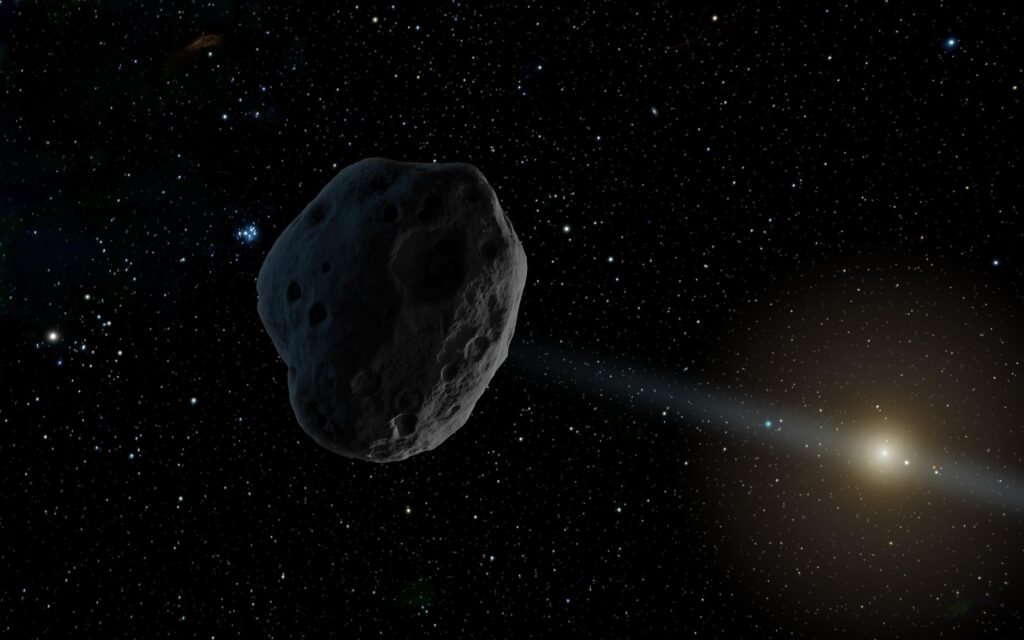

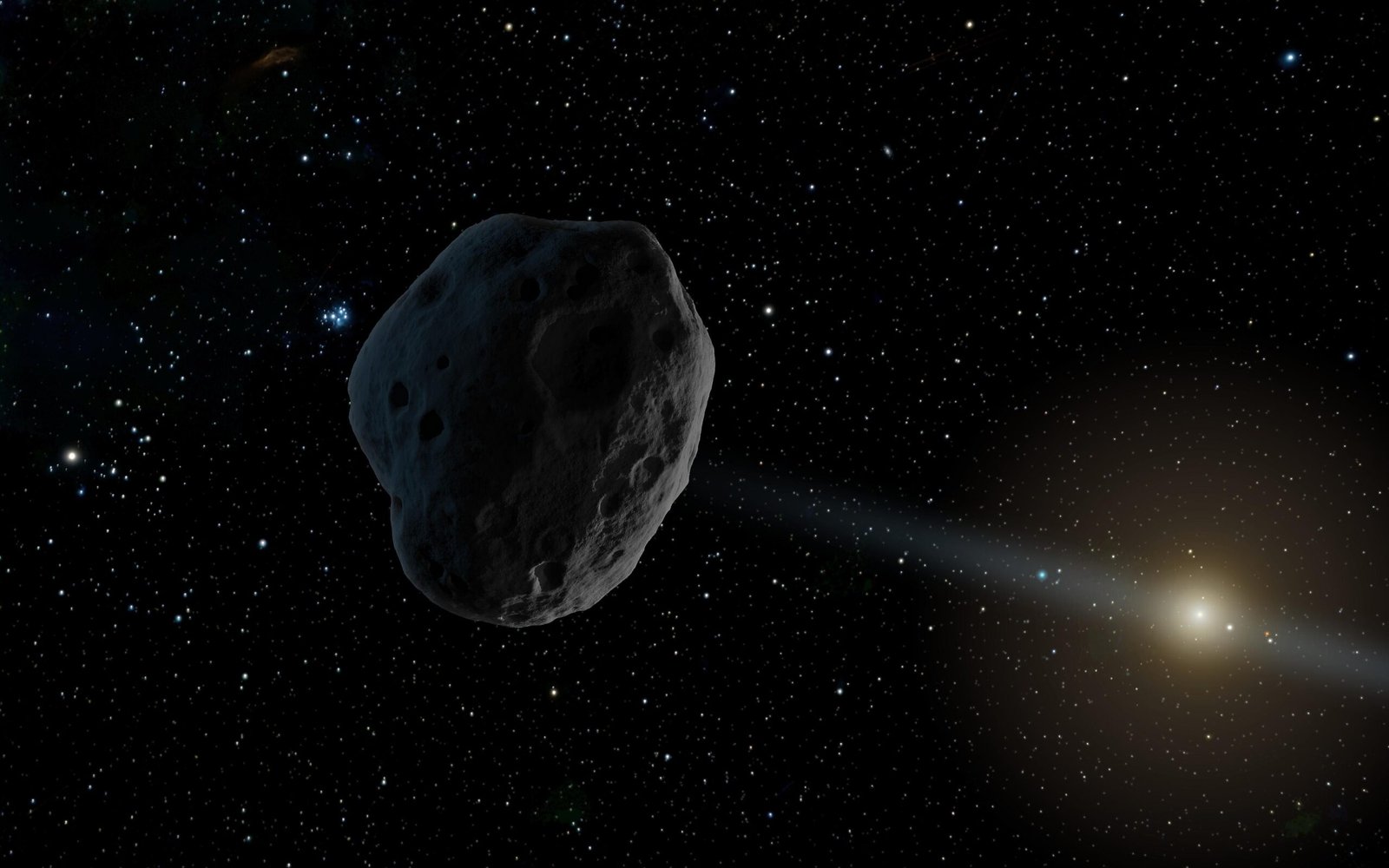
A Swift Visitor from the Void (Image Credits: Upload.wikimedia.org)
Asteroid 2026 GD, roughly the size of a house, will streak past Earth late tonight in a routine cosmic close encounter. Space agencies have tracked the space rock since its recent discovery, confirming its path poses no danger to our planet or the moon. This event highlights ongoing efforts to monitor near-Earth objects amid the vastness of space.[1][2]
A Swift Visitor from the Void
Discovered just days ago, 2026 GD measures between 12 and 28 meters across, comparable to a typical two-story home. It moves at a brisk 12.7 kilometers per second relative to Earth. Observers captured images of the asteroid when it was still about 1.2 million kilometers away, underscoring how quickly these objects can close the gap.[3]
The space rock joins a parade of similar flybys this week. Earlier today, asteroid 2022 GE2, also house-sized at 11 to 25 meters, passed at 17:35 UTC, staying farther out at over 4.6 million kilometers. Such encounters serve as opportunities for scientists to refine orbital data and improve predictions.[1]
Timing and Trajectory of the Flyby
2026 GD reaches its closest point to Earth at 22:58 UTC on April 9, equivalent to around 6:58 p.m. EDT. At that moment, it will sit just 250,696 kilometers away, or 0.652 lunar distances – closer than the moon’s average orbit but still safely distant. This equates to about 156,000 miles, far beyond any satellites or atmospheric reach.[1][2]
Post-flyby, the asteroid may swing even nearer to the moon in a subsequent pass, though details remain preliminary. Tracking stations worldwide contribute data to NASA’s Jet Propulsion Laboratory and the European Space Agency’s Near-Earth Object Coordination Centre. These efforts ensure precise calculations amid the object’s high speed.[4]
Assessing the Risk Level
Despite its proximity, 2026 GD presents no collision threat during this approach. Neither NASA nor ESA classifies it as hazardous for Earth or the moon. The Risk List, which catalogs objects with even tiny future impact chances, does not currently feature this asteroid, reflecting refined observations that rule out immediate danger.[5][6]
House-sized rocks like this one rarely pose global risks; an impact would likely produce a bright fireball and local effects, similar to past airbursts. Continuous radar and optical observations have mapped its trajectory with high confidence. Space agencies emphasize that thousands of near-Earth objects undergo such scrutiny annually.
Why Monitor These Cosmic Neighbors?
Near-Earth object tracking forms a cornerstone of planetary defense. Agencies maintain lists of close approaches and potential risks to catalog threats years in advance. For instance, ESA’s Risk List includes over a dozen objects with non-zero impact probabilities, ranging from small rocks to larger bodies, though none threaten soon.[5]
Recent flybys, including this one, test detection systems and orbital models. Discoveries often occur days or weeks before closest approach, as with 2026 GD imaged on April 8. Improved telescopes and surveys aim to spot smaller objects earlier, reducing surprises.
- ESA’s NEOCC provides real-time close approach data for public access.
- NASA’s CNEOS predicts paths and velocities for thousands of NEOs.
- International collaboration shares observations to boost accuracy.
- Future missions like ESA’s Hera will study deflection techniques.
- Public tools like JPL’s Asteroid Watch track the next five approaches.
Key Takeaways
- 2026 GD: 12-28m diameter, closest at 250,000 km on April 9, 22:58 UTC – no impact risk.[1]
- Safe distance exceeds low-Earth orbit by vast margins.
- Tracking by NASA and ESA ensures vigilance against real threats.
Events like the 2026 GD flyby remind us of our dynamic solar system neighborhood. While tonight’s pass holds no peril, it reinforces the value of vigilance. What do you think about these regular cosmic close calls? Tell us in the comments.