
Picture this. You reach out and touch a solid wall. It feels real. It’s undeniably there. Now imagine a physicist walks up beside you and calmly says, “You know, that wall might be a projection from a flat surface on the edge of the universe.” You’d probably laugh. Most people would. Yet here we are in 2026, and that idea is one of the most serious and fascinating hypotheses in modern theoretical physics.
One of the weirdest theories in cosmology is the holographic principle – the idea that our universe is a three-dimensional image projected off a two-dimensional surface. It is not fringe science, either. The theory, which has been around since the 1990s and is now a mainstream scientific hypothesis, holds that the universe and everything in it is a three-dimensional projection from a two-dimensional plane – a plane encoded with what physicists call “information,” the bits and bytes of computer code that give rise to the universe in its three-dimensional form. If that sentence just broke your brain a little, good. Let’s dive in.
What the Holographic Principle Actually Says

Here’s the thing: the holographic principle is not saying the universe is fake or that we’re characters in some cosmic video game. It is, however, saying something almost equally strange. The holographic principle states that the description of a volume of space can be thought of as encoded on a lower-dimensional boundary to the region – such as a light-like boundary like a gravitational horizon. Think of it like a vinyl record. The music feels rich, layered, three-dimensional even. Yet all that information lives in a flat groove.
The holographic principle asserts that a mathematical description of the universe actually requires one fewer dimension than it seems – what you perceive as three-dimensional may just be the image of two-dimensional processes on a huge cosmic horizon. Honestly, I find this part the most staggering. Everything you have ever seen, touched, or experienced may be a kind of elaborate projection, like a cosmic IMAX movie playing from a screen you can never quite reach.
Where the Idea Was Born: Black Holes and a Stubborn Paradox
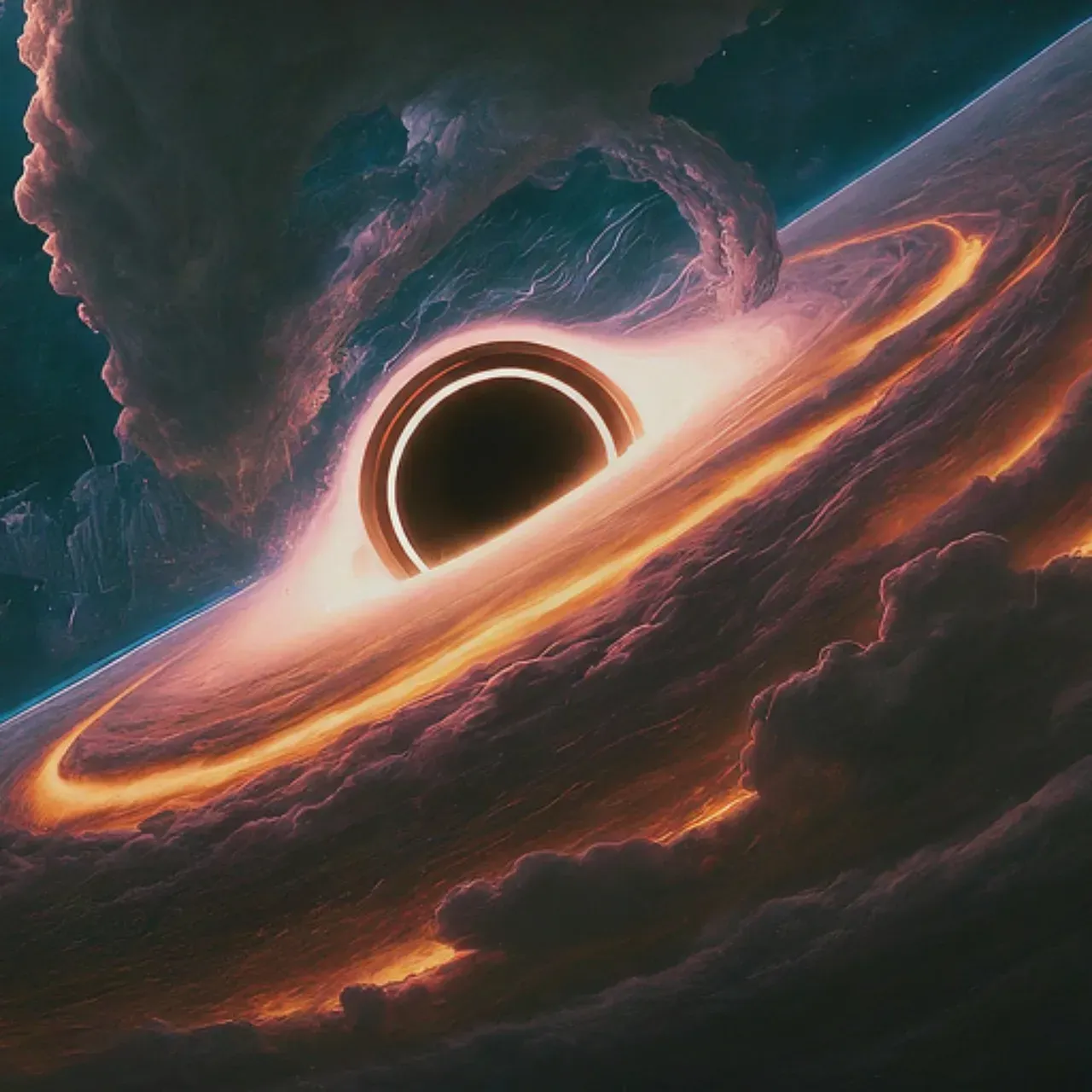
This strange idea was born from a very serious scientific dilemma: the black hole information paradox. According to Einstein’s general theory of relativity, anything that falls into a black hole is lost forever – but quantum mechanics tells a different story, insisting that information cannot be destroyed, ever. These two foundational pillars of physics were essentially in direct contradiction with each other, and physicists needed a way out.
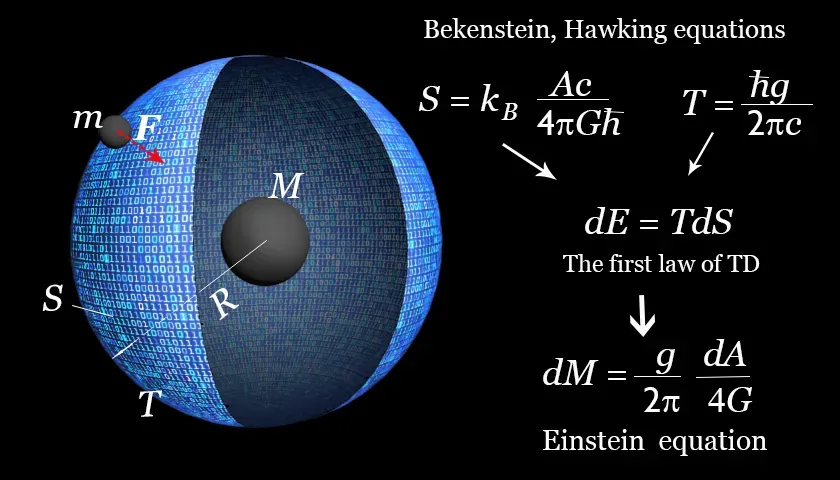
In the 1990s, physicists Gerard ‘t Hooft and Leonard Susskind proposed a radical solution: they suggested that all the information about the matter swallowed by a black hole might not disappear at all – instead, it could be stored on the black hole’s surface, the so-called event horizon. The holographic principle was inspired by the Bekenstein bound of black hole thermodynamics, which conjectures that the maximum entropy in any region scales with the radius squared, rather than cubed as might be expected. That insight – that a surface, not a volume, holds the maximum information – is the conceptual seed of everything that followed.
The Maldacena Conjecture: The Math That Changed Everything
In 1997, physicist Juan Maldacena formulated what is now known as AdS/CFT duality. It states that a universe with gravity inside – an anti-de Sitter space – is mathematically equivalent to a universe without gravity on its boundary, a conformal field theory. In simple terms: a three-dimensional world with gravity equals a two-dimensional world without it. It sounds like a magic trick, but the mathematics is airtight and has survived decades of scrutiny.
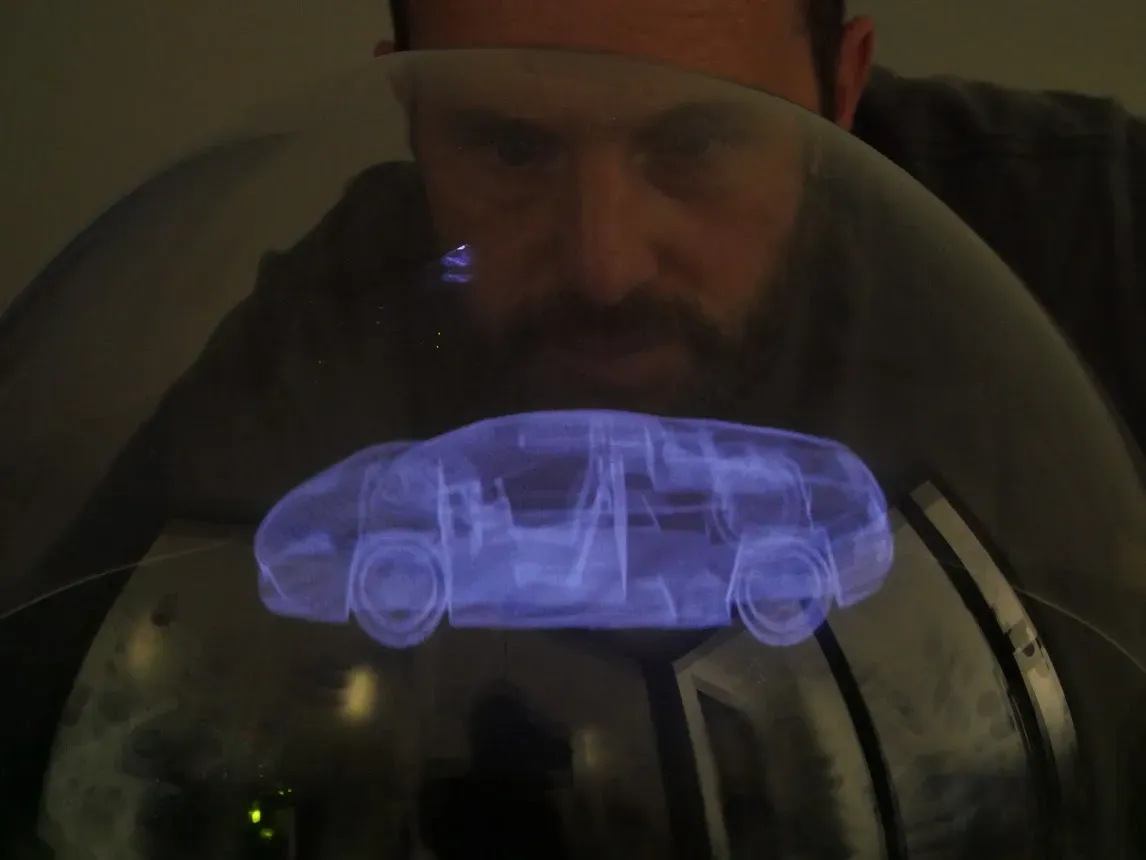
Much like a 3D hologram emerges from the information encoded on a 2D surface, our universe’s 4D spacetime could be a holographic projection of a lower-dimensional reality. Specifically, Maldacena showed that a five-dimensional theory of a type of imaginary spacetime called anti-de Sitter space that included gravity could describe the same system as a lower-dimensional quantum field theory of particles and fields in the absence of gravity. This duality represents a major advance in understanding of string theory and quantum gravity, providing a non-perturbative formulation of string theory with certain boundary conditions and becoming the most successful realization of the holographic principle.
What Does the Evidence Actually Look Like?
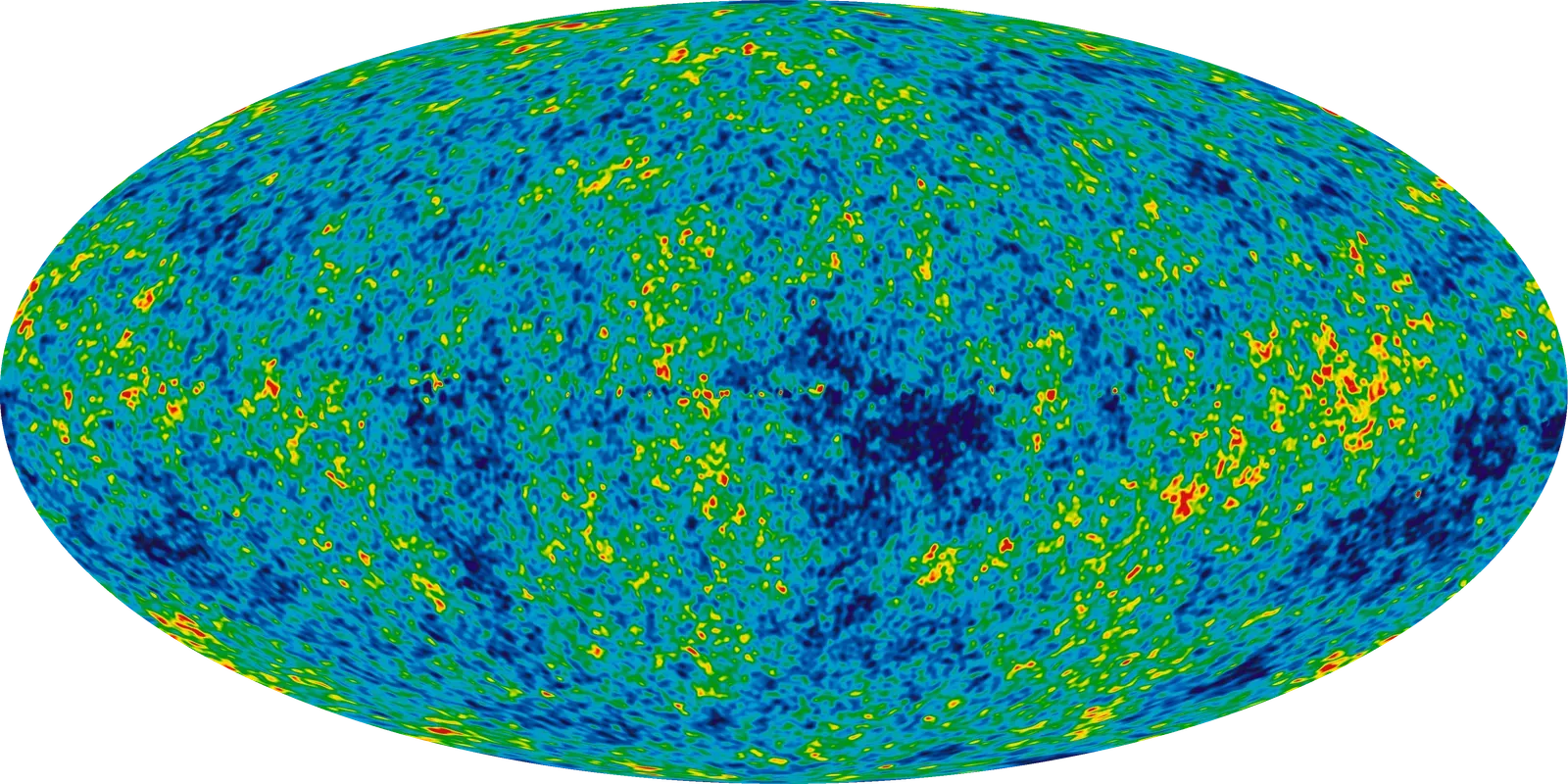
A UK, Canadian and Italian study provided what researchers believe is the first observational evidence that our universe could be a vast and complex hologram. Theoretical physicists and astrophysicists, investigating irregularities in the cosmic microwave background – the afterglow of the Big Bang – found there is substantial evidence supporting a holographic explanation of the universe, in fact as much as there is for the traditional explanation using the theory of cosmic inflation. That is a remarkable statement. Two competing explanations of the early universe, with roughly equal observational support.
Some intriguing hints have emerged, such as patterns observed in the cosmic microwave background, the faint afterglow of the Big Bang that permeates the universe. Studies of the CMB have revealed slight fluctuations that seem consistent with a universe where information might be encoded on a 2D surface. It is hard to say for sure whether these patterns will ever constitute definitive proof, but the fact that they exist at all is genuinely exciting. The study of gravitational waves, ripples in spacetime caused by massive cosmic events like black hole mergers, offers another potential window – by analyzing the properties of these waves, particularly those originating from extreme gravitational environments, scientists hope to find evidence that fits predictions derived from holographic models.
Skeptics, Challenges, and the Limits of Testing
Let’s be real: not everyone is on board. The holographic universe theory faces skepticism from many in the scientific community. While mathematically compelling, the holographic principle often feels speculative and abstract, lacking the direct experimental evidence that typically underpins established scientific theories. Critics argue that without concrete proof, it remains more of a theoretical curiosity than a validated description of our universe. That is a fair critique, and science is built on exactly that kind of demanding standard.
Another major challenge is the difficulty in testing the holographic principle. The theory is rooted in complex mathematics and high-dimensional physics, making it incredibly hard to design experiments that can verify or falsify it. Unlike more accessible theories in physics, such as general relativity or quantum mechanics, the holographic principle does not yet offer clear, testable predictions that can be observed in our 3D world. That said, the field is moving fast. The subfield of celestial holography now seeks to reformulate quantum field theories and quantum gravity in asymptotically flat spacetimes, and researchers aim to approach it as testable within real-world physics using gravitational wave detection with LIGO or LISA.
What It Would Mean If It’s True
If our universe is indeed a hologram, it profoundly alters how you think about reality. It suggests that everything you perceive – from the smallest particles to the vastness of space – might be just a projection. This challenges the notion that the 3D world you experience is the ultimate form of reality. One of the most intriguing implications is that information, not matter or energy, could be the most fundamental building block of the universe. That is not a small thing. It would mean the universe is more like a vast computation than a mechanical clock.
If intricate, timeless quantum entanglement turns out to be fundamental, as holography maintains, then the properties of our universe that we had previously taken to be fundamental – such as four-dimensional spacetime, gravitation, and the particles and forces in the standard model – turn out to be features of an emergent description. Think about that for a moment. Gravity, time, space itself – not fundamental, but emergent. Like how temperature is not a property of any single atom, but emerges from their collective behavior. Physics itself may fade away when we journey back into the Big Bang – and the Big Bang emerges from holography not so much as the beginning of time but more as the beginning of laws.
Conclusion: Reality at the Edge of Understanding
We are living in one of the most extraordinary moments in the history of science. The holographic principle challenges not just our understanding of space and time, but of reality itself. It is crucial to be clear: the holographic principle is still a hypothesis, not a proven law. It has not overthrown relativity or quantum mechanics – in fact, it tries to unite them. Its beauty lies in its consistency with some of our best theories and its ability to offer new perspectives on long-standing puzzles.
Whether you find this idea thrilling or deeply unsettling probably says something about you. Personally, I think the most exciting science has always been the kind that makes you question the ground under your feet. If the universe is a hologram, it does not make it any less wondrous – perhaps even more so. In ancient times, people saw gods in the stars. Today, we see something perhaps just as mysterious: a reality born not of atoms, but of information. The universe you think you inhabit may be the most elaborate projection ever conceived – and working that out is one of humanity’s greatest adventures. What do you think? Could you be living inside a cosmic hologram? Tell us in the comments.