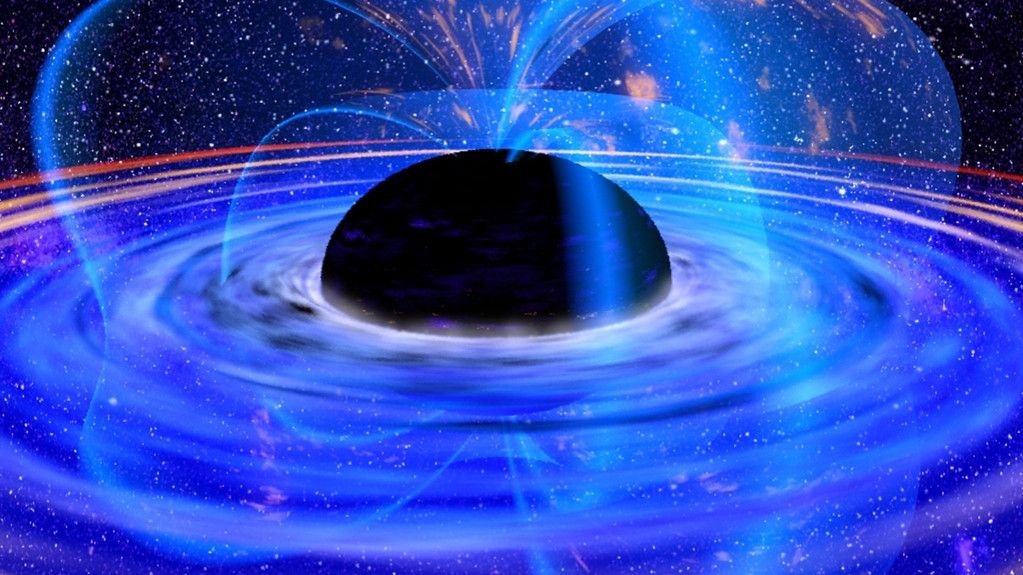
Black holes have haunted human imagination for decades. They sit at the edge of our understanding, swallowing everything, including light itself, and offering no return ticket for anything that crosses their threshold. Or so we’ve always assumed.
Here’s the thing though – a growing body of theoretical physics is quietly challenging that old narrative. The idea that entering a black hole might not be an instant death sentence is gaining serious traction among researchers, and the science behind it is genuinely mind-bending. Buckle up, because what follows might permanently change the way you think about the most terrifying objects in the universe. Let’s dive in.
Not All Black Holes Are Created Equal
Let’s be real – when most people picture a black hole, they imagine something the size of a city with the mass of several suns, ready to shred anything that comes near. That’s actually a stellar-mass black hole, and yes, approaching one would be catastrophic. The tidal forces, which are the difference in gravitational pull between your head and your feet, would stretch you out like cosmic spaghetti before you even got close.
Supermassive black holes, however, are an entirely different story. These giants, often billions of times the mass of our Sun, have event horizons so large that tidal forces at the boundary are actually quite gentle. The one sitting at the center of our galaxy, Sagittarius A*, clocks in at roughly four million solar masses. At that scale, the gravitational gradient across a human body at the event horizon would be barely noticeable, at least initially.
The Event Horizon and What Crossing It Actually Means
The event horizon is the point of no return. Cross it, and the laws of physics as we know them say you can never come back. No signal, no light, no information escapes. From the outside, observers would never actually see you cross it – thanks to extreme time dilation, you’d appear to freeze and slowly fade from view.
From your own perspective, though, crossing a supermassive black hole’s event horizon might feel completely ordinary. No dramatic alarm bells. No sudden crushing sensation. You might not even know it happened. That’s what makes the whole concept so philosophically unsettling – the most significant boundary in the known universe might be invisible and unfelt in the moment you cross it.
Time Dilation: Where Things Get Truly Strange
Once inside or near the event horizon, time itself starts behaving in ways that defy everyday intuition. Gravity warps spacetime, and extreme gravity warps it extremely. For someone falling into a black hole, time would tick at what feels like a normal rate. For everyone watching from a safe distance, that person’s time would appear to slow to an almost complete stop.
Honestly, this is where I think physics becomes more surreal than any science fiction. The closer you get to the singularity at the center, the more dramatic this effect becomes. A few moments of subjective time for the traveler could correspond to millions or even billions of years passing in the outside universe. You wouldn’t age faster, you’d just be cut off from the universe’s future entirely.
Spaghettification: The Real Danger Zone
Let’s talk about spaghettification, because that term alone deserves more attention than it typically gets. This is the actual physical process by which tidal forces stretch an object vertically while compressing it horizontally as it approaches a singularity. For stellar-mass black holes, this happens well outside the event horizon, meaning you’d be torn apart before even reaching the point of no return.
For supermassive black holes, spaghettification occurs much deeper inside, well past the event horizon. In theory, a traveler falling into something like the black hole at the center of the galaxy’s most massive neighbor galaxies would have significant time to exist and experience their surroundings before tidal forces became fatal. It’s a small mercy in an otherwise extreme situation, but it’s a real one.
The Singularity Problem Nobody Has Solved
Here’s where science hits a wall, a very real and very frustrating wall. At the center of a black hole lies what physics calls a singularity, a point of infinite density where our current mathematical models completely break down. General relativity, which describes gravity brilliantly everywhere else, essentially throws up its hands and produces nonsensical infinities when it tries to describe what happens there.
Quantum mechanics offers some hints, but no complete answer yet. Many physicists believe the singularity isn’t a physical reality but rather a symptom of our incomplete theories. Some models propose a quantum “bounce” at extreme densities, others suggest the interior might connect to another region of spacetime entirely. It’s hard to say for sure, but the singularity as a final destination might not be what we think it is.
The Firewall Paradox: A New Threat to the Theory
In 2012, a group of theoretical physicists proposed something that shook the foundations of black hole science. Their idea, known as the firewall paradox, suggests that the event horizon might not be as peaceful as general relativity predicts. Instead, quantum effects could create a wall of intense radiation right at the boundary, which would incinerate anything trying to cross.
This was controversial precisely because it pitted two pillars of modern physics against each other: general relativity and quantum mechanics. If the firewall exists, a gentle crossing becomes impossible even in supermassive black holes. Most physicists today believe there’s likely a resolution to this paradox that preserves the smooth crossing scenario, but no one has definitively proven it yet. The debate is still very much alive.
What This Means for the Future of Space Exploration
Practically speaking, no human is going anywhere near a black hole anytime soon. The nearest known stellar-mass black holes are thousands of light-years away, and the technology required to even approach one safely is far beyond anything we currently possess. Still, this discussion matters enormously for how we develop theories of quantum gravity and understand the deepest structures of the universe.
The real prize here isn’t a manned mission to a black hole. It’s using these extreme thought experiments to stress-test our physics and find where it breaks. Every time theorists seriously grapple with what happens inside a black hole, they’re pushing toward a unified theory of physics that could reshape everything from cosmology to particle physics. The black hole isn’t just a destination – it’s a mirror reflecting the limits of human knowledge back at us.
Conclusion: The Most Extreme Thought Experiment in Science
Black holes force us to confront the edges of what we know and what we can even conceive. The possibility that entering one might be survivable, at least for a time, isn’t just a fun thought experiment. It’s a serious scientific question with real implications for how we understand spacetime, quantum mechanics, and the ultimate fate of information in the universe.
I think what makes this topic so captivating is the combination of genuine mathematical rigor and almost philosophical vertigo. We’re talking about places where time stops, space collapses, and every equation we trust begins to fail. The universe doesn’t owe us clean answers, and black holes are the starkest proof of that. What would you do if you found out crossing a black hole’s threshold might feel like nothing at all? Tell us in the comments.